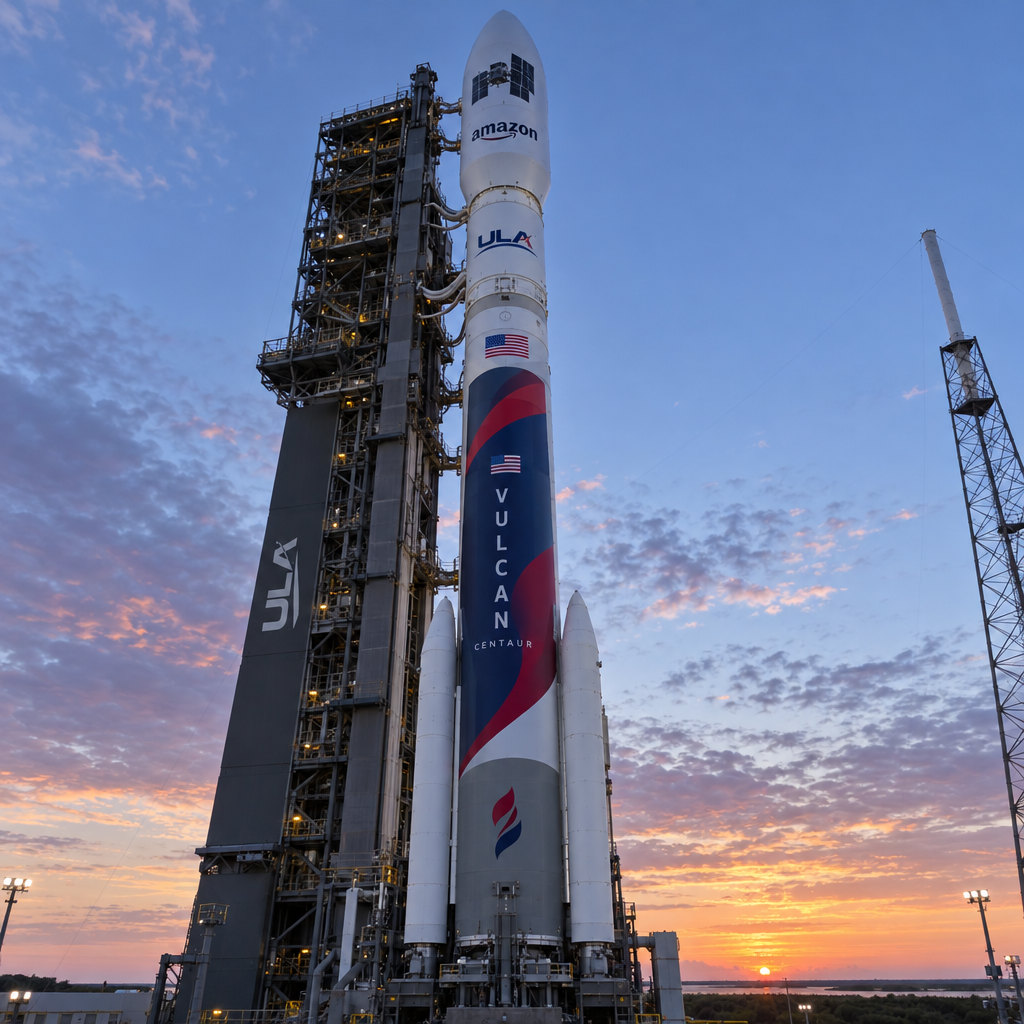
Vulcan Centaur Set for November 13 Return to Flight, Carrying Amazon Satellites and a Military Verdict
United Launch Alliance will return its Vulcan Centaur rocket to flight on November 13, launching 40 Amazon Leo broadband satellites after a nine-month grounding. The flight, designated Leo 1, carries not only the opening payload of a years-long constellation campaign but also the informal scrutiny of the U.S. national security space program, whose clearance decision the Space Force says is directly linked to the mission's outcome. The grounding traces to the same component failing the same way
OST Staff · October 29, 2026
United Launch Alliance will return its Vulcan Centaur rocket to flight on November 13, launching 40 Amazon Leo broadband satellites after a nine-month grounding. The flight, designated Leo 1, carries not only the opening payload of a years-long constellation campaign but also the informal scrutiny of the U.S. national security space program, whose clearance decision the Space Force says is directly linked to the mission's outcome.
The grounding traces to the same component failing the same way on two separate flights. Vulcan debuted on January 8, 2024. Its second flight, Cert-2 in October 2024, suffered the disintegration of a nozzle on one of its Northrop Grumman-built GEM 63XL solid rocket boosters. ULA investigated, identified contributing factors, and modified the nozzle design. The rocket flew again in February 2026 on USSF-87, the first national security mission, carrying two satellites for the Space Force's Geosynchronous Space Situational Awareness Program and a demonstration payload. About 20 seconds after liftoff, one of the four GEM 63XL boosters experienced nozzle burn-through. The mission succeeded because the core-stage engines compensated, but the remediation had not solved the underlying problem.
Brig. Gen. Eric Zarybnisky, the Space Force's portfolio acquisition executive for space access, told reporters on October 21 that the military clearance decision depends heavily on flight data from Vulcan's commercial missions. "It'll depend a lot on what we see, not only on the engineering and tests that we're doing on the ground, but also what we see from the flight data from the commercial missions they fly," he said. ULA's return-to-flight statement, released October 28, said the investigation team identified several potential contributors and mitigated them through design and process improvements to the nozzle, with additional testing and analysis continuing in parallel with the mission. "By flying the improved design, ULA gains valuable flight data that validates these improvements," the company said.
Leo 1 introduces several firsts. It is the first flight in the VC6L configuration, with all six GEM 63XL boosters attached and a long payload fairing, delivering a stated low Earth orbit capacity of approximately 27,200 kilograms. Previous flights used two or four boosters. The redesigned nozzle will be tested across all six units simultaneously. The mission also debuts the Centaur V LEO-Optimized upper stage, roughly 1.8 meters shorter than the High-Energy variant and carrying about one-third less propellant, optimized for Amazon Leo's constellation altitude of approximately 630 kilometers. It retains twin RL-10 engines and multiple restart capability. Vulcan's two Blue Origin BE-4 core engines also carry a valve modification, applied after a liquid oxygen valve failure in a BE-4 was identified as the primary cause of a New Glenn pad explosion at Cape Canaveral on May 28, 2026.
By the Space Force's own characterization, the Amazon launch and the military's clearance decision are directly linked, with neither the commercial deployment nor the national security blessing guaranteed, and both riding on the same flight. Vulcan is returning with two separately identified hardware fixes applied at once, the GEM 63XL nozzle redesign and the BE-4 valve modification, meaning any anomaly would require engineers to determine which system was involved.
Leo 1 opens a 38-launch Amazon deployment campaign with ULA. Assembly began in May when the first stage was hoisted into ULA's Vertical Integration Facility-A, built specifically for the Amazon campaign. The fairing containing 40 Amazon Leo satellites was delivered on October 21. The launch is targeted for November 13.