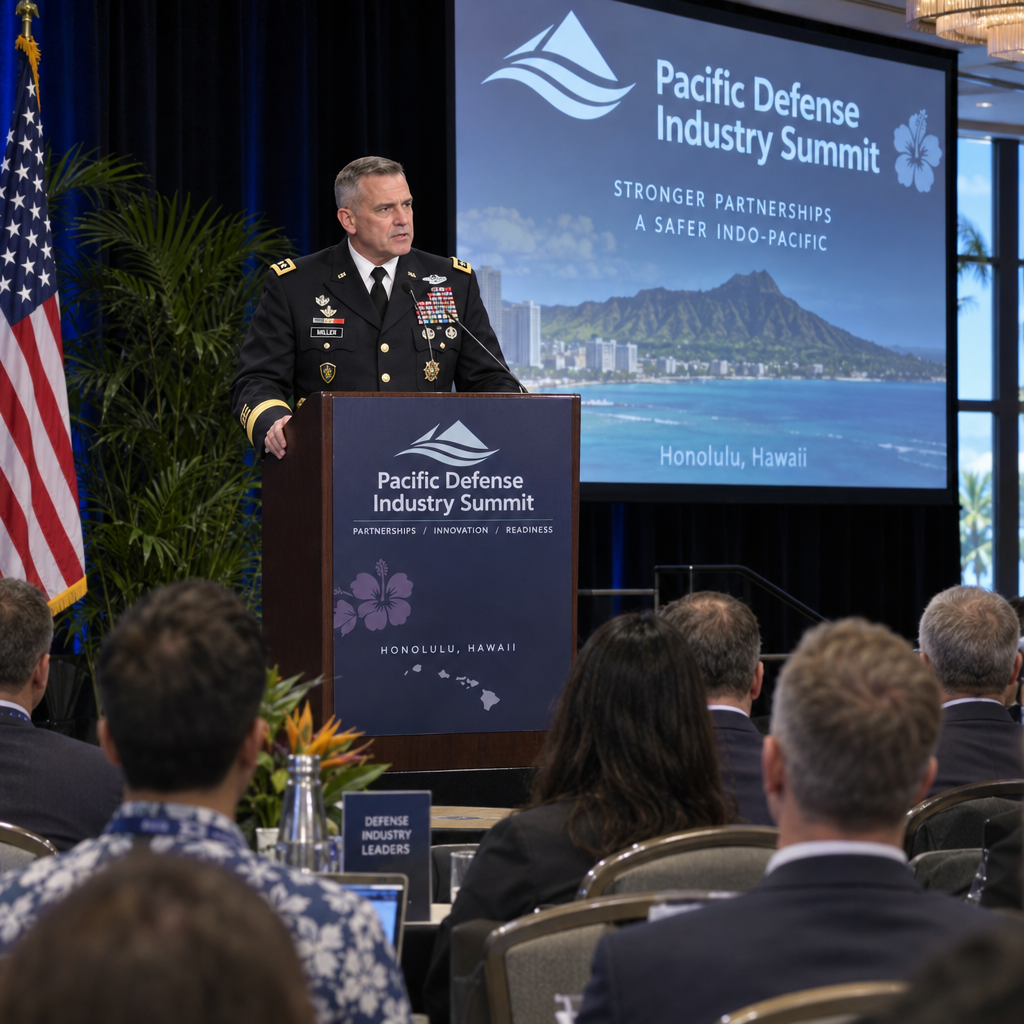
US Commander Warns Industry: Systems That Need Pristine Comms Won't Survive 48 Hours in Korea
US and allied electronic systems are jammed daily on the Korean Peninsula, making it one of the most violently contested electromagnetic environments on the planet, the commander of US Forces Korea told an industry audience. Gen. Xavier Brunson urged companies to deliver resilient, jam-resistant capabilities built for coalition operations from the outset. Brunson made the remarks Tuesday at AFCEA TechNet Indo-Pacific in Hawaii before an audience largely made up of industry members. He described
OST Staff · October 28, 2026
US and allied electronic systems are jammed daily on the Korean Peninsula, making it one of the most violently contested electromagnetic environments on the planet, the commander of US Forces Korea told an industry audience. Gen. Xavier Brunson urged companies to deliver resilient, jam-resistant capabilities built for coalition operations from the outset.
Brunson made the remarks Tuesday at AFCEA TechNet Indo-Pacific in Hawaii before an audience largely made up of industry members. He described a daily reality in which adversaries practice electronic attack, jam GPS in the West Sea, and attempt to blind servers, sensors, and networks. While he did not name an adversary nation during the electronic attack remarks, he referenced earlier in his speech a nuclear-armed adversary across the demilitarized zone that constitutionally designates the Republic of Korea as its principal enemy.
To operate in that environment, Brunson said forces must have resilient and redundant capabilities. If your capability requires pristine satellite communications, infinite bandwidth, and an uninterrupted fiber optic backbone to function, it will not survive 48 hours on the peninsula, he said. He noted that USFK is fielding resilient high-frequency networks alongside proliferated low-Earth orbit satellite communications and terrestrial mesh networks to maintain command and control when primary links are disrupted.
Brunson called on the industrial base to visit the peninsula and see the environment firsthand, but said companies making the trip need to bring lightweight, jam-resistant waveforms with low probability of intercept and low probability of detection. He also asked industry to produce open application programming interfaces and edge sensors that integrate with joint mission networks without vendor lock-in. We can no longer design exquisite systems for pure US enclaves and then try to bolt on partner interface after the contract is signed, he said. We must design combined from the first line of code.
For over 30 years, Brunson said, the security mindset centered on hardened pipes and perimeter defenses in closed networks with stringent classification, requiring a new pipe each time information needed to be shared with partners. In a combined fight inside the weapons engagement zone, that model has failed, he said. Hardened pipes isolate our formations. They create operational blindness. He urged a shift from network-centric perimeters to data-centric security, summarized as tag the payload and not the pipe. In practice, he said, a Korean radar detecting an inbound missile would have its track verified, ingested, and pushed to a coalition fires network in milliseconds.
Brunson told industry to study Pentagon direction and strategic documents to find what the military needs, likening the goal to pickles. He said Vlasic became pickle millionaires by recognizing consumers needed sliced pickles for their burgers rather than whole ones. What is your sliced pickle? he asked, urging companies to adapt offerings to military requirements rather than forcing products that do not fit. He pointed to the Army's recently released How the Army Fights as an example of aligning products with the service's needs.
Brunson warned that networks will be under attack as forces operate in increasingly disaggregated and distributed ways, with plans potentially changing before forces arrive in theater. If your product can't operate on the edge, then it's not a product that's going to be able to help the Army fight the way the Army is going to fight, much less the joint force, he said.