UAE Reveals Asteroid Belt Lander Ahead of 2028 Launch to Mysterious Red Asteroid
The United Arab Emirates has unveiled the lander for its second interplanetary mission, an eight-year journey through the asteroid belt that will end with a touchdown on the unusually red asteroid 269 Justitia. The mission team presented a half-scale model of the homegrown probe at an October 1 press conference in Abu Dhabi, marking a major step toward a planned March 2028 launch. The Emirates Mission to the Asteroid Belt follows the UAE Space Agency's Hope Mars orbiter, which has studied the R
OST Staff · October 12, 2026
The United Arab Emirates has unveiled the lander for its second interplanetary mission, an eight-year journey through the asteroid belt that will end with a touchdown on the unusually red asteroid 269 Justitia. The mission team presented a half-scale model of the homegrown probe at an October 1 press conference in Abu Dhabi, marking a major step toward a planned March 2028 launch.
The Emirates Mission to the Asteroid Belt follows the UAE Space Agency's Hope Mars orbiter, which has studied the Red Planet since 2021. The autonomous lander will ride attached to the main spacecraft, MBR Explorer, named after Sheikh Mohammed bin Rashid al-Maktoum, ruler of Dubai and the UAE's prime minister. The lander was designed, built and tested by the Technology Innovation Institute in Abu Dhabi.
The mission will conduct high-speed flybys of six asteroids before reaching and orbiting 269 Justitia, traveling about 3 billion miles in total, equivalent to circling Earth roughly 125,000 times, said Najwa Aaraj, CEO of TII. MBR Explorer will use gravity assists from Venus, Earth and Mars to pass its targets: 10253 Westerwald, 623 Chimaera, 13294 Rockox, 88055 Ghaf, 23871 Ousha and 59980 Moza. By 2036 the spacecraft is scheduled to rendezvous with 269 Justitia, a roughly 30-mile-wide object whose crimson hue more closely resembles icy Kuiper Belt objects than its main-belt neighbors. Scientists hypothesize it formed in the outer solar system and migrated inward.
The spacecraft will study 269 Justitia from orbit for about seven months before releasing the lander from an altitude of 155 miles. The descent should take two to three hours, depending on the asteroid's gravity, which remains unknown. The probe will approach at 15 to 27 meters per second with no meaningful way to slow down. "We don't expect that the probe will survive the touchdown," said Mariam Alhammadi, a researcher leading the mission's electric propulsion. Should it survive, its battery is built to last 20 to 50 minutes. The high-velocity impact is expected to dig a small crater, possibly exposing pristine subsurface material the team believes could yield the mission's most valuable images.
Officials stressed the mission's thin margins. The launch must occur during a three-week window opening in early March 2028, with no comparable opportunity for at least 100 years. "God forbid we miss that, we basically don't have a mission," said Mohsen al-Awadhi, mission director at the UAE Space Agency, adding he is devoting no energy to a backup plan. Once deployed, the lander must operate with full autonomy, receiving no commands from Earth or MBR Explorer. "In these eight years, I have no control to call it back, so nothing can go wrong," said Aaraj. Equipped with AI, the probe will capture images throughout its eight-year cruise and send the best back to Earth roughly every six months.
Officials said a central pillar of the mission is accelerating the UAE's sovereign deep-space capabilities and fostering its domestic space economy. The EMA probe was designed and built in just under two years by roughly 50 local engineers and scientists, many of whom began as entry-level technicians on the Hope Mars mission. Faisal al-Bannai, secretary general of the Advanced Technology Research Council, called the unveiling "a proud moment for us here at the UAE."
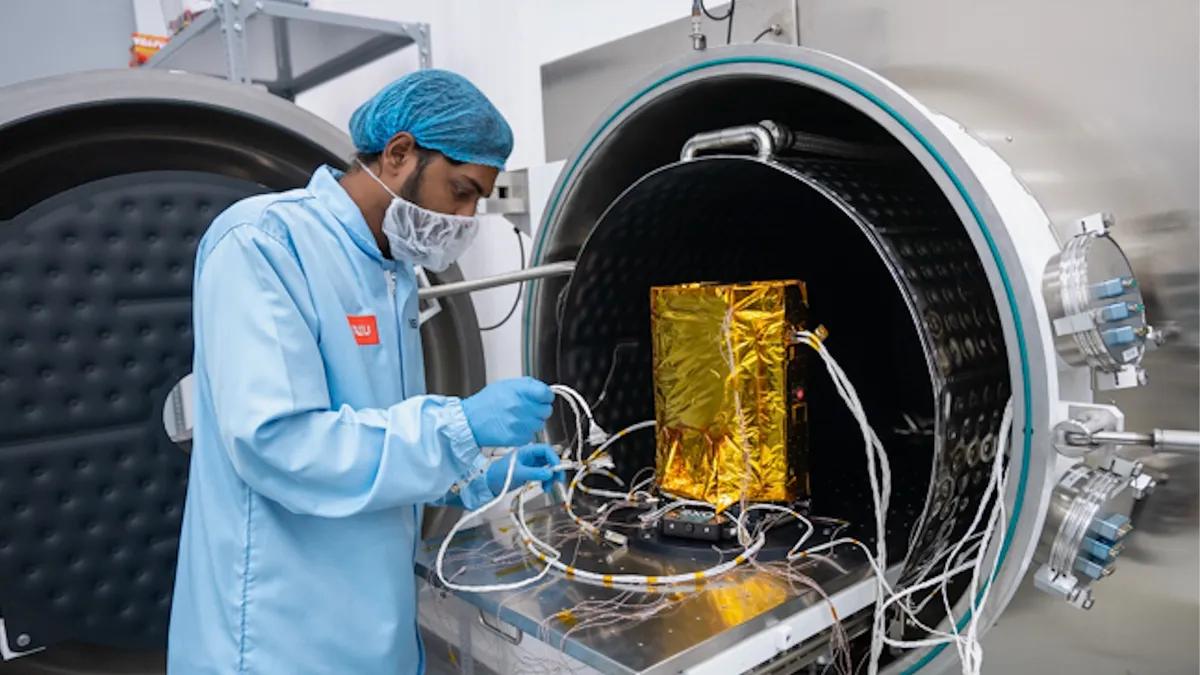
The flight-ready lander is being kept in a vacuum chamber in Abu Dhabi before being transported to Colorado by Etihad Airways for integration with the main spacecraft. The mission is scheduled to lift off from Japan in March 2028.