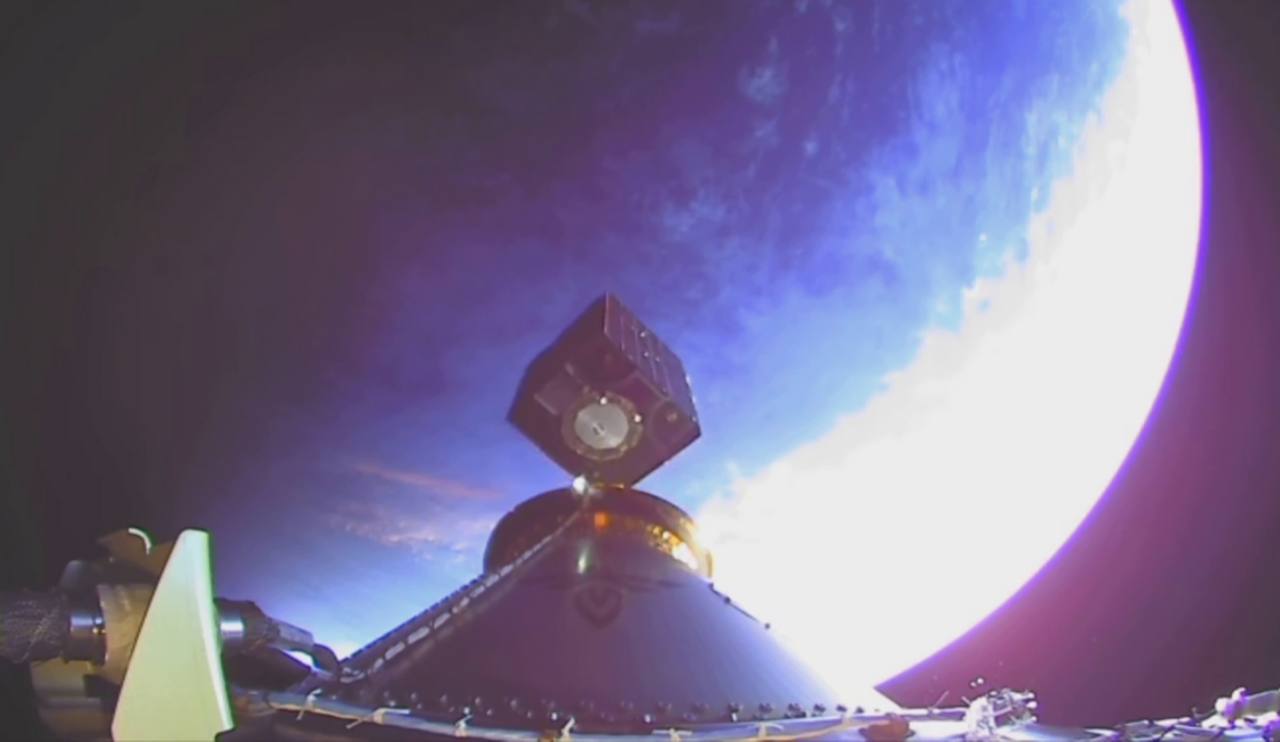
True Anomaly Completes First In-Space Pursuit of an Evading Satellite Under VICTUS HAZE
True Anomaly said it has become the first company to execute an in-space pursuit of an evading target, a milestone reached during the Space Force's tactical responsive space mission VICTUS HAZE. The company's Jackal spacecraft tracked and imaged a Rocket Lab-built satellite called Puma while Puma actively maneuvered to break contact. The sortie marked an escalation from True Anomaly's first VICTUS HAZE objective in July, in which the spacecraft found and characterized a non-evasive Puma in an u
OST Staff · August 3, 2026
True Anomaly said it has become the first company to execute an in-space pursuit of an evading target, a milestone reached during the Space Force's tactical responsive space mission VICTUS HAZE. The company's Jackal spacecraft tracked and imaged a Rocket Lab-built satellite called Puma while Puma actively maneuvered to break contact.
The sortie marked an escalation from True Anomaly's first VICTUS HAZE objective in July, in which the spacecraft found and characterized a non-evasive Puma in an unknown orbit. This time, the target did not cooperate. "We understood that Jackal was capable for this next phase in the mission," True Anomaly COO Sarah Walter said. "The mission objective was different because in this case, the target was not going to cooperate."
On July 14, SSC tasked the team with pursuit. As Jackal approached, Puma broke away, forcing Jackal to track the movement, replan, and re-engage. According to Walter, the team produced a validated mission plan within 30 minutes of tasking, then executed a 23-minute ingress and burn sequence to close in on Puma. Jackal used its Multi-Object Detection and Tracking algorithm to generate target orbit estimates from its own onboard measurements.
Jackal closed to roughly 10 km of Puma, within the target guidance of 10 to 20 km, then spiraled and circled back around the target to image it, giving the spacecraft two opportunities to capture multi-aspect imagery. The mission carried surprises, including higher than normal thermal temperatures at the start of the exercise. Walter said the team adapted quickly thanks to the relationship between the operators and Mosaic, True Anomaly's mission command and control software. "I would equate the relationship between the operators and Mosaic to a Formula One race car driver to their car," Walter said. "This is the engine that is built to execute on all of the mission objectives, and the operators are the brains, the judgments, and the mission-setters."
The mission was designed to test the people running the system rather than the system alone. Walter noted that Jackal has "barely made a scratch in the fuel and the capability that we have left." True Anomaly CEO Even Rogers said the team's performance had been exemplary and pointed to further first-of-a-kind missions ahead. "We are looking forward to conducting more first-of-a-kind missions in the coming months, with more autonomy, more maneuvering, innovative tactics, techniques and enhanced tracking modes," Rogers said. "This is what our Autonomous Orbital Vehicle, Jackal, and our BMC2 software platform, Mosaic, were designed to do."
With this phase of VICTUS HAZE complete, True Anomaly says it plans additional missions in the coming months, adding more autonomy, more maneuvering, new tactics, and enhanced tracking modes, drawing on the fuel and capability Jackal has left.