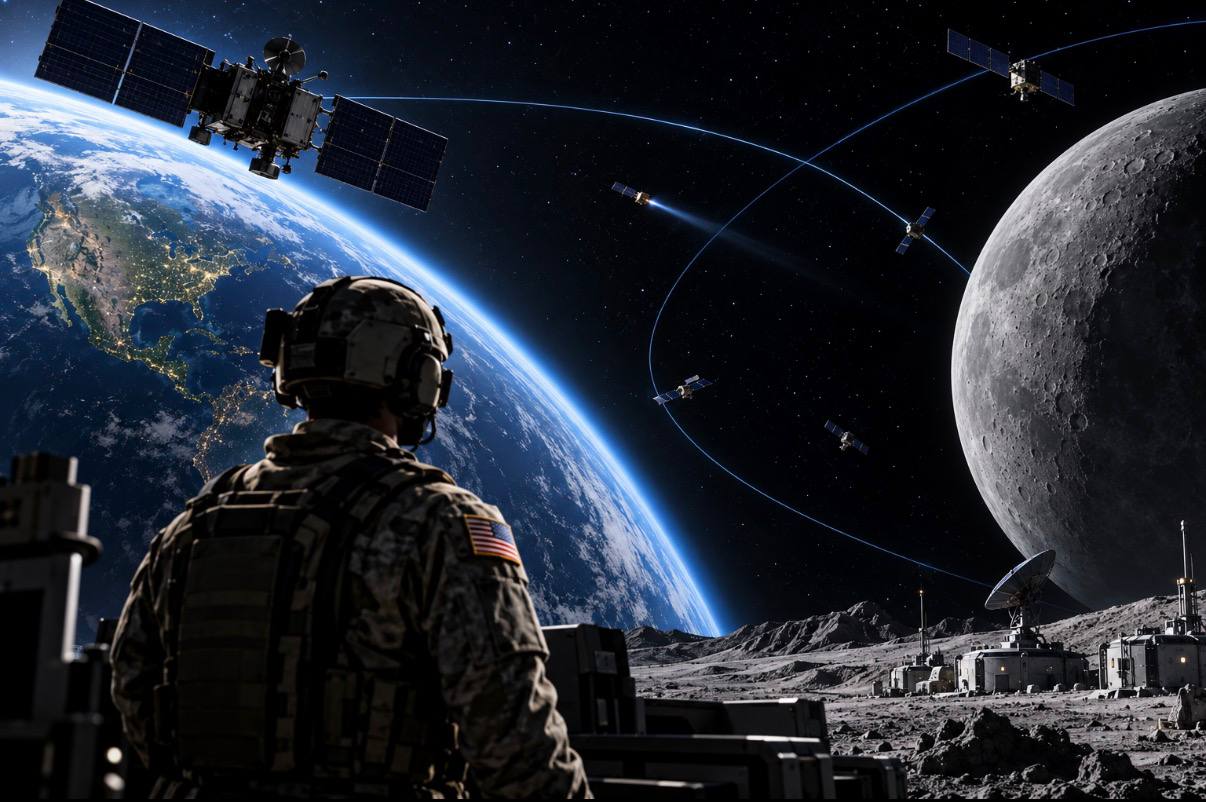
Joint Chiefs Chairman Names Cislunar Space as a Warfighting Domain
The chairman of the US Joint Chiefs of Staff told a Washington conference that American forces must prepare for combat not only in Earth's orbit but around the moon. Gen. Dan Caine's remarks mark a sharp escalation in official rhetoric, coming days after the US acknowledged for the first time that it has deployed weapons in space. Caine spoke on September 16 at the Air, Space and Cyber Conference outside Washington, addressing service members and industry figures. He said the US military should
OST Staff · September 17, 2026
The chairman of the US Joint Chiefs of Staff told a Washington conference that American forces must prepare for combat not only in Earth's orbit but around the moon. Gen. Dan Caine's remarks mark a sharp escalation in official rhetoric, coming days after the US acknowledged for the first time that it has deployed weapons in space.
Caine spoke on September 16 at the Air, Space and Cyber Conference outside Washington, addressing service members and industry figures. He said the US military should adapt now so it "is prepared to fight, endure and win from the seabed to cislunar space." Cislunar space describes the region between the Earth's surface and the moon.
The comments followed a disclosure at the same conference by US Air Force Secretary Troy Meink, who revealed that the US has fielded "on-orbit space control weapons." The Space Force, created by Donald Trump in 2019, is preparing to operate in space and around the moon. Lt. Gen. Gregory Gagnon, head of the force's combat forces command, told reporters that "humanity is advancing deeper into space, the space force's job is to help be prepared to defend US interests."
Gagnon said the intelligence community has been clear that potential adversaries have been seeking to extend warfare into space and that the US military needs to react. He named the People's Republic of China as actively pursuing activities in parts of space. China established its own military space troops in 2024, tasked with boosting capability to manage space crises. Gagnon said the US aims to double the size of the Space Force over the next five years, to roughly 25,000 service members, with about two-thirds of that growth focused on combat forces command.
The wave of announcements about space weaponry runs counter to longstanding conventions holding that outer space should be used only for peaceful purposes. While multiple nations, including the US, have demonstrated the ability to shoot down satellites in Earth orbit, those demonstrations took place from the ground against their own satellites. Chinese foreign ministry spokesperson Guo Jiakun said on September 15 that "China always upholds the peaceful use of outer space" and opposes "the weaponization, militarization and an arms race in outer space," urging the US to "stop expanding its military preparations in outer space."
The 1967 Outer Space Treaty, signed by both the US and China, states that celestial objects such as the moon are to be used "exclusively for peaceful purposes," bars nuclear weapons in space, and holds countries liable for damage caused by their space objects. It is not clear whether deploying weapons in space or possible plans to use them around the moon will run afoul of these provisions.
A sitting Joint Chiefs chairman naming cislunar space as a warfighting domain, immediately after the disclosure of deployed orbital weapons, signals a doctrinal shift with implications for Space Force and industry budgets, according to the framing of the remarks.
Watch whether "cislunar" begins appearing in the next Space Force budget as a line item rather than a talking point, and whether the planned expansion to roughly 25,000 service members proceeds over the next five years.