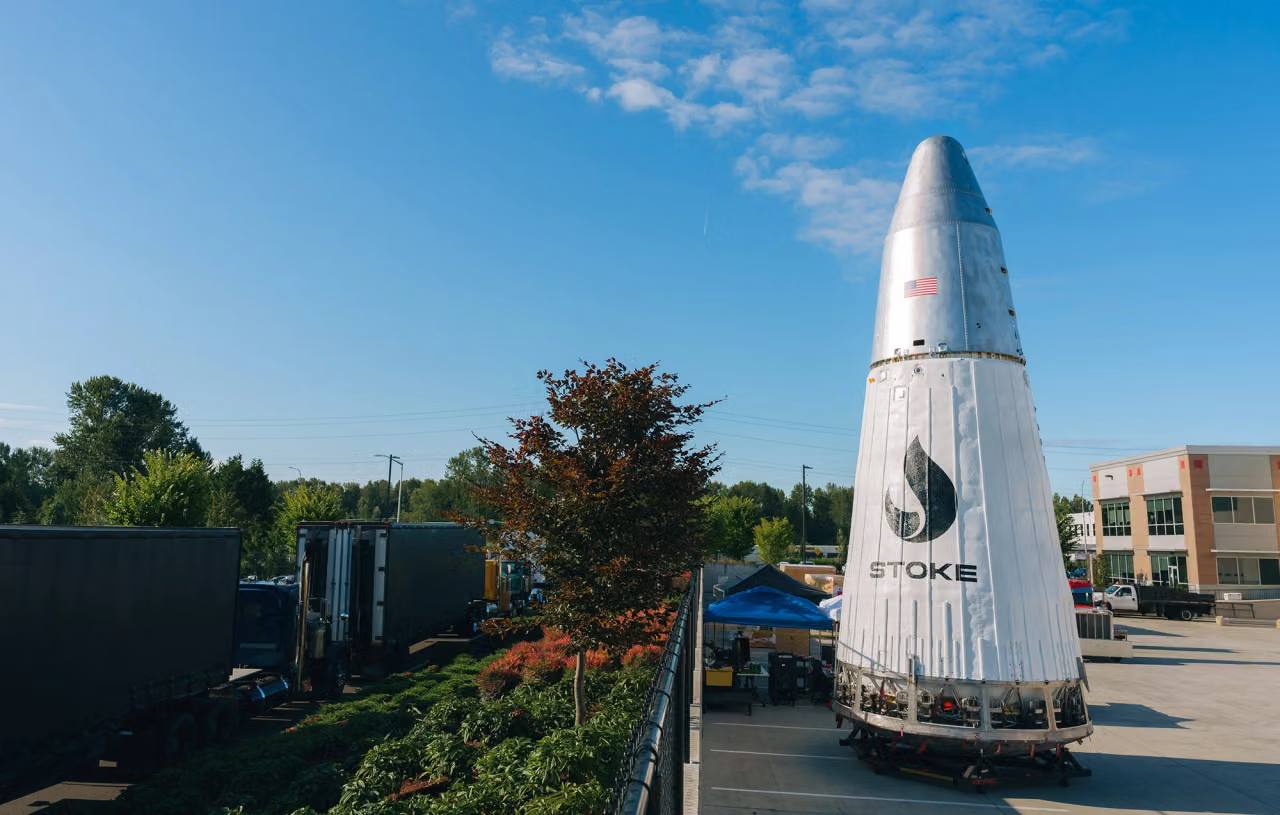
Stoke Space Raises $1 Billion and Reveals 15-Ton Fully Reusable Nova Block 2
Stoke Space has closed a $1 billion Series E financing round as it prepares for the first orbital flight of its fully reusable Nova rocket, and the company used the announcement to publicly unveil a substantially larger vehicle capable of delivering 15 metric tons to low Earth orbit. The raise brings Stoke's total capital to $2.3 billion. The financing was co-led by Point72 Ventures and Spark Capital. General Innovation, Glade Brook Capital, US Innovation Technology, Washington Harbour Partners
OST Staff · September 8, 2026
Stoke Space has closed a $1 billion Series E financing round as it prepares for the first orbital flight of its fully reusable Nova rocket, and the company used the announcement to publicly unveil a substantially larger vehicle capable of delivering 15 metric tons to low Earth orbit. The raise brings Stoke's total capital to $2.3 billion.
The financing was co-led by Point72 Ventures and Spark Capital. General Innovation, Glade Brook Capital, US Innovation Technology, Washington Harbour Partners, Woven Capital and Y Combinator also participated alongside other investors. The capital will fund Stoke's push toward orbital flight, expand its manufacturing, testing, launch and recovery infrastructure, and accelerate development of Nova Block 2.
Stoke is targeting early 2027 for the first orbital launch of Nova Pathfinder, its initial orbital vehicle. Pathfinder is intended to reach orbit and carry customer payloads while also demonstrating the technologies and operating procedures required to recover and rapidly reuse both stages. The company plans to conduct multiple Pathfinder missions through 2027 and 2028.
Nova Block 2 is designed to deliver 15 metric tons to LEO while remaining fully reusable, placing Stoke in a significantly larger launch class than Pathfinder. The vehicle will feature a five-meter payload fairing and is targeting a first flight in 2029. Rather than building an entirely new rocket, Stoke plans to scale technologies already being demonstrated aboard Pathfinder, with both vehicles sharing the same fundamental propulsion, manufacturing, reentry and recovery architecture. Pathfinder will fly with seven of Stoke's Zenith engines, while Block 2 will use fourteen. Zenith is a liquefied natural gas and liquid oxygen full-flow staged-combustion engine designed to combine high performance with lower thermal and mechanical stress for repeated reuse.
Both vehicles use stainless steel skin-and-stringer structures, allowing Stoke to scale Block 2's dimensions without replacing its manufacturing process. The larger vehicle remains sized so major components can be transported by road rather than requiring specialized marine transportation infrastructure. The biggest changes come on the reusable upper stage, which combines the propulsion system with an actively cooled metallic heat shield. Liquid hydrogen flows through the heat shield during reentry, letting the stage manage atmospheric heating without a conventional ceramic tile thermal protection system.
For Block 2, Stoke is evolving its Andromeda upper-stage propulsion into twelve independently operating engines with two thrust chambers each, creating 24 thrust chambers around the vehicle's base. The design increases upper-stage thrust by more than five times and introduces engine-out capability, allowing the vehicle to shut down an individual engine and potentially continue its mission. The Block 2 version of Andromeda is expected to exceed 440 seconds of specific impulse. Block 2 will replace Pathfinder's tapered upper stage with cylindrical propellant tanks, increasing both propellant capacity and payload volume.
Stoke says Block 2 will be capable of delivering more than four metric tons to geosynchronous transfer orbit while retaining the maneuverability needed for payload deployment, repositioning and servicing. The five-meter fairing is intended to give customers a conventional payload environment while preserving Stoke's base-first reentry architecture.
Stoke's next milestone is the first orbital launch of Nova Pathfinder, targeted for early 2027, followed by multiple Pathfinder missions through 2027 and 2028. The company is targeting a first flight of Nova Block 2 in 2029.