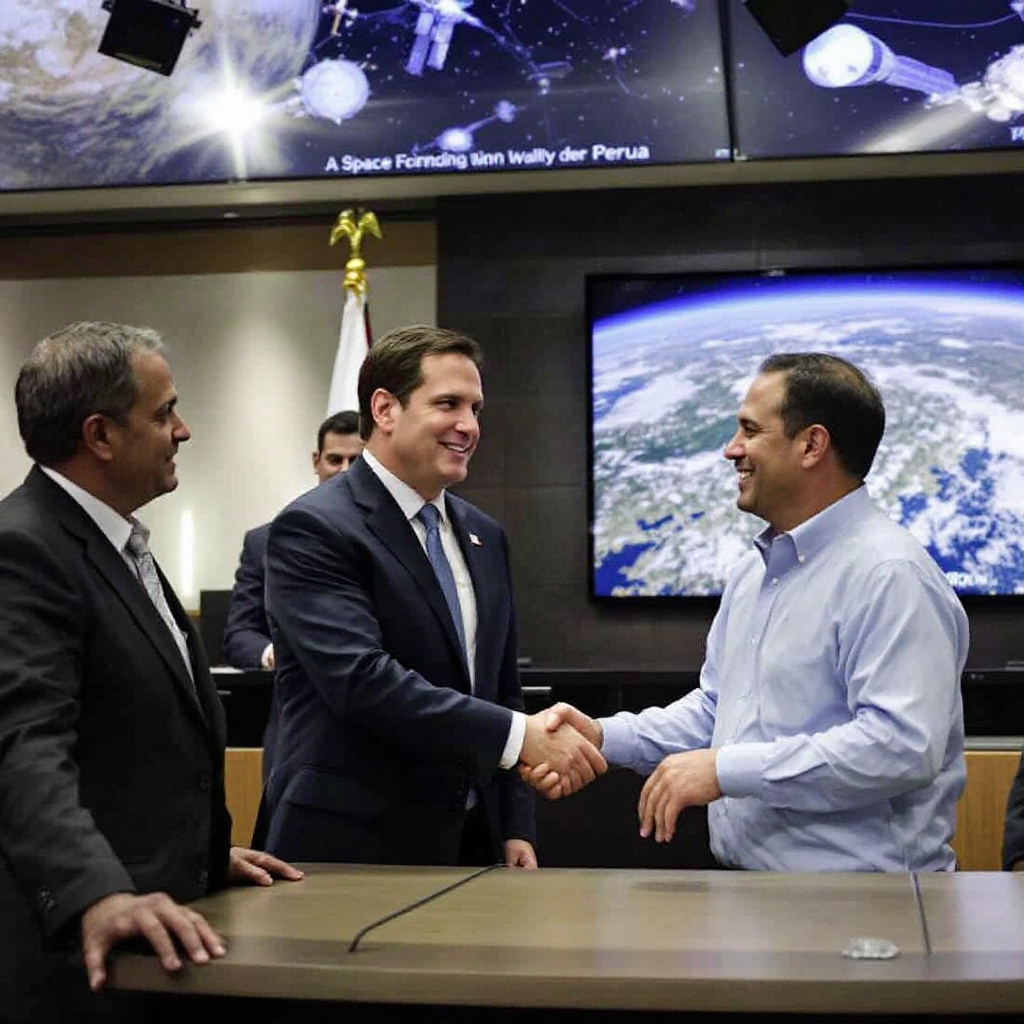
State Department Launches Space Catalyst Partnership With Peru Satellite Internet Project
Secretary of State Marco Rubio unveiled the department's new flagship space diplomacy initiative, the Space Catalyst Partnership, during an official visit to Lima on September 10. The effort directs foreign-assistance dollars to support US space companies, with Peru serving as its first project. By creating new opportunities for foreign governments and space agencies to engage with the US civil and commercial space sectors, the SCP aims to deepen cooperation between the US and Artemis Accords s
OST Staff · September 15, 2026
Secretary of State Marco Rubio unveiled the department's new flagship space diplomacy initiative, the Space Catalyst Partnership, during an official visit to Lima on September 10. The effort directs foreign-assistance dollars to support US space companies, with Peru serving as its first project.
By creating new opportunities for foreign governments and space agencies to engage with the US civil and commercial space sectors, the SCP aims to deepen cooperation between the US and Artemis Accords signatories. Participation is limited to Accords signatories, making access to the US commercial-space sector an incentive to sign on. Peru joined the Accords in 2024.
A senior State Department official, speaking to reporters on a background call, said what is novel is the department itself steering foreign aid to promote US industry, a role State has not played in a coordinated manner previously. The official tied the launch to President Donald Trump's December executive order on space superiority and his 2025 National Security Strategy, which calls for the US to be the hemisphere's partner of choice.
Alongside the announcement, Rubio unveiled the SCP's first project, a two-year, $6.5 million effort to bring satellite internet to rural southern Peru. The partnership bundles three tools the State Department will deploy project by project: diplomatic outreach coordinating across US agencies to help partner countries access American space tech and financing, industry engagement connecting US firms with foreign customers and promoting them at international trade shows, and targeted foreign assistance to help emerging spacefaring nations buy US space goods and services. State will also work closely with NASA on SCP efforts, officials said, a point echoed by NASA Administrator Jared Isaacman on social media.
State officials would not explicitly call SCP a China play, but did not argue hard against it. Beijing has spent years building a space presence across Latin America, from a deep-space tracking station in Argentina's Patagonia to satellites built and launched for Bolivia and Venezuela. Asked whether SCP foreign-assistance recipients would be barred from working with Chinese providers, the senior official said no such limit exists, betting instead that US technology and standards make American firms the obvious pick. Argentina is both an Artemis Accords signatory and the host of the Chinese tracking station. China, the official said, overproduces and then exports at low prices to leave countries dependent, while the US offer comes with no coercive diplomacy and no debt traps.
The initiative reflects the administration's stated goal, drawn from the 2025 National Security Strategy, of positioning the US as the hemisphere's partner of choice and advancing US industry through coordinated foreign aid, a role officials said the department has not previously played in this manner.
Funding remains the biggest open question. Asked whether money had been appropriated, the senior official said there is no overall program number. Instead, the department is working with Congress to pair various pots of foreign assistance with projects as they coalesce. The launch comes as State absorbs foreign-aid functions following the dismantling of USAID in 2025 and cuts to assistance budgets. The official did not say which company will support the Peru project, or how much money beyond the initial $6.5 million it expects to line up for future ones.