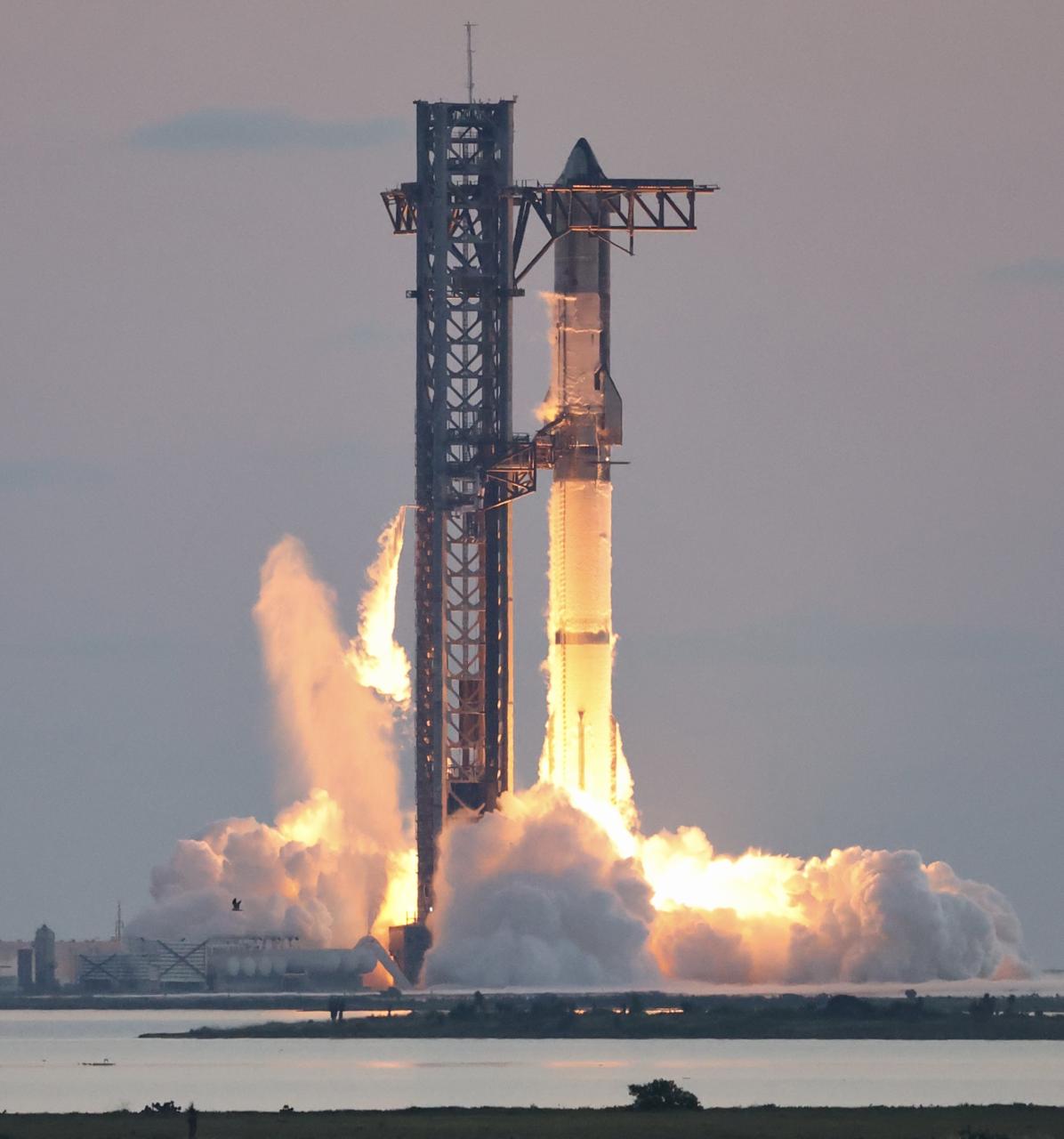
SpaceX Sets IFT-14 for Late August With First Operational Starlinks and Ship Catch Attempt
SpaceX will fly the next Starship test, IFT-14, as soon as the end of August, deploying operational Starlink Version 3 satellites into orbit for the first time and attempting to catch the Starship upper stage back at Starbase, Texas. Company officials confirmed the plan during SpaceX's first earnings call since going public, marking the point at which Starship shifts from a test program toward operational delivery. The announcement came from CEO and CTO Elon Musk, President and COO Gwynne Shotw
OST Staff · August 5, 2026
SpaceX will fly the next Starship test, IFT-14, as soon as the end of August, deploying operational Starlink Version 3 satellites into orbit for the first time and attempting to catch the Starship upper stage back at Starbase, Texas. Company officials confirmed the plan during SpaceX's first earnings call since going public, marking the point at which Starship shifts from a test program toward operational delivery.
The announcement came from CEO and CTO Elon Musk, President and COO Gwynne Shotwell, and CFO Bret Johnsen, who described a positive outlook across the company's space, connectivity, and AI segments. Shotwell said SpaceX flew 78 Falcon launches in the first half of the year, mostly carrying its own Starlink satellites but also serving commercial and government demand. "We're currently launching at our highest Falcon cadence and are on the precipice of operationalizing Starship," she said.
IFT-14 will attempt two firsts on a single mission. IFT-13, flown last month, carried and deployed 20 Starlink V3 satellites, but because Starship was on a suborbital trajectory, they reentered along with the vehicle rather than reaching orbit. IFT-14 will be the first attempt to deploy the new generation of satellites into orbit and then return the Ship to Starbase for a catch. Musk said IFT-13 "demonstrated the core capabilities necessary to achieve an orbital mission and return to Starbase for catch."
The Super Heavy booster has already been caught back at the launch site three times, but a catch of the Ship would be a first. Since IFT-3, the Ship's destination has been the Indian Ocean, where it is expected to make a soft splashdown, tip over, and explode from residual propellant. IFT-13 remained intact after reentry and is still floating in the ocean, giving SpaceX time to study the heat shield in detail. Musk said the vehicle will be retrieved and expressed confidence the heat shield poses no obstacle to reuse. "I think we consider the heat shield problem solved at this point," he said. "We do not see any technical obstacles at this point to achieving full and rapid reusability."
Musk also said he expects Starship flight cadence to reach at least one flight per day within roughly a year, and that the very high launch rate needed to achieve human spaceflight safety levels would come "probably by the end of next year." On lunar plans, Shotwell said propellant transfer in orbit is critical to both SpaceX's internal ambitions and its Human Landing System work. "Artemis III mission is next year. That's where we will dock with the Orion spacecraft. We will follow that up with a direct to lunar cargo mission, uncrewed, and then we want to put boots on the ground, boots on the moon in 2028," she said.
Officials framed IFT-14 as the transition of Starship from a test vehicle into an operational delivery system, with real commercial stakes from the V3 payload rather than an engineering demonstration alone. A Ship catch attempt on the same flight would combine two high-risk objectives, making it the most ambitious single Starship mission to date.
The immediate milestone to watch is IFT-14 itself, targeted for as soon as late August, and whether SpaceX secures regulatory approval for the Ship catch attempt. Beyond that, Shotwell named the Artemis III docking mission next year, a direct-to-lunar uncrewed cargo mission, and a crewed lunar landing targeted for 2028.