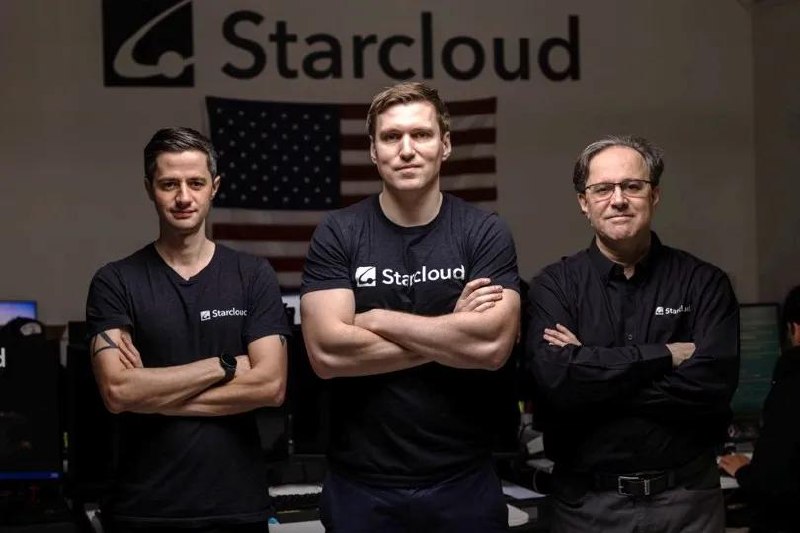
Starcloud Adds $250 Million to Series A at $2.3 Billion Valuation as Launch Capacity Tightens
Starcloud, a startup building satellites that perform AI inference in orbit, has added a $250 million extension to its March Series A round, lifting its valuation to $2.3 billion. The company plans to use the capital to open a larger manufacturing facility and secure scarce launch capacity as the market for rides to orbit constricts. The funding arrives as launch availability grows more uncertain. SpaceX intends to phase out its Falcon 9, scheduled to end in 2028, while its larger Starship rock
OST Staff · August 21, 2026
Starcloud, a startup building satellites that perform AI inference in orbit, has added a $250 million extension to its March Series A round, lifting its valuation to $2.3 billion. The company plans to use the capital to open a larger manufacturing facility and secure scarce launch capacity as the market for rides to orbit constricts.
The funding arrives as launch availability grows more uncertain. SpaceX intends to phase out its Falcon 9, scheduled to end in 2028, while its larger Starship rocket remains unproven. CEO Philip Johnston said the tightening market is shaping the company's strategy. "We can see what's coming, we're going to need to book an enormous amount of launch," he told TechCrunch.
Launch costs have been one of the biggest challenges for orbital data center startups. "As soon as we can, we want to get under contract with things like Starship," Johnston said. "One of the biggest costs is now on securing your launch capacity. Launch is pretty constrained right now because Falcon 9 program is scheduled to end in 2028." Competing rockets, including Blue Origin's New Glenn and ULA's Vulcan, are not flying regularly, and Rocket Lab's Neutron is not yet on the pad.
Starcloud has requested FCC permission to operate 88,000 spacecraft. For now, the company is focused on launching two of its new 8 kilowatt compute satellites, dubbed Starcloud-2, on rideshare flights in 2027, performing orbital inference for customers including US government agencies. It is weighing a dedicated Falcon 9 launch and contracts with other providers to support future missions. Its largest spacecraft, Starcloud-3, is intended to fly on Starship. This week, Elon Musk said SpaceX will delay an attempt to catch a returning Starship for a few months and will attempt to re-fly the vehicle for the first time at the end of the year or early 2027.
The extension was led by Manhattan West Ventures and included participation from Nvidia and Cisco. A person familiar with the deal said Nvidia contributed $25 million. Other participants included Benchmark, EQT, Soma, NFX, 776, Cedar Capital, Goanna Capital, and Standard Capital. Starcloud is the only company known to be operating an Nvidia H100 terrestrial data center GPU in orbit, and the first to train a model using it. It is sharing those learnings with Nvidia as the chipmaker develops its first purpose-built space GPU, the Vera Rubin Space-1 chip. Starcloud hopes to fly that chip in late 2028. The company, currently 25 employees, is developing production lines at a 100,000 square foot facility in Woodinville, Washington.
Johnston framed the Nvidia investment as a signal of Starcloud's position in the nascent space compute sector. "The reason they've chosen to do this investment now is because of all of this data that we got from Starcloud One," he said. "They, more than any other VC, did way more technical duty on this than anybody else." He said he remains confident in SpaceX's ability to show that Starship can be reused quickly and often, the condition Starcloud's business ultimately depends on.
The company faces a clear risk in booking launch. "Obviously if we can't book any SpaceX launch capacity in 2029, that will be challenging for us," Johnston said. Starcloud's near-term milestones include the 2027 rideshare flights of Starcloud-2, SpaceX's planned Starship re-flight, and the targeted late 2028 orbital debut of the Vera Rubin Space-1 chip.