SpaceX Rebuilds Starbase Pad 1 While Block 3 Starships Fly From Pad 2
SpaceX has begun flying Starship Block 3 vehicles from the newly designed Pad 2 at Starbase in Texas, while crews simultaneously retrofit the original Pad 1 to bring it up to the same specification. The parallel effort allows SpaceX to upgrade its ground infrastructure without pausing its flight cadence, with two flights already completed from Pad 2. The Pad 1 retrofit began shortly after the end of Flight 11 and Block 2 of Starship. The work will bring the pad in line with Pad 2, LC-39A, and t
OST Staff · August 1, 2026
SpaceX has begun flying Starship Block 3 vehicles from the newly designed Pad 2 at Starbase in Texas, while crews simultaneously retrofit the original Pad 1 to bring it up to the same specification. The parallel effort allows SpaceX to upgrade its ground infrastructure without pausing its flight cadence, with two flights already completed from Pad 2.
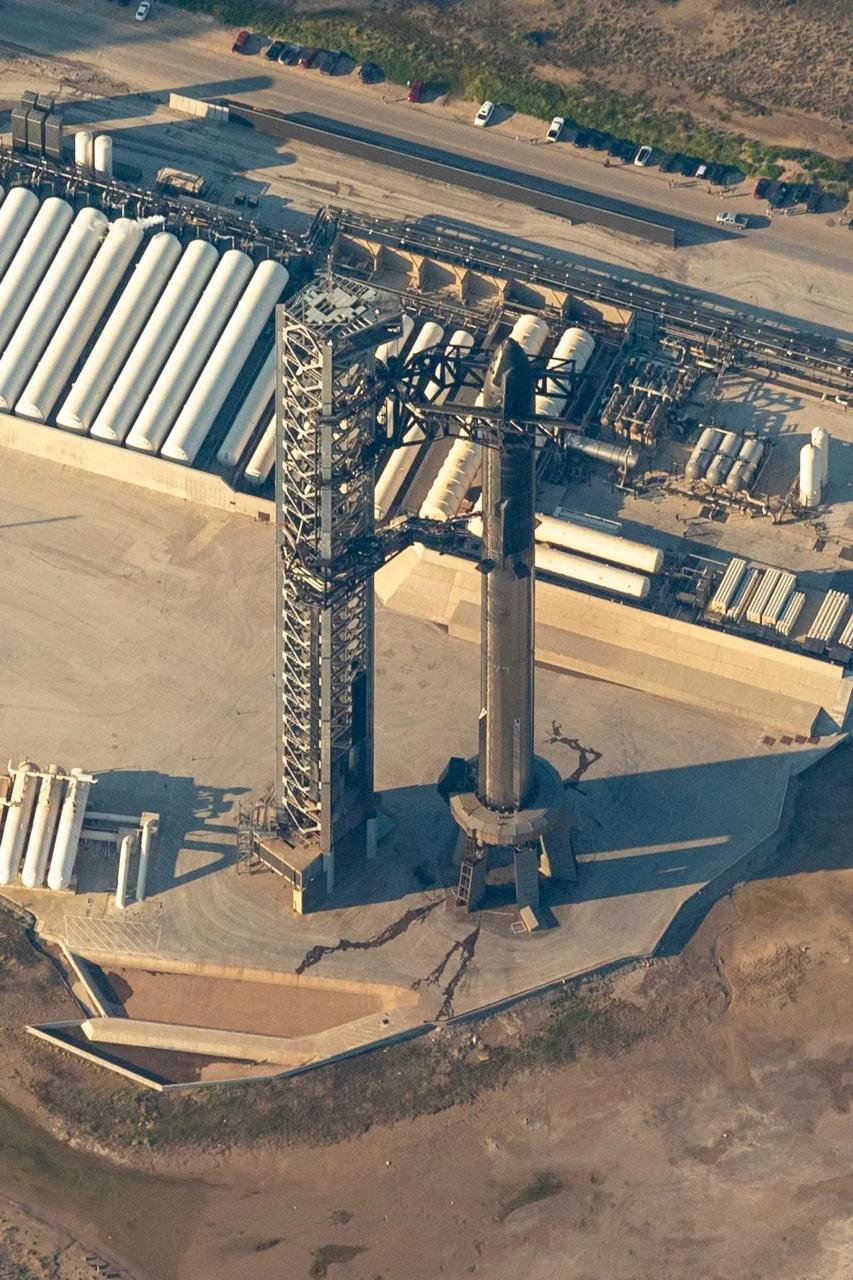
The Pad 1 retrofit began shortly after the end of Flight 11 and Block 2 of Starship. The work will bring the pad in line with Pad 2, LC-39A, and the still under construction SLC-37 pads. Since starting, crews have made progress on the flame trench and are now beginning construction of the launch mount itself.
Most of the trench has been excavated, with the south side already receiving its rat slab layer of concrete, a hard working surface that lets crews lay rebar for the primary floor pour without standing on mud. Before that pour, crews must break the concrete off the tops of the Continuous Flight Auger piles supporting the trench and launch mount. Once rebar and embed plates are set, crews will pour the trench floor first, then the ramps. The flame trench walls will follow, and here construction differs from Pad 2 and LC-39A. Crews are preassembling middle sections of the flame trench walls beside the trench, which will be lifted into place using the yellow Buckner LR11000 crane and given their final welds.
After most wall sections are installed, crews will add the A-frames supporting the pair of flame diverter buckets, which are about to begin assembly in Sanchez from prefabricated sections delivered over recent months. The launch mount trails where Pad 2 stood at the same stage. SpaceX has held all four sides of the mount's first level for months but could not begin construction until the four corners arrived, some of which started arriving this week. Depending on further deliveries, the launch mount could be finished in the next five to six months. Crews have already removed and scrapped the old Ship Quick Disconnect elbow and arm, with parts for a new SQD arm staged in Sanchez.
Alongside the retrofit, SpaceX has added two more Liquid Nitrogen tanks next to the Liquid Methane tank farm to supply subcooling LN2 for LOX and LCH4, with spots for two more. The site currently holds roughly 13,740 metric tons of LOX storage, 6,136 metric tons of LN2 storage, and 3,268 metric tons of LCH4 storage, equal to about 3.2 stacks of LOX and 2.5 stacks of LCH4. Separately, Starship Flight 13 produced footage of the vehicle in space captured by a Starlink V3 satellite.
Running one pad in flight operations while rebuilding another in parallel represents an operational tempo not being attempted at this scale elsewhere. It signals that SpaceX is treating Starship as an operational system being industrialized in real time rather than a test program. If Pad 1 returns online before the end of the year, SpaceX would become the only entity with two fully operational Starship launch pads.
Attention now turns to the arrival of remaining launch mount components, which will determine whether the mount is completed within the projected five to six months. At the nearby Gigabay, under construction since June 2025, the main structural steel is nearly complete, with roof trusses the largest remaining item before roof installation, transfer aisle bridge cranes, and new ship and booster stands follow.