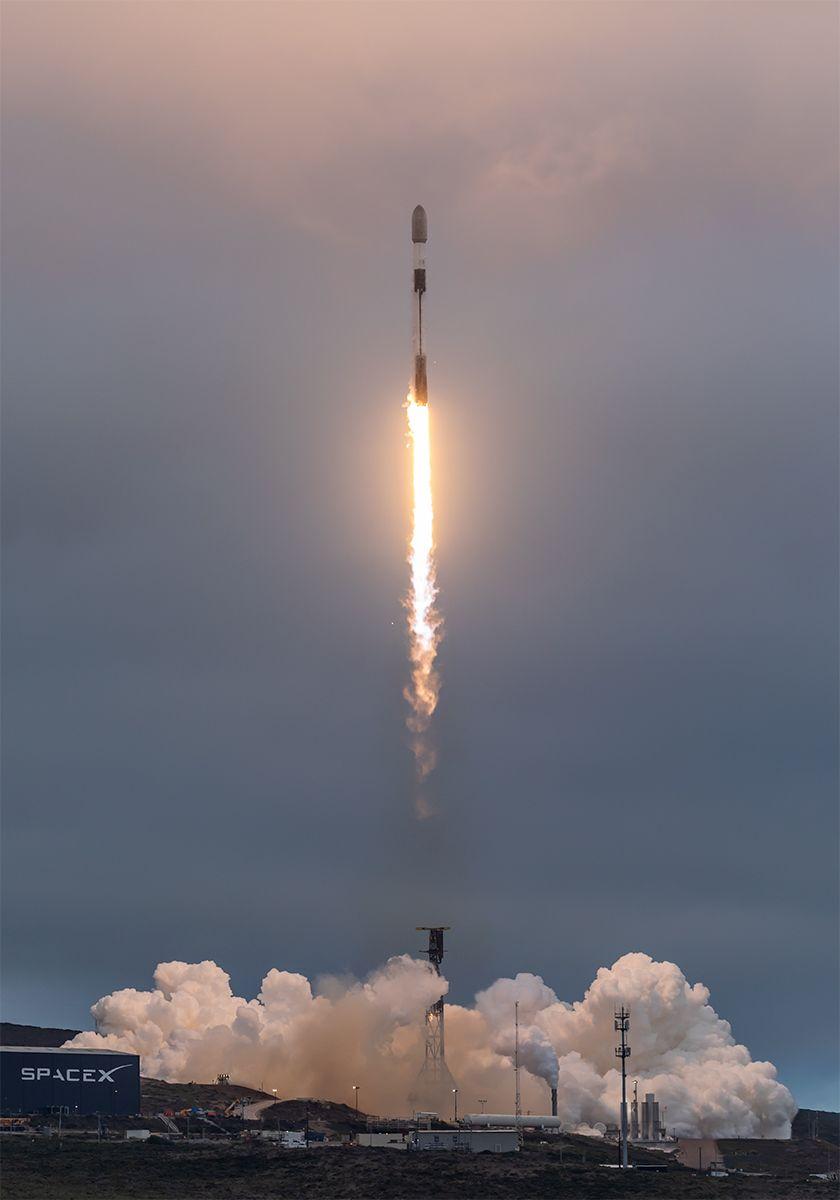
SpaceX Launches Two Falcon 9s From Opposite Coasts in 38 Minutes
SpaceX completed two orbital Falcon 9 launches within 38 minutes on August 15, 2026, lifting off from operational pads on opposite coasts of the United States. The dual-coast doubleheader set a record for the shortest elapsed time between orbital missions executed by a single launch provider. The two flights deployed the USSF-366 mission for the U.S. Space Force from Florida and a Globalstar-2R communications satellite from California. The milestone highlights SpaceX's approach of treating orbi
OST Staff · August 17, 2026
SpaceX completed two orbital Falcon 9 launches within 38 minutes on August 15, 2026, lifting off from operational pads on opposite coasts of the United States. The dual-coast doubleheader set a record for the shortest elapsed time between orbital missions executed by a single launch provider.
The two flights deployed the USSF-366 mission for the U.S. Space Force from Florida and a Globalstar-2R communications satellite from California. The milestone highlights SpaceX's approach of treating orbital launch operations as a high-density transportation network, relying on automated range safety protocols and parallel pad refurbishment to increase turnaround throughput.
Company executives frequently compare rocket pad logistics to commercial airline turnarounds, where intercontinental jets are deplaned, serviced, refueled, and boarded in roughly 45 to 60 minutes. The rapid turnaround capability aligns with SpaceX's long-term targets for fleet utilization, decoupling launch schedules from extended multi-week range refurbishments so that pads function more like airport gates.
Both first stages, upper stages, and payload fairing halves from the August 15 campaign were recovered for inspection and subsequent integration onto future commercial manifests. While the global space industry completed roughly 250 total orbital launches in 2025, SpaceX surpassed 150 individual launches during the same period and is operating at a cadence exceeding 160 orbital missions annually in 2026.
The operational rationale driving this frequency is the consolidation of launch capacity to maintain cost leadership and market dominance. By deploying its internal Starlink broadband constellation alongside commercial customer payloads on tight turnaround schedules, SpaceX maximizes capital efficiency across its reusable launch infrastructure. The company provides flexible, high-frequency launch availability for commercial operators and government defense customers, including the Department of Defense's Tactically Responsive Space framework, securing long-term contracts as the dominant provider of low Earth orbit payload delivery.
The source states that no other launch provider currently operates at this cadence level, and that maintaining a high-density schedule creates a commercial barrier to entry for competing launch providers. Thirty-eight minutes between two orbital launches from opposite coasts is described as a demonstration of infrastructure depth that competitors cannot presently match.
Launch teams at Cape Canaveral and Vandenberg have re-entered standard pad turnaround protocols following the dual-launch campaign. As regulatory authorities approve higher annual flight caps across U.S. launch ranges, including Vandenberg's expanded annual limit of 50 Falcon 9 launches, SpaceX continues to refine automated range tracking, autonomous droneship recoveries, and rapid fairing refurbishment to support planned high-density launch manifests through late 2026 and 2027.