SpaceX Calls for Better Satellite Coordination in New Space Safety Update
The company says unannounced orbital maneuvers are creating preventable collision risks, detailing an incident that left a Starlink satellite just 30 minutes to respond. SpaceX published a new space safety update on October 6, urging satellite operators to share their planned movements before changing orbit. The company argues that gaps in coordination are creating dangerous situations that could often be avoided with better information. The update describes how SpaceX tracks nearby spacecraft
OST Staff · October 6, 2026
The company says unannounced orbital maneuvers are creating preventable collision risks, detailing an incident that left a Starlink satellite just 30 minutes to respond.
SpaceX published a new space safety update on October 6, urging satellite operators to share their planned movements before changing orbit. The company argues that gaps in coordination are creating dangerous situations that could often be avoided with better information.
The update describes how SpaceX tracks nearby spacecraft, distributes orbital predictions and responds to potential collisions across a Starlink constellation now numbering more than 11,000 satellites. It also makes the case for adopting those practices more broadly as the company prepares to expand its communications network and begin deploying computing infrastructure in space.
One incident illustrates the urgency. In August 2026, a Starlink satellite received an updated warning just 30 minutes before another spacecraft was expected to pass nearby. According to SpaceX, there was no longer enough time to perform a propulsion maneuver.
Instead, the satellite rotated its body and solar arrays into a narrow, edge-on profile to reduce the area exposed to a potential impact. The two spacecraft ultimately passed within 134 meters of each other.
SpaceX says the encounter could have been prevented if the other operator had shared its maneuver in advance.
The missing information behind collision risk
Avoiding collisions requires knowing where objects will be in the future. Satellite operators use predicted orbital trajectories, known as ephemerides, to identify potentially dangerous close approaches and decide whether to move.
That process becomes less reliable when another spacecraft changes course without warning.
Ground-based radar and optical observations can help reconstruct a satellite’s orbit, but they cannot predict an unannounced maneuver. SpaceX says tracking systems may need hours or days to rebuild an accurate prediction after such a change, leaving operators working with outdated information.
According to the update, Starlink encountered close approaches involving approximately 650 distinct maneuvering third-party satellites in 2026. Only about half shared their predicted trajectories.
Over a six-month period, SpaceX also recorded approximately 164,000 close approaches whose time of nearest passage fell within four hours of an unannounced maneuver.
The company explicitly notes that these were not all high-risk encounters. The concern is that missing information can prevent operators from reliably identifying and avoiding the encounters that are dangerous.
Using Starlink to track the surrounding sky
SpaceX is using the constellation itself to help close those information gaps.
Its Stargaze system draws on more than 31,000 star trackers aboard Starlink satellites to collect optical observations of nearby objects. Those observations reach the ground within seconds through the network’s laser links, allowing orbital predictions to be updated within minutes.
The updated trajectories feed into SpaceX’s coordination platform, where collision-risk messages can be generated within approximately 60 seconds of a trajectory being submitted.
SpaceX describes an October 2025 incident in which another satellite’s maneuver changed a predicted miss distance from roughly nine kilometers to just 57 meters. Stargaze detected the change and delivered an updated trajectory in less than an hour, allowing the Starlink satellite to plan an avoidance burn that would restore separation to one kilometer.
The August 2026 encounter offered a less comfortable outcome, with too little warning for a propulsion maneuver.
Together, the examples show both the value and the limits of faster tracking. Detecting an unexpected movement can buy time, but SpaceX says it cannot fully replace advance notice from the operator making the move.
A free platform for sharing orbital plans
SpaceX’s proposed remedy centers on routine information sharing.
The company says Starlink begins publishing trajectories immediately after deployment using launch vehicle telemetry. High-accuracy predictions based on each satellite’s navigation receiver follow as the spacecraft establish communications, with the process taking approximately two to three hours after launch.
Predictions are then updated hourly throughout each satellite’s remaining life.
SpaceX also offers a free coordination platform that allows operators to upload their own trajectories, access those shared by others and screen for potential close approaches. The system checks submitted paths against other uploaded trajectories and the Stargaze catalog, while also helping operators assess prediction accuracy.
The company is encouraging operators to share planned movements before a maneuver and publish updated information afterward.
Preparing for a much larger orbital population
The update arrives as SpaceX pursues plans for up to 100,000 Starlink satellites and up to one million Starmind AI satellites. The company says it intends to begin launching the Starmind constellation in 2027.
Those are future ambitions, rather than the size of its deployed fleet. But they explain why SpaceX is putting coordination at the center of its safety argument now.
The company draws a comparison with aviation, where flight plans, continuous position reporting and traffic management help aircraft maintain safe separation.
For the growing space economy, the practical challenge is making that level of coordination routine in orbit. More capable tracking systems can improve warning times, but the most useful information may still come from the operator that already knows when its spacecraft is about to move.
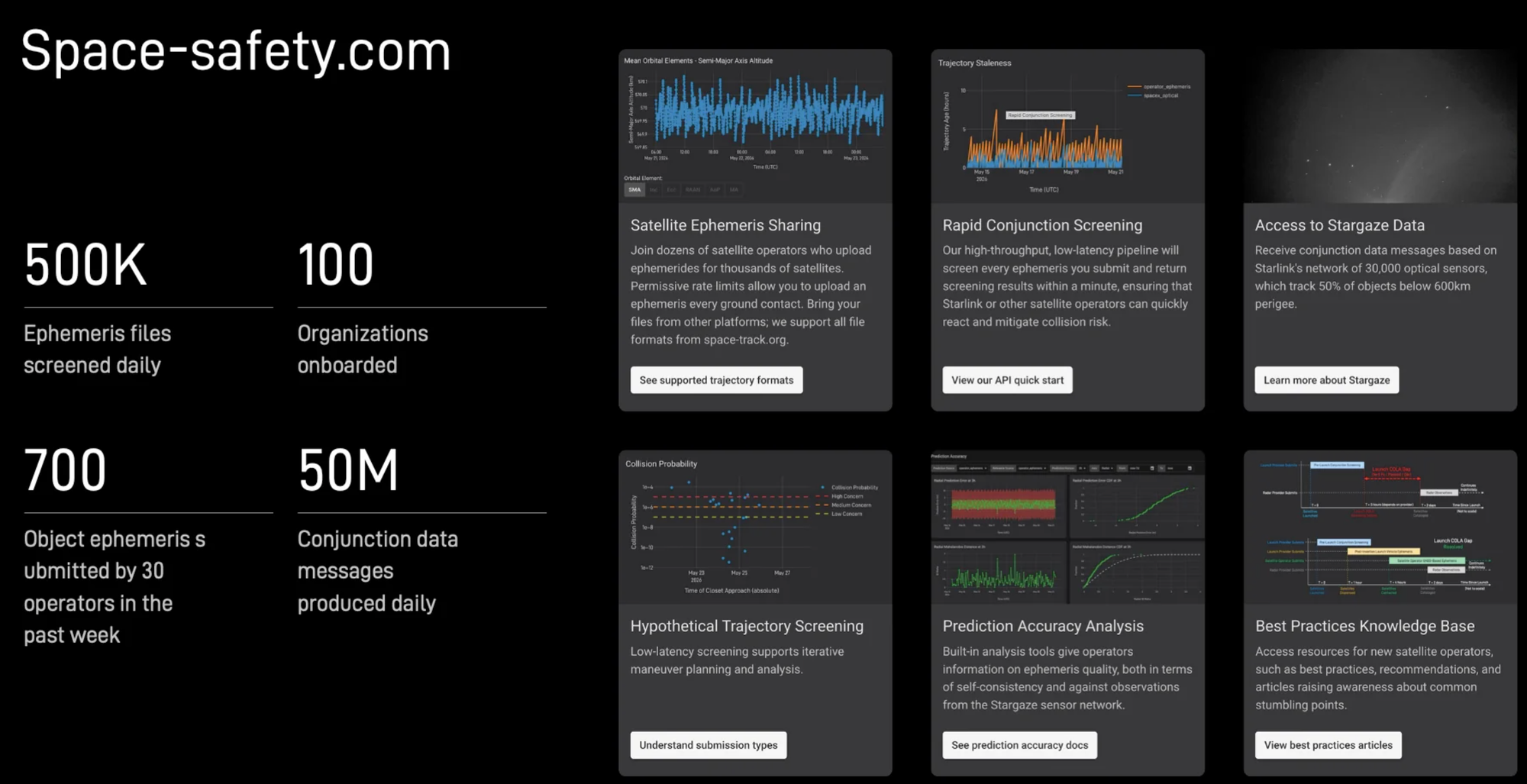
To read SpaceX’s full update, visit: Starlink Space Safety.