SpaceX Commits Exclusively to Nvidia for Orbital AI Hardware
SpaceX announced a partnership with Nvidia to design the compute payload for Starmind AI1, the first satellite in a planned constellation built to run AI workloads directly in orbit. Hours later, on the company's first earnings call as a public company, Elon Musk pledged that SpaceX will build its AI infrastructure exclusively on Nvidia hardware. Starmind has been in development since Musk confirmed the name in June, following an xAI trademark filing that surfaced the project before SpaceX made
OST Staff · August 5, 2026
SpaceX announced a partnership with Nvidia to design the compute payload for Starmind AI1, the first satellite in a planned constellation built to run AI workloads directly in orbit. Hours later, on the company's first earnings call as a public company, Elon Musk pledged that SpaceX will build its AI infrastructure exclusively on Nvidia hardware.
Starmind has been in development since Musk confirmed the name in June, following an xAI trademark filing that surfaced the project before SpaceX made it official. The concept moves computation off the ground entirely. Rather than shipping data to terrestrial servers, satellites equipped with onboard processors and large solar arrays would run AI workloads in orbit and beam results back to Earth. SpaceX has filed with the FCC for a constellation of up to one million satellites, citing constant solar power and the absence of zoning restrictions as advantages over ground based data centers.
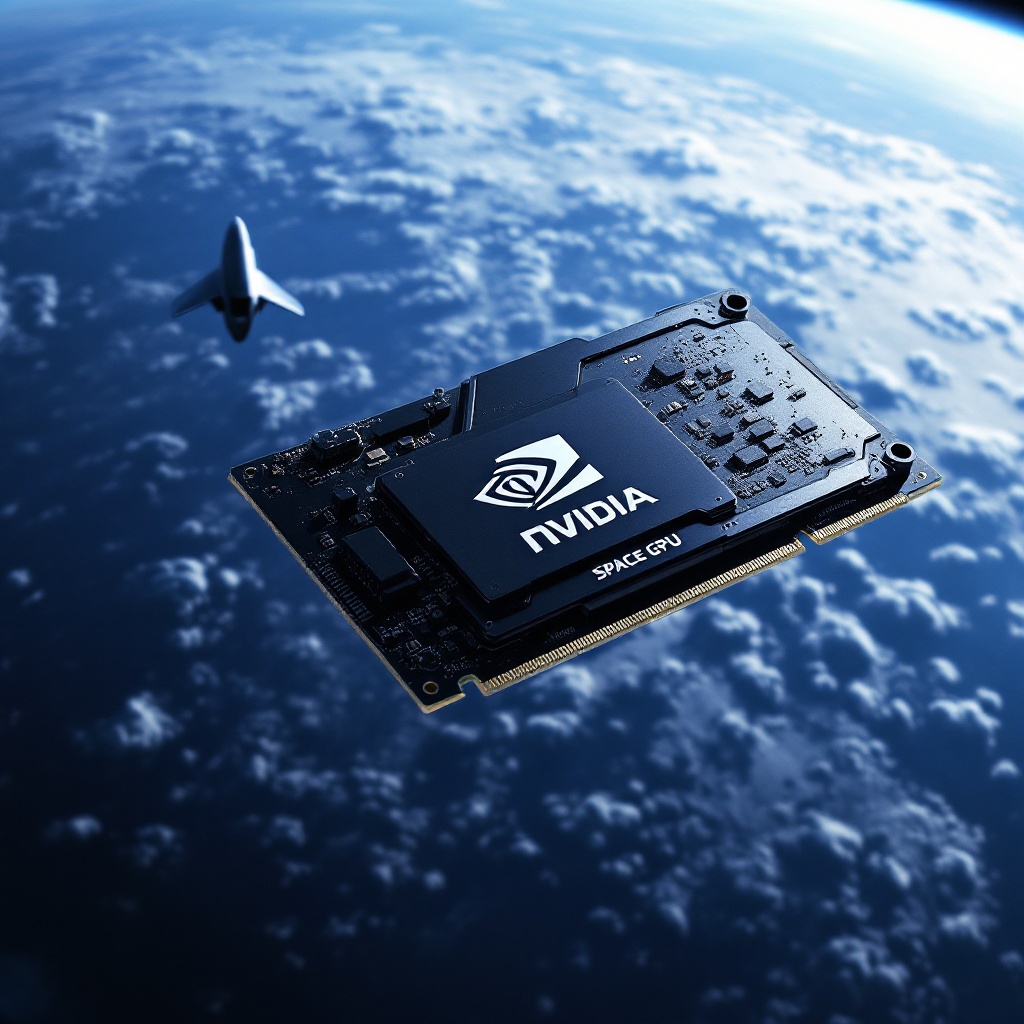
SpaceX said each Starmind satellite will carry Nvidia's Rubin GPUs and Vera CPUs, and its announcement included renderings of the payload design. On the earnings call, Musk went further. "We think the Vera Rubin architecture is the best architecture. We think it's the best AI computer, and we greatly value our close cooperation and partnership on many levels with Nvidia," he told investors. "So we're exclusive to Nvidia."
Musk said SpaceX plans to deploy Nvidia's Vera Rubin NVL72 rackscale system, codenamed Kyber, both on the ground and in space. He set a target of 2 gigawatts of compute capacity online by the end of this year, scaling to roughly 10 gigawatts by the end of 2027. The exclusivity commitment marks a shift in tone from two weeks earlier, when Musk dismissed a report that SpaceX had ordered $52 billion in Nvidia GPUs through Foxconn as fake news. SpaceX's AI division already leases Colossus compute capacity to Anthropic and Google, and the earnings report showed AI revenue climbing sharply as those deals ramp.
Musk described the orbital AI bet as a core part of SpaceX's future revenue. An exclusive hardware commitment of this scale between two of the most valuable technology companies is unusual and strategically significant. It locks SpaceX into Nvidia's supply chain and roadmap for its orbital computing ambitions, while giving Nvidia a high-profile anchor customer for space based AI applications. The scale of the spending was reflected in xAI related capital expenditures, which reached $15.8 billion in the second quarter alone.
Investors will be watching whether SpaceX hits Musk's stated capacity targets of 2 gigawatts by the end of this year and roughly 10 gigawatts by the end of 2027, as well as the progress of the Starmind AI1 satellite and the broader constellation SpaceX has filed for with the FCC.