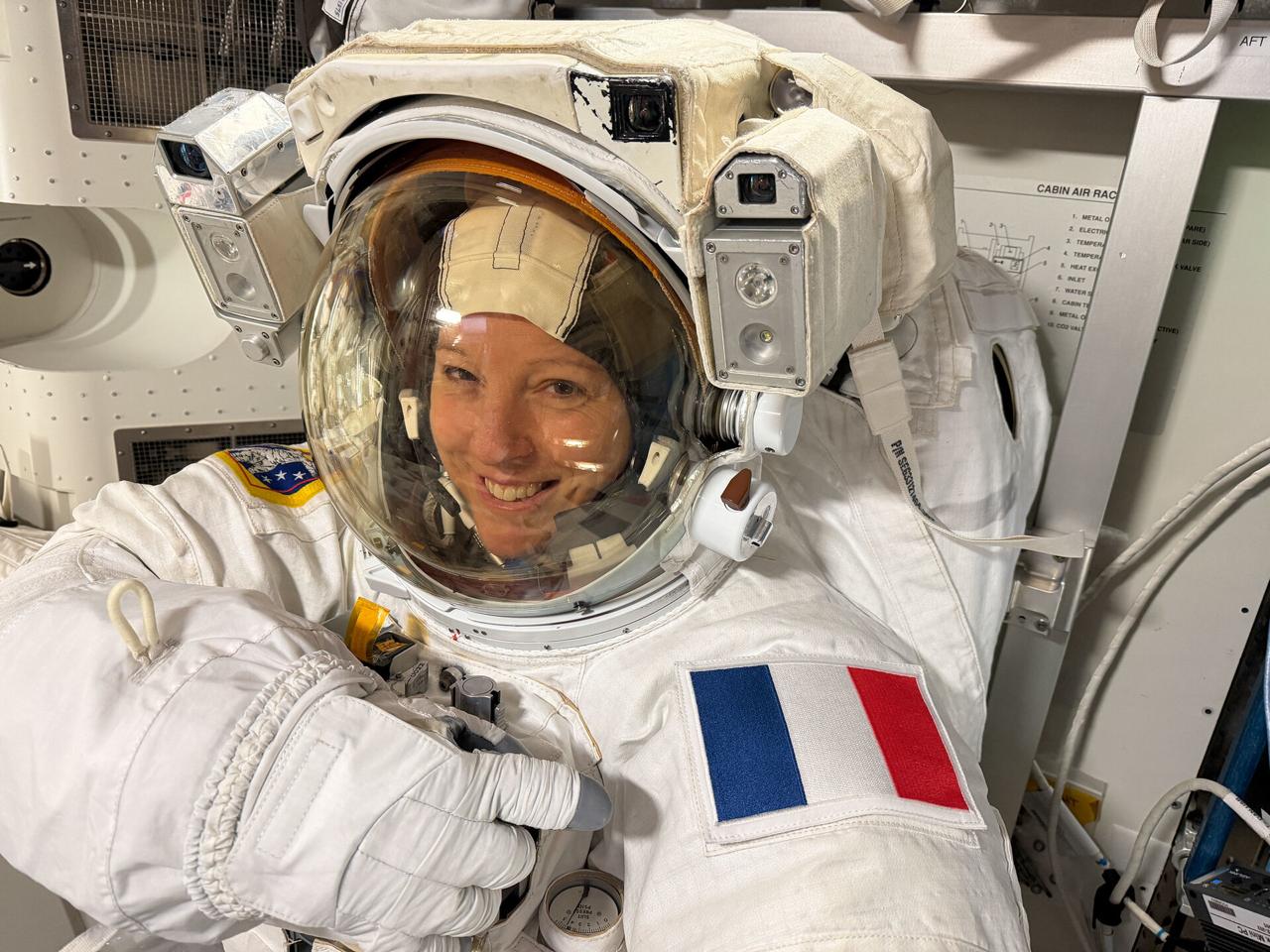
Adenot Makes History in French First as Antenna Swap Runs Out of Clock
ESA astronaut Sophie Adenot became the first French woman to perform a spacewalk on August 18, 2026, removing a failed antenna from the International Space Station alongside NASA astronaut Anil Menon. The six hour, 23 minute excursion accomplished half its objective, with flight controllers deferring the replacement install after cable and bolt work consumed the schedule. The failed unit was a Space-to-Ground antenna, or SGANT, mounted on the station's Z1 truss. Since November it had lost the a
OST Staff · August 19, 2026
ESA astronaut Sophie Adenot became the first French woman to perform a spacewalk on August 18, 2026, removing a failed antenna from the International Space Station alongside NASA astronaut Anil Menon. The six hour, 23 minute excursion accomplished half its objective, with flight controllers deferring the replacement install after cable and bolt work consumed the schedule.
The failed unit was a Space-to-Ground antenna, or SGANT, mounted on the station's Z1 truss. Since November it had lost the ability to track NASA's data-relay satellites, the antenna's core function, leaving it as dead weight. The plan for U.S. Spacewalk 97 was a straightforward swap: remove the failed antenna and bolt on a fresh one. The pair got the old unit off and secured but ran out of time for the install.
The suits switched to battery power at 8:29 a.m. EDT, starting the clock that governs every spacewalk, and the airlock was re-pressurized at 2:52 p.m. EDT. This was the 282nd spacewalk in support of station assembly, maintenance and upgrades, and the second by a European woman after Samantha Cristoforetti in 2022. Adenot is the fifth French citizen to walk in space.
Planners had budgeted about six and a half hours for the full remove-and-replace, so at six hours and 23 minutes the crew was not slow. The work was simply more resistant than expected. As the station account put it, the crew needed more time than expected to disconnect electrical cables and loosen bolts, delaying the install. Mission Control radioed the revised plan: "We are going to go directly to the long-duration tie-down of this SGANT on the Z-1 truss." Communications with Houston never dropped, because a second working antenna carried the high-speed link throughout, making the failed unit a maintenance item rather than an emergency.
Menon was candid about the gap between plan and reality. "We got into this with the mindset that we wanted everything to go perfectly," he said afterward. "Things were a lot different than expected." He credited the preparation for the shortfall. "What I would say that I am really impressed with is that all of those contingencies were well thought out," he said, noting the plan for not finishing existed before anyone knew it would be needed.
Menon framed the deferral as a choice from a menu of options written before launch, not a failure. Securing the hardware and stopping was the designed response when consumables run down and the checklist is incomplete. Adenot kept the focus on the teams behind the mission. "My deepest gratitude goes to everyone who made this possible," she said, "pioneers who came before us, but also the incredible teams working behind the scenes today."
The replacement antenna is expected to go on during the next spacewalk, currently planned for August 25. A working antenna is already carrying the traffic in the meantime, so the cost of the deferral is a second trip outside rather than a degraded station. That follow-up excursion may give Adenot a chance to add to her record.