Shape-Shifting Tensegrity Robots Could One Day Crawl Across the Moon and Mars
Researchers at Colorado State University's Adaptive Robotics Lab have developed a flexible, modular robot that bends like an elephant's trunk and can link up with others to form new shapes. Described in a recent paper in Nature Machine Intelligence, the design borrows a structural principle from architecture, tensegrity, to create a form factor the team believes could eventually navigate the jagged boulders, crevices, and caverns that defeat conventional wheeled rovers. Most space exploration r
OST Staff · November 13, 2026
Researchers at Colorado State University's Adaptive Robotics Lab have developed a flexible, modular robot that bends like an elephant's trunk and can link up with others to form new shapes. Described in a recent paper in Nature Machine Intelligence, the design borrows a structural principle from architecture, tensegrity, to create a form factor the team believes could eventually navigate the jagged boulders, crevices, and caverns that defeat conventional wheeled rovers.
Most space exploration robots rely on wheels or rotors, which perform well on flat terrain but struggle with rough or tight environments. Tensegrity, a term popularized by Buckminster Fuller in the mid-20th century, blends the words tension and integrity. It uses rigid rods that push outward against elastic cables that pull inward, allowing the rods to float on a web of tension rather than depending on heavy metal hinges. NASA has explored the concept for over a decade, notably with the SUPERball, a spherical cage designed to absorb the shocks of high-speed planetary landings without parachutes.
The CSU team calls its creation the Tensegrity-based Continuum Robot, or TeCoBot. The cylindrical robot measures about 587 mm, roughly two feet, and weighs around 600 grams. Its body is built from four stacked icosahedral tensegrity modules forming a continuous flexible backbone, with each module centered on six lightweight rods suspended inside a 3D printed stretchy lattice. Three cables of 40-pound braided fishing wire run through the center, and small motors at the base pull on each to bend the robot in any direction. Pulling all three lines simultaneously allows it to scrunch down to about half its original size.
The robot carries swappable dual mechanical claws at each end. Soft-padded claws can handle delicate cargo, while heavier gripper claws using a worm gear can clamp and hold onto another gripper without draining battery. As a standalone unit, TeCoBot can inch along like a caterpillar, roll sideways, and climb vertically. It also exhibits what roboticists call embodied intelligence, meaning its body naturally yields when bumped without requiring a control system to adjust.
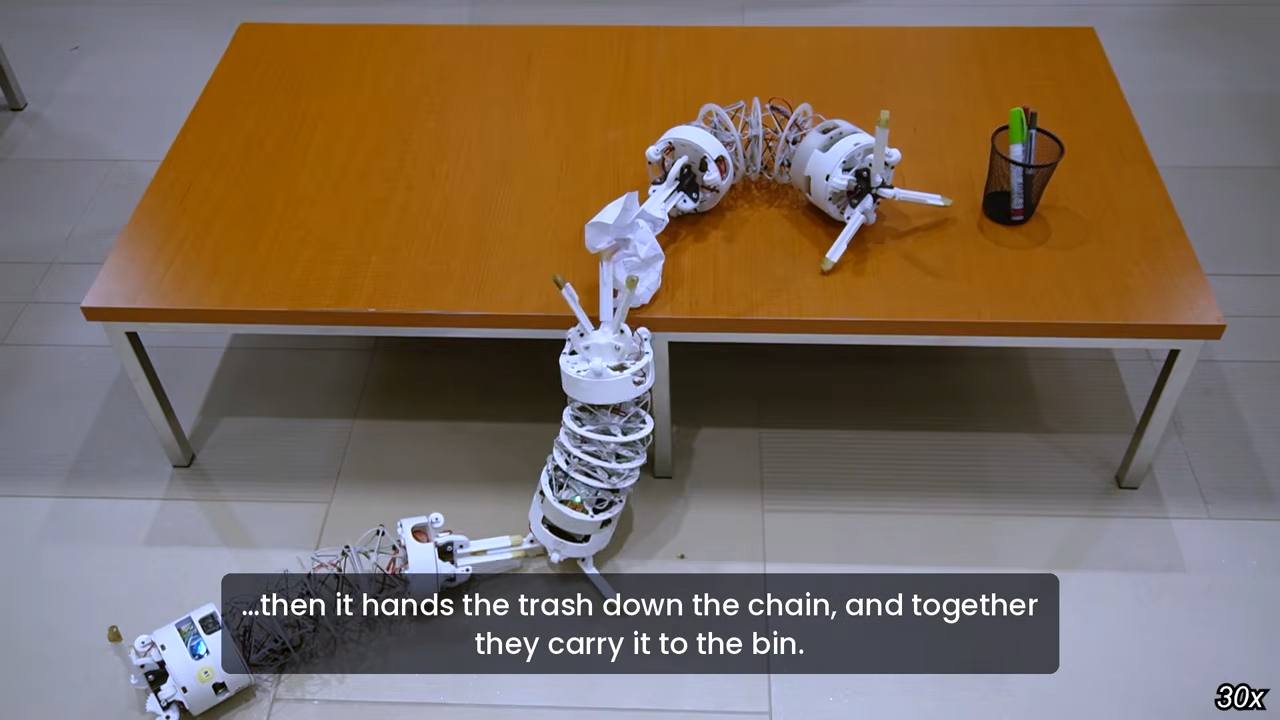
The modularity unlocks additional operating modes. Using their claws to grab one another, three TeCoBots can self-configure into a variety of shapes. The paper describes three robots wrapping around a large pipe, forming an H-shaped walker to crawl through tight spaces, and teaming up to clean off a table.
The researchers say the underlying modularity and adaptability would be useful in the rough craters of the Moon or underground caverns on Mars. The design still faces significant limits. Engineers currently control the robots manually over a WiFi connection, which is not practical for deep space missions.
The team plans to upgrade the motors for faster movement and add swarm intelligence to allow dozens of the modular robots to band together. If that development proceeds as planned, the researchers suggest these elephant trunk styled robots could one day serve as deep space explorers.