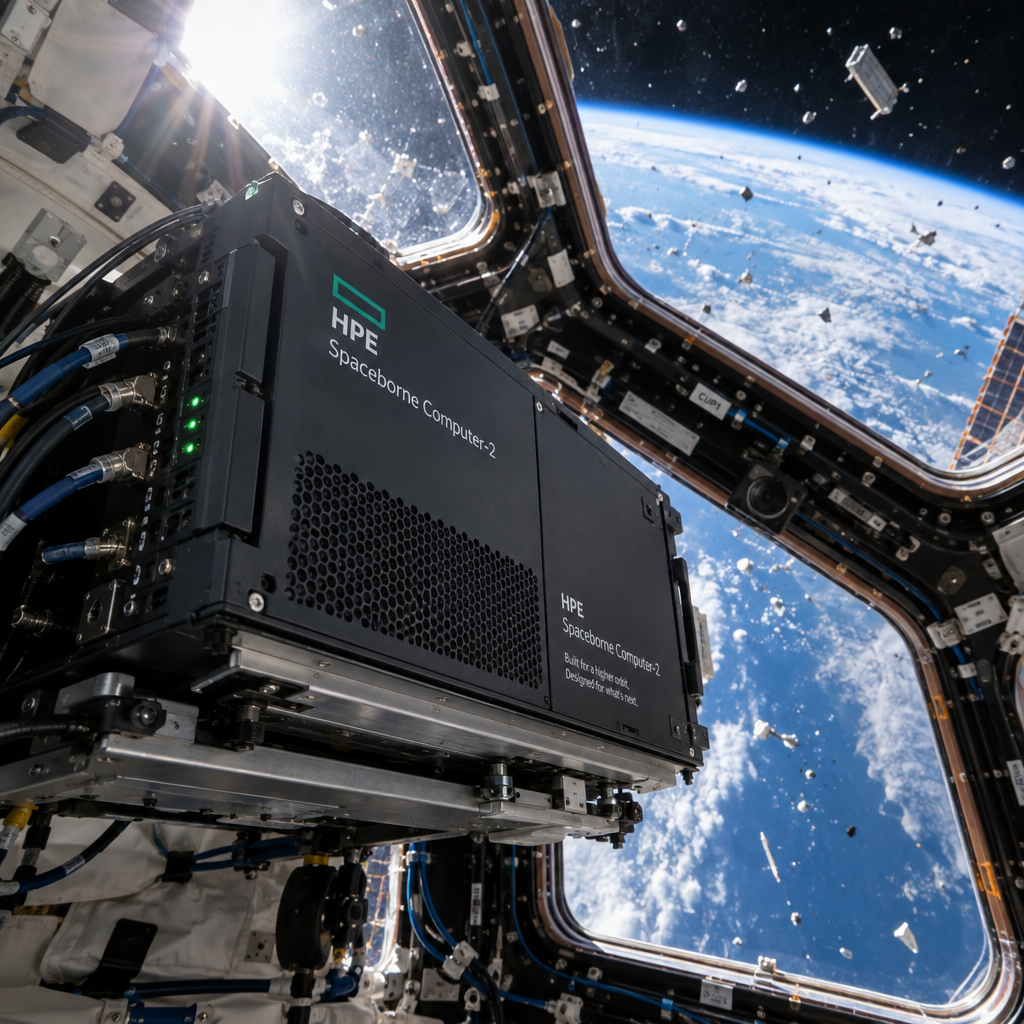
SAP to Run Tabular AI Model on HPE Spaceborne Computer-2 Aboard the ISS
SAP SE will deploy SAP-RPT, its proprietary tabular artificial intelligence foundation model, aboard the International Space Station on Hewlett Packard Enterprise's Spaceborne Computer-2. The orbital mission, slated for implementation by early 2027, will serve as an edge-computing validation testbed for enterprise-grade tabular foundation models operating in low Earth orbit. SAP disclosed the plans in an announcement released Tuesday, Oct. 27. Orbital platforms face substantial operational haza
OST Staff · October 28, 2026
SAP SE will deploy SAP-RPT, its proprietary tabular artificial intelligence foundation model, aboard the International Space Station on Hewlett Packard Enterprise's Spaceborne Computer-2. The orbital mission, slated for implementation by early 2027, will serve as an edge-computing validation testbed for enterprise-grade tabular foundation models operating in low Earth orbit.
SAP disclosed the plans in an announcement released Tuesday, Oct. 27. Orbital platforms face substantial operational hazards, including cosmic radiation, extreme thermal cycles, space debris, and solar storms, while generating massive volumes of operational sensor telemetry. Downlinking raw sensor data to terrestrial stations introduces transmission delays and depends on intermittent communication windows, which restricts real-time emergency intervention.
Running natively on HPE Spaceborne Computer-2, SAP-RPT will analyze telemetry streams directly at the orbital edge. The model is configured to triage sensor anomalies, infer missing telemetry values using historical baselines, predict component failures before escalation, and output automated, explainable health reports for onboard crew members and ground controllers.
Unlike large language models engineered for unstructured language analysis, tabular foundation models are optimized for structured datasets that drive complex physical systems. SAP-RPT functions within SAP's broader TFM architecture, which includes the TabPFN model and SAP AI Core for pipeline orchestration. The payload software operates at approximately 50,000 times greater energy efficiency than contemporary large language models, accommodating strict orbital power envelopes. It generates predictions from multi-variable tabular inputs without requiring on-orbit model training or parameter fine-tuning.
The system also delivers computer and mission risk scores alongside automated indicators assessing whether manual crew intervention is required. "Space is the ultimate stress test for AI," said Mayank Shrivastava, vice president of Generative AI and Foundation Models at SAP SE. "If a foundation model can predict mission-critical failures in orbit, under radiation, energy, and connectivity constraints, imagine what it can do for a global enterprise."
SAP states that findings from the orbital test will be incorporated into its edge-AI framework for disconnected terrestrial applications, including remote logistics, disaster relief, and distributed manufacturing. The mission also aims to establish operational baselines for future space-based data center architectures.
Following the scheduled deployment aboard the ISS in early 2027, SAP will fold the orbital results into its broader edge-AI roadmap. The company has not named additional milestones beyond that early 2027 deployment target.