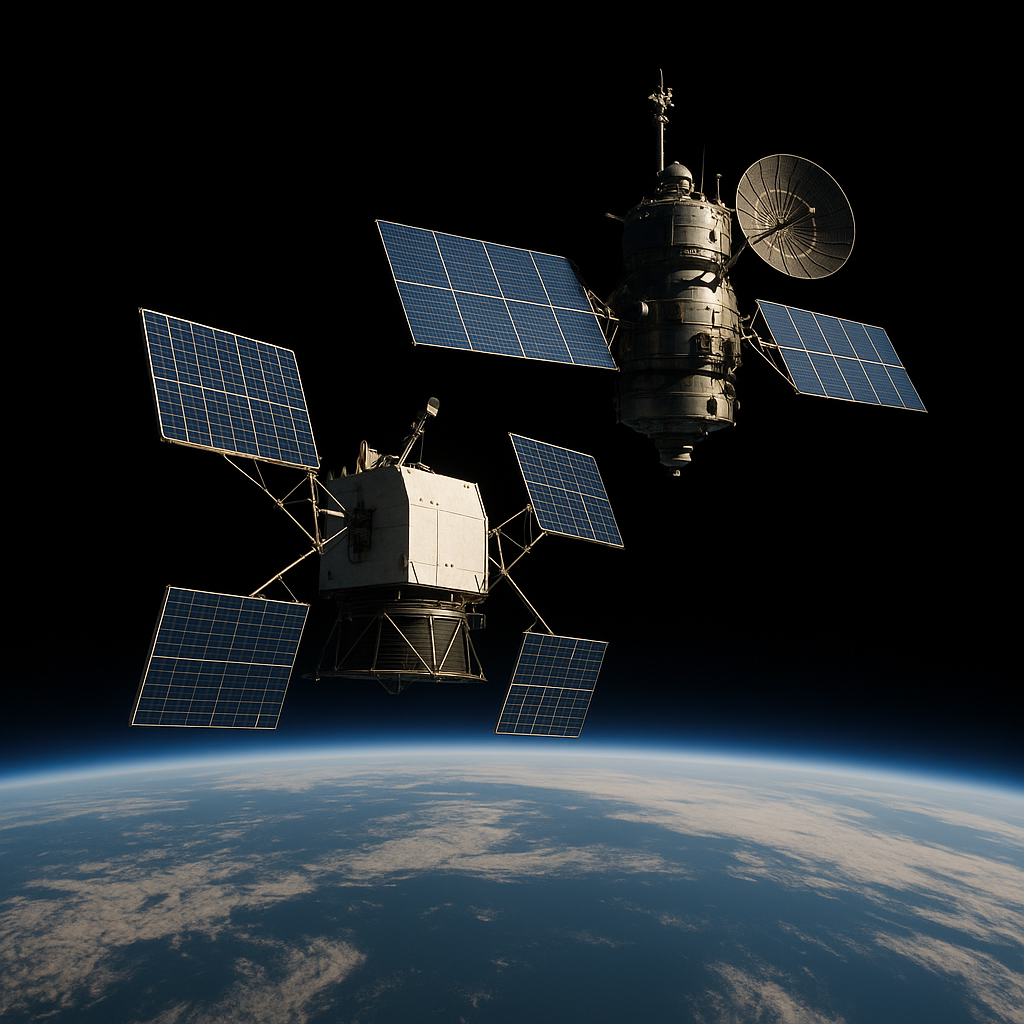
Russian Military Satellite Shadows Finnish ICEYE Radar Craft in Low Earth Orbit
A Russian military satellite, Kosmos 2612, executed a sequence of synchronized orbital maneuvers to shadow ICEYE-X36, a commercial synthetic aperture radar satellite operated by Finnish firm ICEYE, according to space tracking data and defense reports revealed on Saturday, October 17, 2026. The close-proximity pursuit marks an escalation in orbital grey-zone friction, coinciding with recent disclosures by senior U.S. defense officials confirming the operational fielding of space-based defensive c
OST Staff · October 19, 2026
A Russian military satellite, Kosmos 2612, executed a sequence of synchronized orbital maneuvers to shadow ICEYE-X36, a commercial synthetic aperture radar satellite operated by Finnish firm ICEYE, according to space tracking data and defense reports revealed on Saturday, October 17, 2026. The close-proximity pursuit marks an escalation in orbital grey-zone friction, coinciding with recent disclosures by senior U.S. defense officials confirming the operational fielding of space-based defensive control systems.
The rendezvous highlights intensifying pressure on commercial space assets supporting western defense and Ukrainian tactical intelligence. ICEYE-X36 is part of the company's radar-imaging constellation, which provides all-weather radar reconnaissance and expanded operational access under an intelligence cooperation agreement with Ukraine's Ministry of Defence. The maneuvering sequence unfolds as space has become an active warfighting domain.
Publicly disclosed orbital data tracked by commercial space domain awareness providers confirmed that Kosmos 2612, launched in April 2026 from the Plesetsk Cosmodrome, executed repeated propulsion burns beginning in late September to match the orbital plane and inclination of ICEYE-X36. Telemetry released by independent satellite monitors confirmed the Russian inspector vehicle entered an altitude profile almost identical to the target, operating at approximately 557 kilometers compared to ICEYE-X36's 555 kilometers.
The closing maneuver required a velocity change of approximately 27.9 meters per second, narrowing the separation distance between the two spacecraft from several hundred kilometers down to an estimated five kilometers, with subsequent modeling indicating close passes within several hundred meters. Maintaining orbital co-planar alignment consumes significant onboard propellant, signaling a deliberate tasking to monitor the radar satellite's revisit tracks and cross-link frequencies. Neither platform sustained physical damage or orbital disruption.
Defense analysts warn that co-orbital shadowing enables adversarial platforms to conduct close-range electronic inspection, signal interception, or non-kinetic jamming against allied remote sensing networks. The pursuit unfolds amid official acknowledgments that space has become an active warfighting domain. In recent weeks, the U.S. Department of Defense disclosed that the U.S. Space Force has deployed on-orbit space control weapons to defend critical national security satellites from counterspace maneuvers.
As foreign military platforms demonstrate persistent proximity operations against dual-use commercial constellations, western defense commands are accelerating the development of dynamic orbital maneuvering tactics, defensive laser shielding, and responsive space surveillance to deter uncoordinated approaches in low Earth orbit.