Radiation, Not Weightlessness, Drives Lasting Heart Damage in Deep Space Study
Researchers at the Medical College of Wisconsin have found that galactic cosmic radiation can trigger lasting cardiovascular damage, immune suppression, and permanent genetic mutations in rats, with some effects taking the equivalent of decades to appear. The findings, published in PLoS One, help quantify the long-term biological risks astronauts would face on a mission to Mars or elsewhere in deep space. On Earth's surface, the planet protects humans from both radiation and weightlessness, two
OST Staff · October 14, 2026
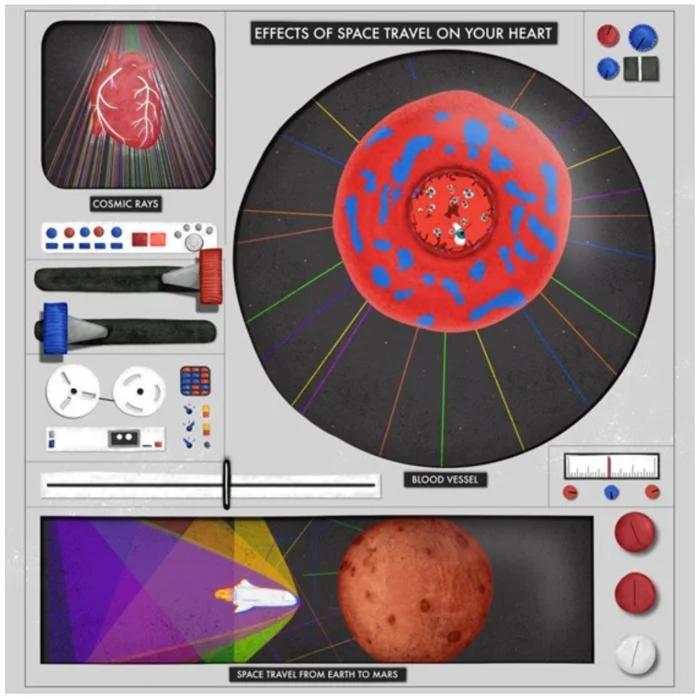
Researchers at the Medical College of Wisconsin have found that galactic cosmic radiation can trigger lasting cardiovascular damage, immune suppression, and permanent genetic mutations in rats, with some effects taking the equivalent of decades to appear. The findings, published in PLoS One, help quantify the long-term biological risks astronauts would face on a mission to Mars or elsewhere in deep space.
On Earth's surface, the planet protects humans from both radiation and weightlessness, two hazards that deep space travelers would confront simultaneously. Scientists already know both can profoundly affect the body, but how severe the impact is and how long it lasts have remained unknown. Because there is no deep space research lab and because running long-term exposure experiments on humans is impractical and unethical, the researchers used rats.
To simulate weightlessness, the team used a NASA protocol called hindlimb unloading, lifting the back legs of middle-aged rats to a 30 degree angle with a harness attached to the tail, shifting bodily fluids toward the head. To recreate radiation, they used NASA's Space Radiation Laboratory at Brookhaven National Laboratory and its five-ion, six-beam cosmic ray simulator, dubbed simGCRsim, which blasts targets with high-speed protons and heavy ions such as silicon and iron. The rats were unloaded for five days, bombarded for a few minutes at levels meant to mimic months of exposure, then suspended for another 25 days. A monitoring period of about a year corresponded to roughly 25 years of human life.
The study produced three primary findings. At a dose of 1.5 Gray, the rats developed perivascular fibrosis, scar tissue wrapping around the coronary vessels. By 270 days after exposure, the scar tissue had doubled in size, squeezing the blood vessels and raising heart attack risk. The weightlessness simulation had essentially no effect on this outcome, which appeared entirely driven by radiation. At a lower dose approximating a three-year Mars mission, heart scarring was not visible immediately, but a year later 83 percent of rats had developed it.
The study also found immune damage. Months after exposure, the rats' spleens had still lost two thirds of their Natural Killer cells, which destroy virus-infected and cancerous cells. Here microgravity and radiation worked in tandem. Rats exposed only to microgravity recovered, but those also hit with radiation showed muted recovery, with cosmic rays appearing to stunt the bone marrow's response to stress. Genome sequencing of white blood cells 235 days after exposure revealed permanent mutations, some tied to Clonal Hematopoiesis of Indeterminate Potential, a condition that increases leukemia risk and quadruples the risk of heart attacks and strokes.
The researchers note the findings are not good news for the future of long-term spaceflight, though likely not surprising to biologists who study these effects. The study helps quantify the types of problems that will eventually have to be dealt with as humans move beyond Earth's protective shell.
The researchers acknowledged limitations. The radiation dose was delivered all at once rather than continuously over months or years, leaving it unclear whether cellular repair mechanisms could keep pace with the effects or whether damage would accrue regardless. The experiment was also run only on male rats, meaning a large portion of the potential astronaut population might respond differently, questions that future work would need to address.