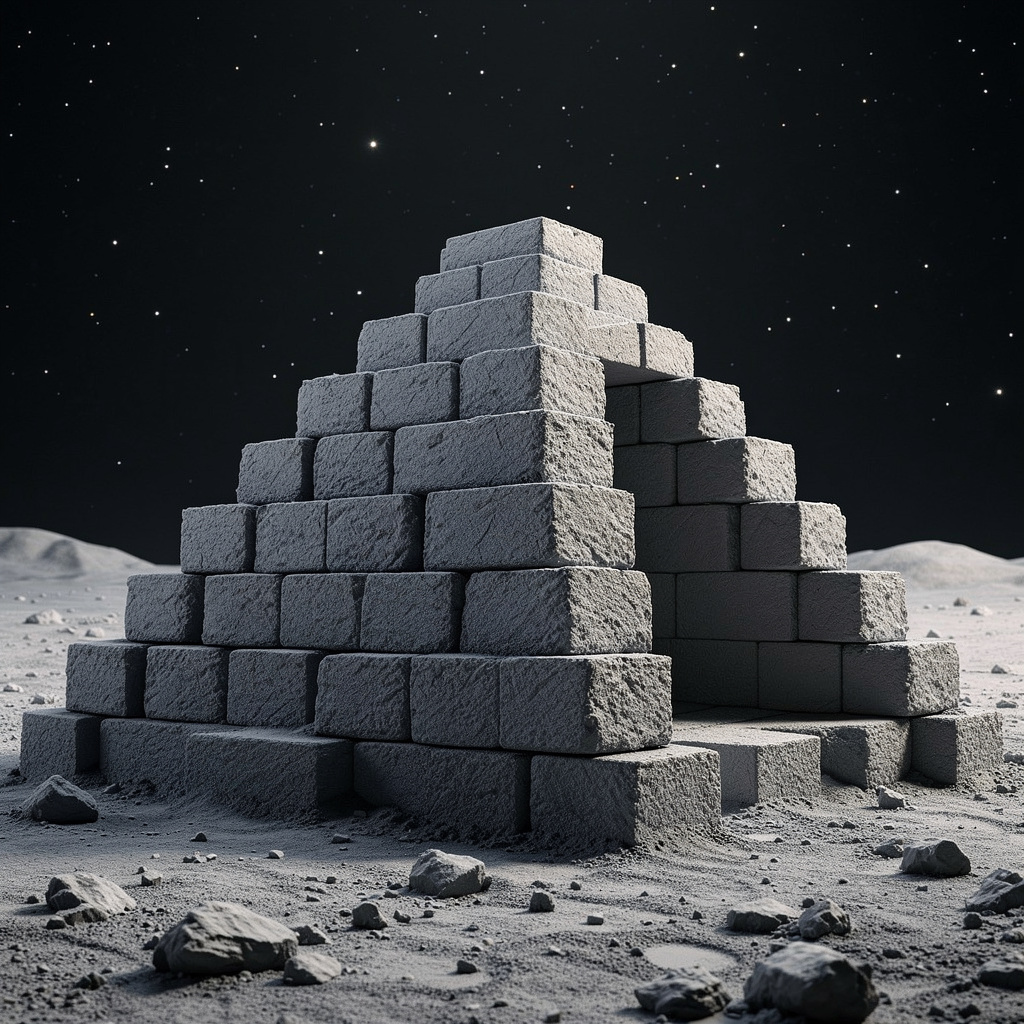
Pyramid Habitat From Lunar Soil Holds Up in Early Structural Tests
A preprint posted October 1 proposes a hollow pyramid assembled from sintered lunar regolith, soil heated into solid blocks, as a possible habitat on the Moon. Early computer simulations found the structure retained integrity even with a block missing, though the work is preliminary and does not demonstrate a functioning habitat. Researchers from RWTH Aachen University and Monash University designed the structure using topological interlocking, a method in which blocks are held together by thei
OST Staff · October 4, 2026
A preprint posted October 1 proposes a hollow pyramid assembled from sintered lunar regolith, soil heated into solid blocks, as a possible habitat on the Moon. Early computer simulations found the structure retained integrity even with a block missing, though the work is preliminary and does not demonstrate a functioning habitat.
Researchers from RWTH Aachen University and Monash University designed the structure using topological interlocking, a method in which blocks are held together by their geometry rather than mortar or connectors. The proposal enters a field that already has government funding and industrial participants, including work under a NASA construction technology effort.
The design contains 361 blocks across three types, with an external base approximately 8.6 metres wide and a height of 6.1 metres. An internal membrane would provide airtightness. In four computer simulations, the researchers tested an intact structure and three configurations each missing one block. All retained structural integrity under the modelled conditions. Maximum vertical displacement increased from approximately 0.07 millimetres to roughly 1.6 millimetres with a block missing.
The model carries a significant qualification. It assumes external loading of 150 kilopascals, proposed to come from covering regolith, against internal air pressure of approximately 81 kilopascals. Radiation protection was not evaluated. The simulations do not establish that the interior would remain pressurised after a structural block is lost.
The broader field includes NASA's Moon to Mars Planetary Autonomous Construction Technology project, known as MMPACT. In November 2022, NASA awarded Texas-based ICON a $57.2 million contract to develop lunar construction technologies, with work extending through 2028. The agency identified landing pads, habitats and roads as potential applications. NASA has described MMPACT's work on robotic construction and testing how regolith behaves under lunar gravity, including comparisons involving Apollo material and terrestrial simulants.
For any lunar building concept, the decisive questions extend beyond whether its walls can carry a load. How much equipment must arrive first, how much power production requires, how quickly robots can prepare a site, manufacture components and complete assembly, and how a crew would inspect and repair the finished structure will determine whether local construction delivers a practical advantage over transporting more of a habitat from Earth. A system that saves imported building material could still demand substantial machinery, energy and maintenance. That creates potential opportunities across excavation, materials processing, autonomous assembly and inspection, and the eventual construction method will need all of those capabilities to work together.
The next milestone to watch is experimental evidence connecting structural models to a repeatable construction process. A convincing lunar building technology will need to demonstrate both a reliable structure and a credible way to build it.