Philadelphia Designer Wins $300,000 in NASA Mars Food System Challenge
NASA announced the winners of the Deep Space Food Challenge: Mars to Table on Thursday, awarding a combined $650,000 to five teams. The top $300,000 prize went to Chinyere Ukeje of Philadelphia for the Adaptive Nourishment Infrastructure, or ANI, a concept for a complete space food system designed to feed astronauts living and working in space. Mars to Table launched in January 2026 as a follow on to the earlier Deep Space Food Challenge, which NASA ran in collaboration with the Canadian Space
OST Staff · September 24, 2026
NASA announced the winners of the Deep Space Food Challenge: Mars to Table on Thursday, awarding a combined $650,000 to five teams. The top $300,000 prize went to Chinyere Ukeje of Philadelphia for the Adaptive Nourishment Infrastructure, or ANI, a concept for a complete space food system designed to feed astronauts living and working in space.
Mars to Table launched in January 2026 as a follow on to the earlier Deep Space Food Challenge, which NASA ran in collaboration with the Canadian Space Agency. The original challenge focused on prototyping novel food production methods. The 2026 competition asked teams to conceptualize space meals not as individual technology components but as a complete food-production system that could offer variety while requiring limited crew time and maintenance.
Astronaut meals are currently almost entirely cooked, packaged, and sent to the International Space Station from the Space Food Systems Laboratory at NASA's Johnson Space Center. A one-way trip to Mars will take at least nine months, so bringing all required meals will not be sustainable. Shelf stability issues and mass restrictions mean pre-packaged foods cannot be the default for future Martian astronauts.
Teams designed systems in response to a mission scenario addressing a 15-person crew for 500 Martian sols, or about 513 Earth days. The challenge focused on surface operations and system integration, and each team delivered a design layout, meal plan, concept of operations, and walkthrough video. NASA judged 113 submissions from teams in 33 countries and 28 U.S. states before selecting five winners.
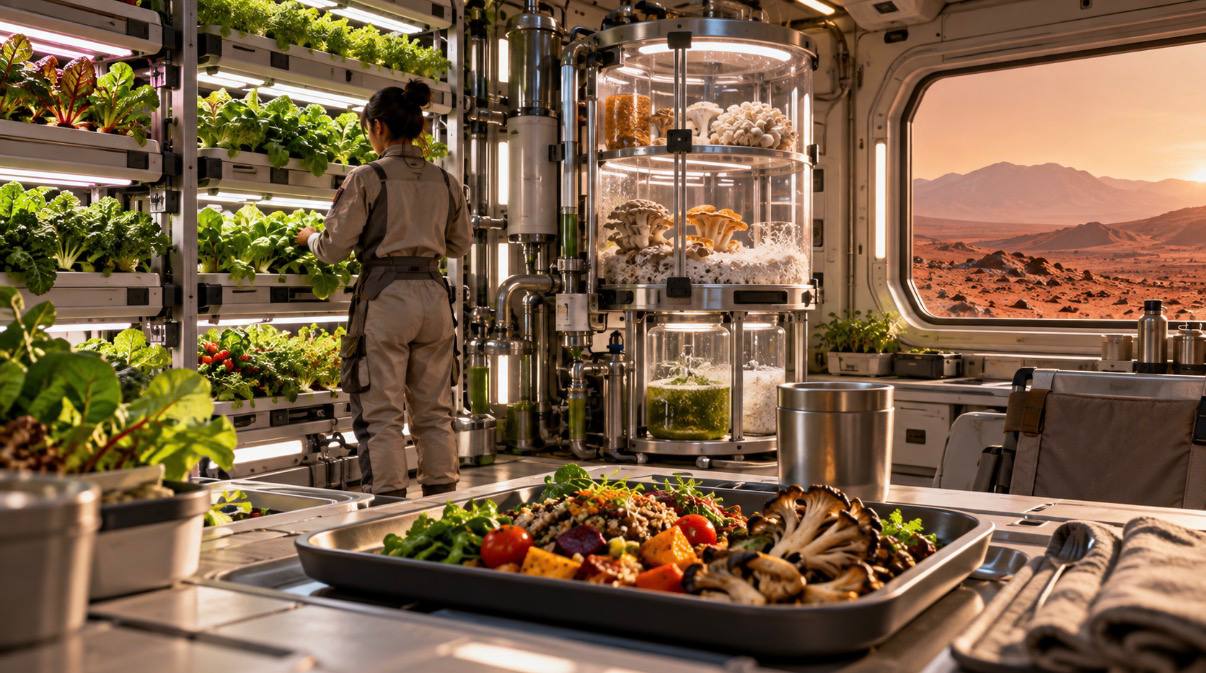
Ukeje's first-place ANI concept is a modular food ecosystem combining controlled-environment agriculture, fermentation and fungi cultivation, and closed-loop nutrient recycling through bioreactors, with limited Earth-provisioned foods to produce 50 percent of the food away from Earth. Named after the Nigerian Earth goddess of harvest and fertility, ANI envisions a system that cooks fresh meals daily and has provisions to work through shortages of power, water, equipment, or crew time. The second-place prize of $200,000 went to Cislune of Rosemead, California for its Fresh, Ferment, Reserve food infrastructure, which grows model-selected crops, converts part of the harvest into familiar foods in instrumented culture cassettes, and uses a protected Earth-loaded reserve to supplement in cases of biological variability, utility curtailment, and rejected batches.
Three additional $50,000 awards went to Ohā Kanu of Hilo, Hawaii for its ahupuaʻa-inspired food system, Orbital Health Systems of Evansville, Indiana for its New Lunar Settlers Cookbook Mars Edition, and Autonomic Resilience Collective of Bentonville, Arkansas for its AEGIS Mars concept. NASA also recognized Astrofood of Ellezelles, Belgium as international winner for its Food Resilience Ecosystem for Space Habitats.
Jennifer Edmunson, program manager for Centennial Challenges at NASA's Marshall Space Flight Center, said the agency was thrilled to keep advancing the future of space food systems. Head judge Dr. Alexander Meyers said the criteria were intentionally challenging and that every new idea presented represents a possible new tool in NASA's plans for the future of space exploration. NASA described the winning technologies as inspirational launching pads for future deep space food systems.
The challenge is managed at NASA Marshall by Centennial Challenges, part of the Prizes, Challenges, and Crowdsourcing Program within NASA's Research and Technology Mission Directorate. Further information is available at go.nasa.gov/marstotable.