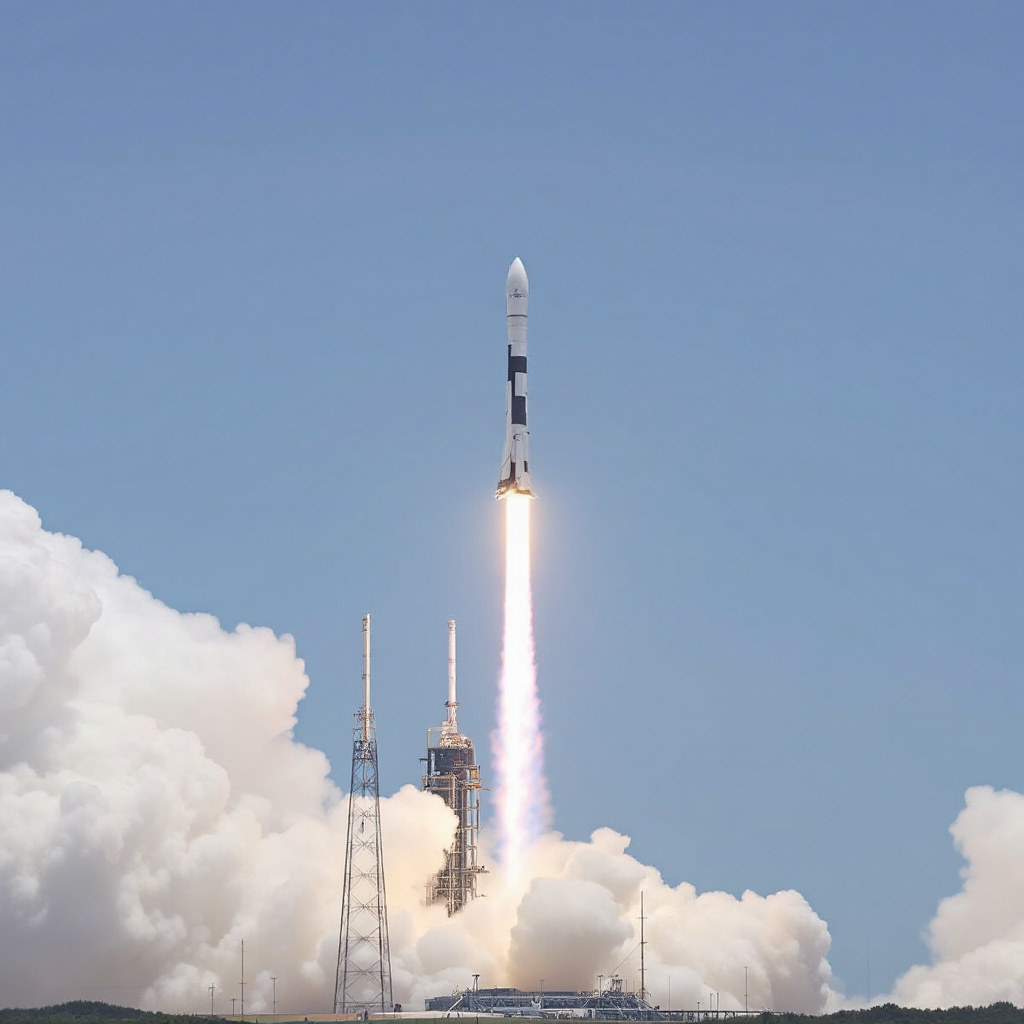
Nuri Achieves First On-Time Liftoff, Deploys All 15 Satellites on Fifth Flight
South Korea's homegrown Nuri launch vehicle reached its target orbit and separated all 15 payload satellites on its fifth spaceflight, launching from the Naro Space Center in Goheung on October 7. All flight procedures and engine burns proceeded normally, and for the first time the rocket lifted off at a preconfirmed launch time. The Korea AeroSpace Administration and the Korea Aerospace Research Institute released the results at the mission control center of the Naro Space Center at 1 p.m. tha
OST Staff · October 7, 2026
South Korea's homegrown Nuri launch vehicle reached its target orbit and separated all 15 payload satellites on its fifth spaceflight, launching from the Naro Space Center in Goheung on October 7. All flight procedures and engine burns proceeded normally, and for the first time the rocket lifted off at a preconfirmed launch time.
The Korea AeroSpace Administration and the Korea Aerospace Research Institute released the results at the mission control center of the Naro Space Center at 1 p.m. that day. A launch management committee convened at 8 a.m. reviewed technical readiness, weather, the space environment, and the possibility of collision with space objects before fixing the launch time at 12:25 p.m.
Nuri lifted off at 12:25 p.m. from Launch Pad 2. In the morning, it completed loading kerosene as fuel and liquid oxygen as oxidizer. At 11:55 a.m. the erector was retracted, and at 12:15 p.m. the vehicle entered prelaunch operations, automatically carrying out final checks and engine ignition. Oh Tae-seok, head of KASA, said at a briefing that this was the first time Nuri was launched at the scheduled time, and that each stage's engine burn occurred as planned, reaching the target orbit.
After liftoff, Nuri separated the first stage and jettisoned the fairing after surpassing an altitude of 200 kilometers, then separated the second stage and continued flight on the third-stage engine. Near the target altitude of about 575 kilometers, it separated five primary payload satellites, Micro-satellite Constellation 2 through 6, one by one at intervals of several tens of seconds. Nuri's upper stage adjusted its attitude during deployment to prevent collisions among the satellites. Ten CubeSats developed by domestic corporations, universities, and research institutes were then deployed in pairs. Under the original flight plan, the final CubeSat separation was designed to occur about 17 minutes after liftoff.
This fifth launch was Nuri's first mission to carry five primary payload satellites at once and separate them in sequence. In last year's fourth launch, it carried one primary payload satellite, Next-generation Medium Satellite 3, and 12 CubeSats. Micro-satellite Constellation 2 through 6 are Earth observation satellites developed by the KAIST Satellite Technology Research Center, enabling more frequent imaging of the same area for disaster monitoring and national land observation. The 10 CubeSats will perform missions including Earth and space environment observation, in-orbit performance verification of domestically made components, and demonstrations of optical communication technology.
With this flight wrapping up normally, the likelihood has grown that Nuri will extend its streak of consecutive successes to four since the second launch in 2022. Nuri failed to insert a dummy satellite into the target orbit on its first launch in 2021 but succeeded on the second launch in 2022, the third in 2023, and the fourth last year. KASA said that, based on flight data secured so far, the satellite separation procedures were carried out as planned.
However, a launch vehicle separating a satellite and the satellite operating normally in space are separate matters. Additional confirmation is needed to determine whether the separated satellites are communicating with ground stations and deploying their solar panels. KASA and KARI planned to hold a briefing at 2 p.m. to announce detailed results, including target orbit insertion and satellite separation, and to release the initial communication results for Micro-satellite Constellation 2 through 6 at 4:30 p.m.