NASA's Twin Venus Missions Regain Momentum, DAVINCI Moves Up a Year
NASA's two Venus-bound missions, DAVINCI and VERITAS, are back on track after budget pressures threatened to cancel one and delay the other. DAVINCI will now launch in December 2030, a year earlier than previously planned, while VERITAS is scheduled for November 2032. The revival marks a turnaround for a scientific community whose exploration priorities have been sidelined for decades. The developments were announced last week at a meeting of the Venus Exploration Analysis Group, a gathering of
OST Staff · October 14, 2026
NASA's two Venus-bound missions, DAVINCI and VERITAS, are back on track after budget pressures threatened to cancel one and delay the other. DAVINCI will now launch in December 2030, a year earlier than previously planned, while VERITAS is scheduled for November 2032. The revival marks a turnaround for a scientific community whose exploration priorities have been sidelined for decades.
The developments were announced last week at a meeting of the Venus Exploration Analysis Group, a gathering of scientists focused on the planet. None of the current progress was guaranteed. Budget cuts imperiled one US mission to Venus and delayed the other, then forced NASA to pull out of a partnership with Europe to supply a key part for the European Space Agency's Envision orbiter. The money problems largely stemmed from delays and cost overruns on the Psyche mission, NASA's first spacecraft to explore a metal asteroid.
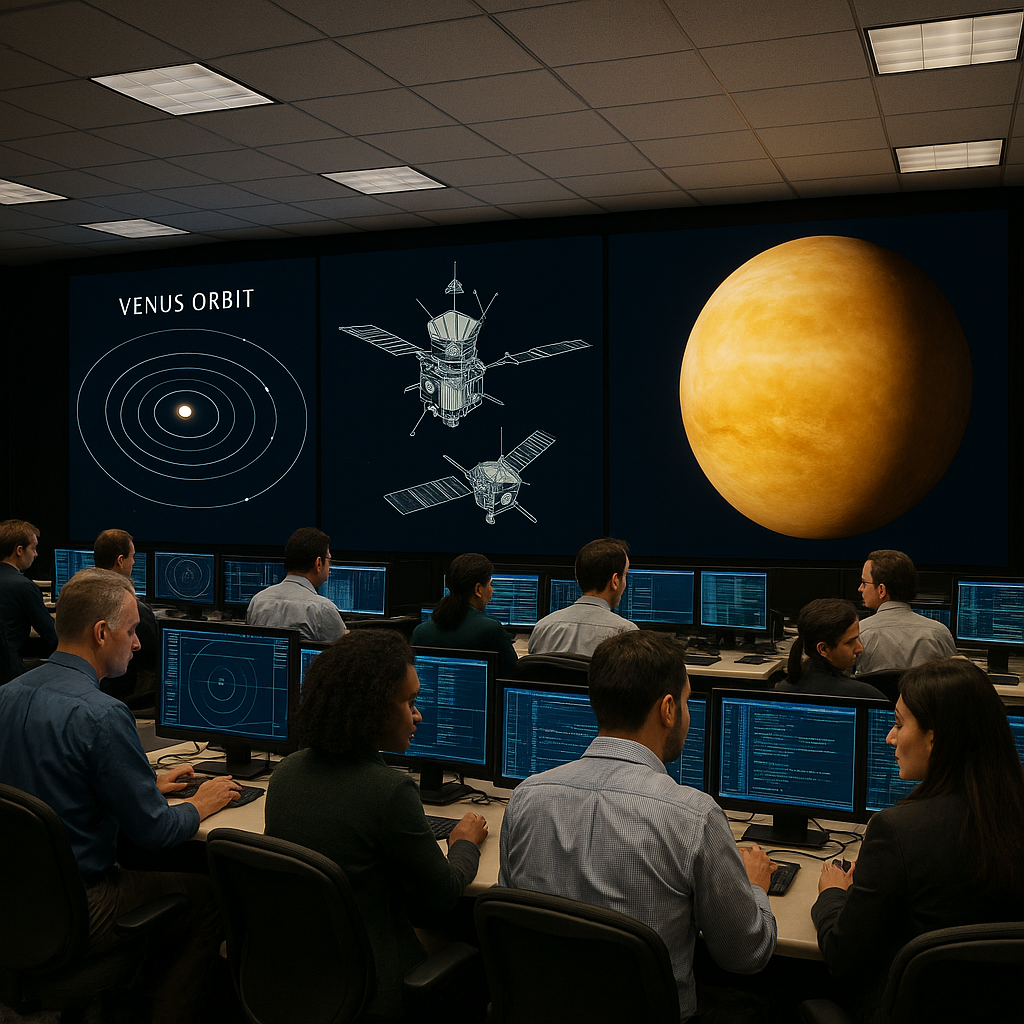
DAVINCI, the Deep Atmosphere Venus Investigation of Noble gases, Chemistry, and Imaging, will send a parachute-assisted descent probe through the Venusian atmosphere, returning the first direct images of the planet's surface since 1982. VERITAS, the Venus Emissivity, Radio science, InSAR, Topography, And Spectroscopy mission, will map the surface by radar from orbit, building on the legacy of the Magellan mission with a much better radar and a particular focus on regions with active volcanoes. The European Space Agency's Envision orbiter is also set to launch to Venus in 2032. A privately funded Rocket Lab probe aims to launch as soon as late 2027 to search for signs of organic material in the planet's high-altitude clouds.
"We have some good news for Venus," said Jim Garvin, a planetary scientist at NASA's Goddard Space Flight Center and principal investigator for DAVINCI. VERITAS stayed alive but just barely after NASA officials considered canceling it amid budget pressures. At the same time, NASA's Jet Propulsion Laboratory struggled through layoffs and the cancellation of the Mars Sample Return mission. Nick Lang, a program scientist in NASA's planetary science division, confirmed that NASA pulled out of its agreement to provide a radar instrument for Envision, citing budget limitations. "That decision was not an easy one," Lang said. ESA is now moving ahead with a European-built radar for Envision.
Ending support for Envision and canceling Mars Sample Return freed up enough funding for NASA to move forward with DAVINCI and VERITAS, and in some cases to buy back past delays. Garvin credited encouragement in early 2026 from NASA Headquarters and the Planetary Science Division. "This is our new scenario for the most cost-effective and science-effective launch to Venus," he said. "What we've done now is accelerated launch by 54 weeks to a case where we have a very low delta-V trajectory that gets off the ground in late December 2030." The low delta-V trajectory is an important qualifier for the mission's revised plan.
NASA's planetary science budget remains under pressure. The Trump administration has twice proposed deep cuts to planetary science. Congress restored most of the funding for fiscal year 2026 and is expected to do the same in the 2027 budget.