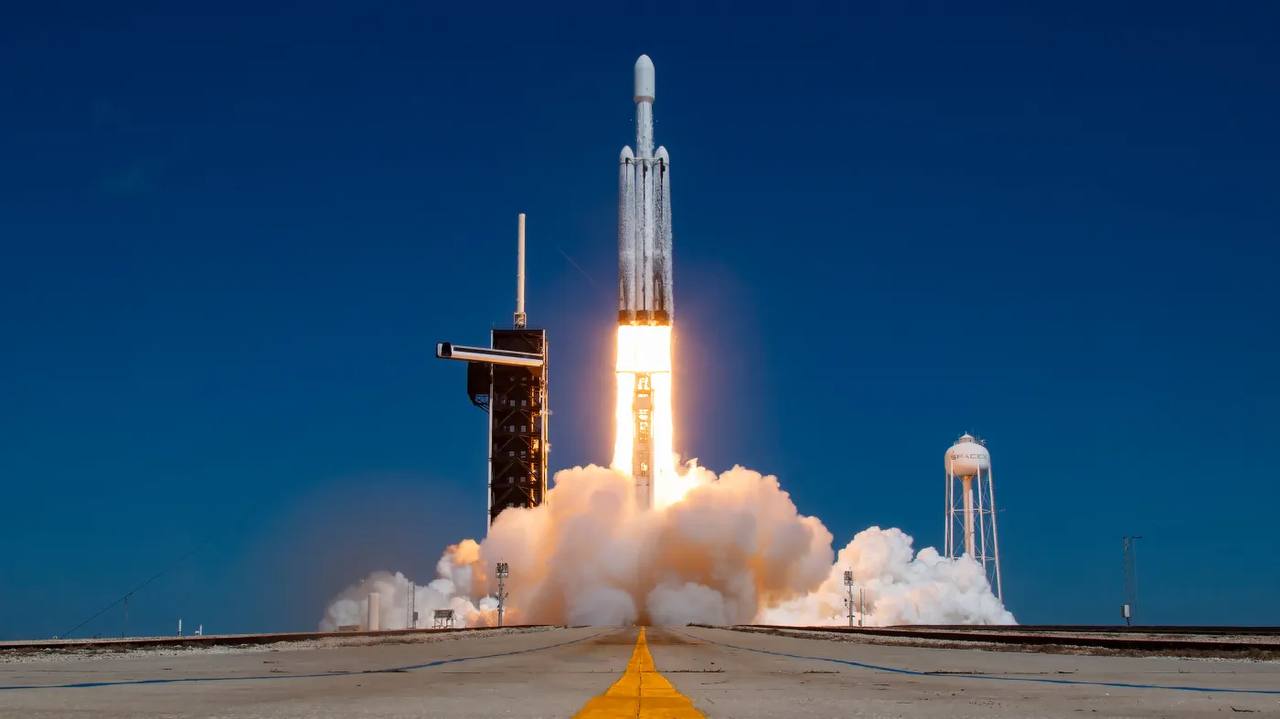
NASA's Roman Space Telescope Lifts Off on Falcon Heavy for Survey of Two Billion Galaxies
NASA's Nancy Grace Roman Space Telescope launched Sunday, August 30, from the Kennedy Space Center in Florida aboard a SpaceX Falcon Heavy rocket. The $4.3 billion observatory is bound for a point 1.5 million kilometers from Earth, where it will begin a five to ten year science mission mapping more than two billion galaxies and probing the nature of dark energy and dark matter. Roman is NASA's next flagship observatory after the James Webb Space Telescope, and its arrival at the launch pad foll
OST Staff · August 30, 2026
NASA's Nancy Grace Roman Space Telescope launched Sunday, August 30, from the Kennedy Space Center in Florida aboard a SpaceX Falcon Heavy rocket. The $4.3 billion observatory is bound for a point 1.5 million kilometers from Earth, where it will begin a five to ten year science mission mapping more than two billion galaxies and probing the nature of dark energy and dark matter.
Roman is NASA's next flagship observatory after the James Webb Space Telescope, and its arrival at the launch pad followed proposed budget cuts that the mission survived. Its wide field camera covers vastly more sky per observation than Hubble or Webb, opening a new mode of survey science aimed at the dark energy and dark matter that together make up roughly 95 percent of the universe's mass energy budget.
Falcon Heavy lifted off from Launch Complex 39A carrying the observatory toward the Sun Earth Lagrange Point 2. The rocket's two side boosters returned to land at Cape Canaveral Space Force Station landing zones, while the center core was not recovered to give the vehicle enough performance to loft the telescope. Roman will spend roughly a month cruising to its destination, a period the telescope team will use to commission the observatory and prepare it for science observations.
The observatory carries a 300 megapixel camera, the largest ever sent to that orbit. It is expected to generate about 1.4 terabytes of compressed sky data per day, accumulating an estimated 20 petabytes over the mission lifetime. The telescope will use two instruments, the Wide Field Instrument and the Coronagraph Instrument, to search for exoplanets, study dark energy, and observe other astrophysical phenomena.
The mission is named after Nancy Grace Roman, known as the Mother of Hubble, who was told as a young woman that women could not be scientists. Roman will spend more than a quarter of its observing time staring at the Milky Way's densest star fields in a hunt for rocky exoplanets.
The launch on a Falcon Heavy cements SpaceX as the default ride for NASA's biggest science missions, and the successful liftoff marks a notable institutional win for NASA's science directorate after the observatory survived proposed budget cuts before reaching the pad. Roman's wide field camera opens a new mode of cosmological survey science by capturing far more sky per observation than either Hubble or Webb.
With launch complete, Roman now begins its roughly month long cruise to Lagrange Point 2, where commissioning and calibration will precede the start of its primary survey mission mapping more than two billion galaxies.