PUNCH Mission Pins Solar Storm Arrival to Within 30 Minutes in First Test
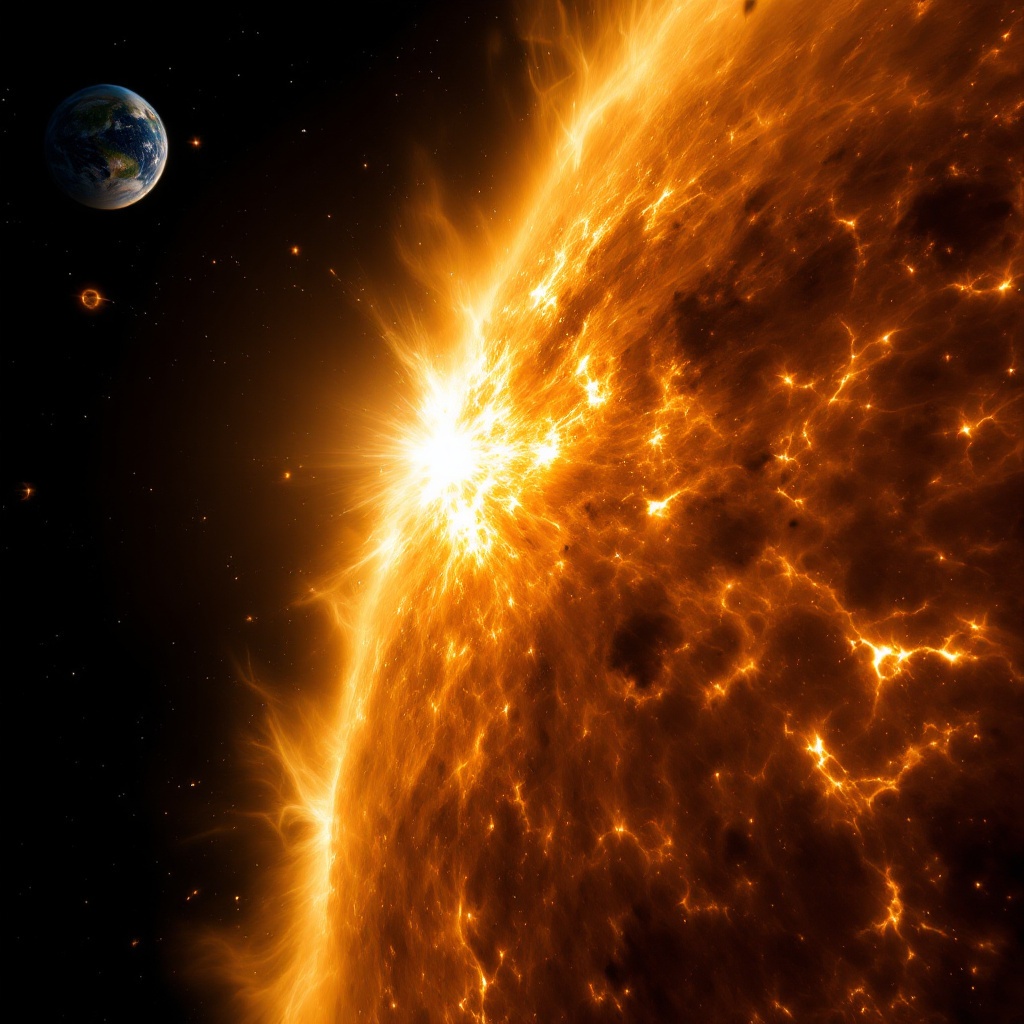
NASA's PUNCH mission has predicted the near-Earth arrival of a solar eruption to within 30 minutes in an initial proof of concept test, using continuous imagery of the inner solar system. The results, presented Tuesday at the Committee on Space Research Scientific Meeting and under review at the journal Space Weather, point to a significant advance in how Earth-impacting storms are forecast. Solar storms are caused by coronal mass ejections, huge explosions of material off the Sun. Predicting w
OST Staff · August 4, 2026
NASA's PUNCH mission has predicted the near-Earth arrival of a solar eruption to within 30 minutes in an initial proof of concept test, using continuous imagery of the inner solar system. The results, presented Tuesday at the Committee on Space Research Scientific Meeting and under review at the journal Space Weather, point to a significant advance in how Earth-impacting storms are forecast.
Solar storms are caused by coronal mass ejections, huge explosions of material off the Sun. Predicting when these ejections reach Earth is central to limiting their effects on power grids, satellites, and astronauts. Until recently, coronal mass ejections could not be tracked continuously across much of their journey. Before PUNCH, they could only be observed as they traveled one-fifth of the way from the Sun to Earth, leaving scientists to estimate what happened over the remaining distance.
PUNCH, short for Polarimeter to Unify the Corona and Heliosphere, launched in 2025 and uses four spacecraft in low Earth orbit to make continuous 3D observations of the inner solar system. Its wider field of view allows scientists to track solar explosions nearly all the way to Earth, capturing a new image every four minutes.
Scientists tested the forecasting capability using a coronal mass ejection that left the Sun on May 31, 2025. They input PUNCH images into a computer model, which analyzed the leading edge of the ejection over time and used its speed and geometry to calculate when it would reach Earth. Twelve hours after the ejection left the Sun, the model settled on a final prediction showing the storm would arrive eight hours later. That predicted arrival time proved accurate to within a half hour, making it 10 times better than current methods, which provide only a 5-hour window. The model also revealed when the estimate had stabilized, allowing a forecaster to predict the arrival time with confidence.
"We thought PUNCH would be good at this, but it's a stunning result," said Craig DeForest, principal investigator for PUNCH at Southwest Research Institute's Solar System Science and Exploration Division in Boulder, Colorado. "To put it in perspective, this could be the space weather equivalent of going from a steam engine to a modern internal combustion engine." DeForest added that the team "accomplished an order of magnitude better result than the state-of-the-art method with a really basic process, just informed by the fact that the coronal mass ejection could be tracked continuously across the solar system."
The results demonstrate the power of PUNCH's wide-field imagery to track solar events as they travel out from the Sun. The high-resolution images also allowed scientists to see new structures in coronal mass ejections, revealing that the clouds of material are clumpier than previously thought and continue to evolve as they cross the solar system. The data is helping scientists better understand how plasma moves across space, which can inform how astrophysicists study plasma behavior across the galaxy, such as in star-forming regions.
Scientists think that with more refined PUNCH data and better models, they could forecast coronal mass ejection arrival times even further in advance. Southwest Research Institute, based in San Antonio, leads the mission and operates the four spacecraft from its facilities in Boulder. The mission is managed by Space Science Mission Operations at NASA's Goddard Space Flight Center in Greenbelt, Maryland, for the Science Mission Directorate at the agency's headquarters in Washington.