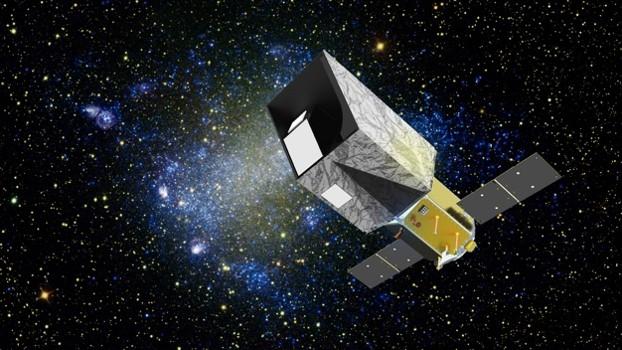
NASA Sets 2031 Launch for UVEX, First New UV Space Telescope in Two Decades
NASA has committed to launching UVEX, the UltraViolet EXplorer, in 2031, a mission that will conduct the first deep-sky all-sky survey in ultraviolet light. The telescope will be roughly 100 times more sensitive than GALEX, its predecessor, whose mission ended in 2013. UVEX will fill a long-standing gap in ultraviolet sky coverage and complement surveys by other major observatories. The mission, led by Caltech, is designed to work alongside the Nancy Grace Roman Space Telescope, the Vera Rubin
OST Staff · October 29, 2026
NASA has committed to launching UVEX, the UltraViolet EXplorer, in 2031, a mission that will conduct the first deep-sky all-sky survey in ultraviolet light. The telescope will be roughly 100 times more sensitive than GALEX, its predecessor, whose mission ended in 2013. UVEX will fill a long-standing gap in ultraviolet sky coverage and complement surveys by other major observatories.
The mission, led by Caltech, is designed to work alongside the Nancy Grace Roman Space Telescope, the Vera Rubin Observatory, and ESA's Euclid Space Telescope. Those missions survey the sky in infrared and visible light. UVEX will add the ultraviolet piece, producing deep, two-band data in near and far-ultraviolet to build a multiwavelength picture of the sky. It is the first new UV telescope in 20 years and the first UV mission to create deep-sky maps in that wavelength.
Over a two-year baseline mission, UVEX will perform a multi-cadence all-sky survey 50 to 100 times deeper than GALEX in the near and far-ultraviolet, along with cadenced surveys of the Large and Small Magellanic Clouds, rapid target of opportunity followup, and spectroscopic followup of samples of stars and galaxies. The mission rests on three pillars. First, it will study low-mass, low-metallicity galaxies, a population that contains half of the Universe's mass and serves as an analog for the Universe's first galaxies. Second, it will probe the dynamic universe through time-domain surveys and prompt spectroscopic followup, observing the aftermaths of compact object mergers, hot fast UV transients, and the early stages of stellar explosions. Third, it will generate a large open UV dataset for the research community.
UVEX will observe nearby low-mass galaxies that are bright in ultraviolet, complementing infrared observations from the James Webb Space Telescope and the Roman telescope, which see the red-shifted light of similar galaxies billions of light years away. The telescope will also follow up on gravitational-wave events. "With UVEX, we will now be able to follow up on gravitational-wave events in ultraviolet light," said Mansi Kasliwal, a professor of astronomy at Caltech and director of the Palomar Observatory. Caltech President Ray Jayawardhana called the mission "a bold leap forward in our exploration of the ultraviolet universe." Team member Kareem El-Badry added, "Every time you look at the skies in a new wavelength, you learn something new and unexpected."
The mission's significance lies in its ability to see transient and calamitous events that are too dim or invisible in optical light. Explosions, stellar mergers, and tidal disruption events will become visible as never before. With its extreme sensitivity and spectroscope, UVEX will discern different wavelengths of light from distant objects, clarifying which chemical elements are present. It will combine steady surveying with the ability to quickly point at transient events and watch them unfold.
What remains to be seen is whether the 2031 date holds through the coming years. The firm launch commitment is a program milestone at a time when NASA science budgets are under pressure, and the real test is whether the schedule survives further budget decisions before launch.