IXPE Observations of a Magnetar May Capture a 90-Year-Old Quantum Prediction
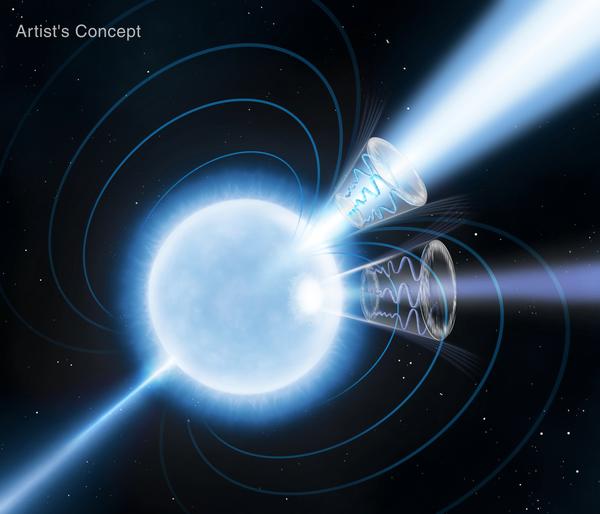
Scientists using NASA's Imaging X-ray Polarimetry Explorer may have observed empty space behaving in a way physicists predicted nearly 90 years ago but had never directly seen. The findings, drawn from more than 140 hours of observations of the magnetar 1E 1547-5408 and published in Nature, point to a phenomenon called vacuum birefringence. Vacuum birefringence was first predicted by Werner Heisenberg in the 1930s. The idea holds that even a perfect vacuum is filled with virtual particles that
OST Staff · August 6, 2026
Scientists using NASA's Imaging X-ray Polarimetry Explorer may have observed empty space behaving in a way physicists predicted nearly 90 years ago but had never directly seen. The findings, drawn from more than 140 hours of observations of the magnetar 1E 1547-5408 and published in Nature, point to a phenomenon called vacuum birefringence.
Vacuum birefringence was first predicted by Werner Heisenberg in the 1930s. The idea holds that even a perfect vacuum is filled with virtual particles that alter the behavior of light. For nearly a century it has remained one of the most stubbornly unconfirmed predictions in quantum electrodynamics, with no direct observational evidence.
The IXPE telescope trained its instruments on the magnetar 1E 1547-5408 across more than 140 hours of observation time. Magnetars, with their extreme magnetic environments, serve as natural laboratories for testing effects that cannot be reproduced in a conventional experimental setting. The team used the observatory's X-ray polarimetry capability to probe how light behaved in that environment.
The results were published in Nature and represent what would be the first direct observational evidence of vacuum birefringence if confirmed. The researchers describe the data as having "may have proven" the effect rather than confirmed it, a distinction that leaves the finding open to further scrutiny.
Using a magnetar as a natural laboratory to test vacuum birefringence demonstrates the scientific value of X-ray polarimetry as a tool and validates the core purpose of the IXPE mission. If confirmed, the result would rank as one of the most significant experimental physics results in years, closing a gap that has persisted since Heisenberg first set out the prediction.
The physics community will spend the coming months stress-testing the data before the finding can be treated as settled. Until that scrutiny is complete, the result stands as a possible confirmation rather than a proven one.