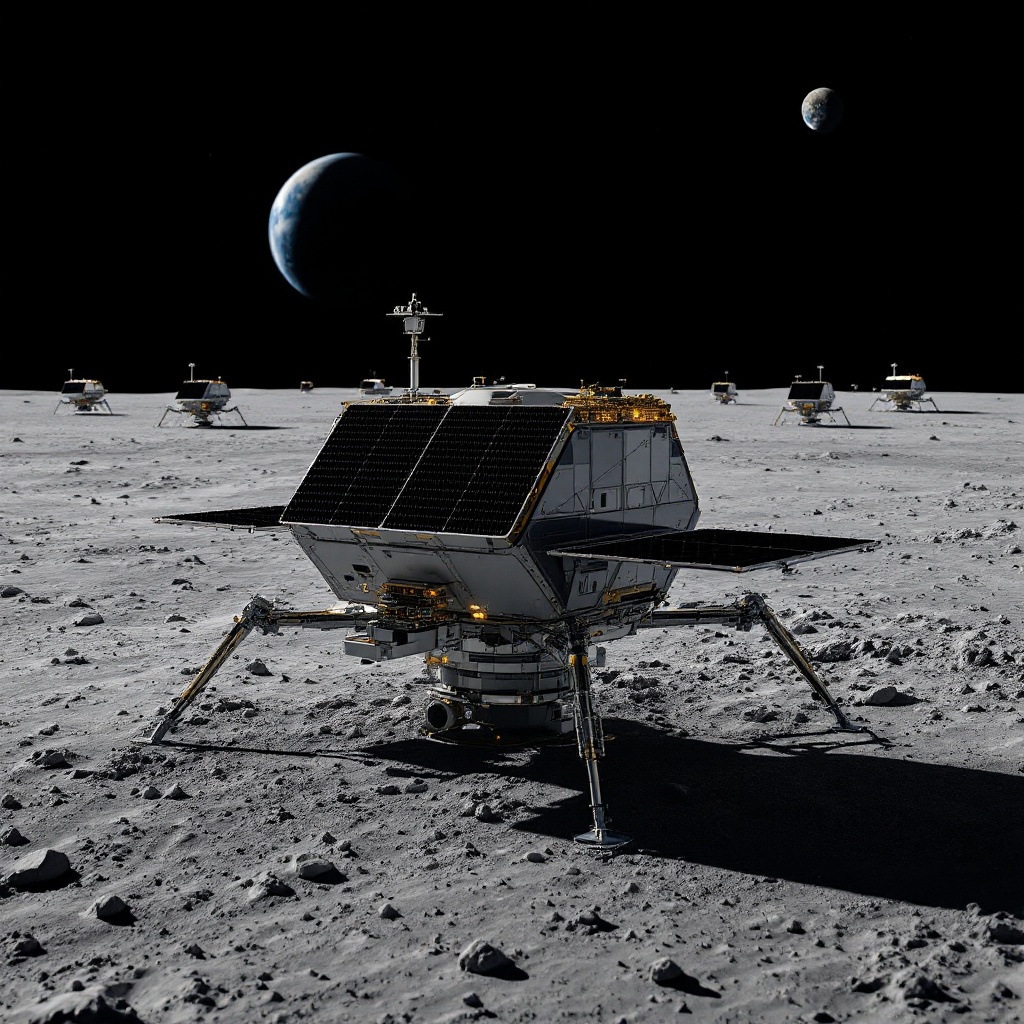
Four Commercial Landers Race Toward 2028 Cargo Deliveries for NASA's Moon Base
NASA confirmed on August 4, 2026, that Blue Origin, Firefly Aerospace, Intuitive Machines, and Voyager Lunar Systems are working to deliver cargo landers to the lunar surface by 2028 in support of its Moon Base program. The landers will deliver the foundational architecture for a sustained outpost near the Moon's South Pole intended for science, technology, and eventual human operations. Phase I of the Moon Base architecture plan runs from now through 2029 and includes more than twenty robotic
OST Staff · August 4, 2026
NASA confirmed on August 4, 2026, that Blue Origin, Firefly Aerospace, Intuitive Machines, and Voyager Lunar Systems are working to deliver cargo landers to the lunar surface by 2028 in support of its Moon Base program. The landers will deliver the foundational architecture for a sustained outpost near the Moon's South Pole intended for science, technology, and eventual human operations.
Phase I of the Moon Base architecture plan runs from now through 2029 and includes more than twenty robotic landings, each designed to incrementally advance system capabilities and validate components for missions that follow. Before astronauts arrive, robotic missions will deploy scientific instruments to characterize the lunar environment, test new technologies, and begin assembling infrastructure for human habitation. Recurring deliveries under NASA's Commercial Lunar Payload Services initiative are intended to build a dependable lunar supply chain.
Blue Origin's Blue Moon MK1 lander, on a first mission named Endurance, completed an extensive environmental test campaign including a thermal vacuum assessment at NASA's Johnson Space Center. Its structure, propulsion elements, and avionics are fully assembled, and it completed communications checkouts with NASA's Tracking and Data Relay Satellite System and the Deep Space Network. Cryogenic propellants will be loaded as one of the final tests before launch integration.
Firefly's Blue Ghost Mission 2 builds on its first lunar landing with a dual-spacecraft configuration for far side operations. Blue Ghost is stacked on top of Firefly's Elytra orbital spacecraft, forming a 22-foot-tall system nearly three times the height of the vehicle flown for Blue Ghost Mission 1 in 2025. Planned as the first American landing on the Moon's far side, the mission carries three NASA payloads and will study far side geology and the cosmic Dark Ages.
Intuitive Machines' IM-3 mission, with a Nova-C lander named Trinity, introduces Altus-1, the company's first lunar data-relay satellite. The lander recently completed long-range thermal vacuum testing at NASA's Marshall Space Center to confirm its sensors operate accurately across the thermal range expected during lunar descent. Engine integration and hot fire tests are next. IM-3 will deliver five NASA payloads plus six commercial and one civil payload to the surface, along with Altus-1 and its three payloads, and will be the first mission to explore a lunar swirl, at Reiner Gamma's geomagnetic environment.
Voyager Technologies' Griffin-1, an infrastructure-class lander, is undergoing testing at NASA's Jet Propulsion Laboratory. Planned to launch in late 2026, it will transport the largest commercial payload ever delivered to the lunar surface, with five NASA payloads mounted on the Astrolab FLIP rover. Griffin-1 recently completed mass properties testing and will undergo additional environmental tests before returning to Voyager's Pittsburgh facility for final assembly and shipment to Cape Canaveral.
NASA is also working with Northrop Grumman to develop three technology demonstration payloads for the lunar surface, building on power and avionics hardware developed for the Gateway program's HALO module. That hardware is being repurposed following NASA's shift from an orbital-focused lunar strategy to one centered on surface operations.
The progress of these four companies represents major advances in commercial lunar delivery and lays the groundwork for the systems and surface capabilities the Moon Base will rely on, according to NASA.
What comes next includes cryogenic propellant loading for Blue Origin's Endurance, engine integration and hot fire tests for Intuitive Machines' Trinity, continued environmental testing for Voyager's Griffin-1 ahead of a late 2026 launch, and the more than twenty robotic landings planned through 2029.