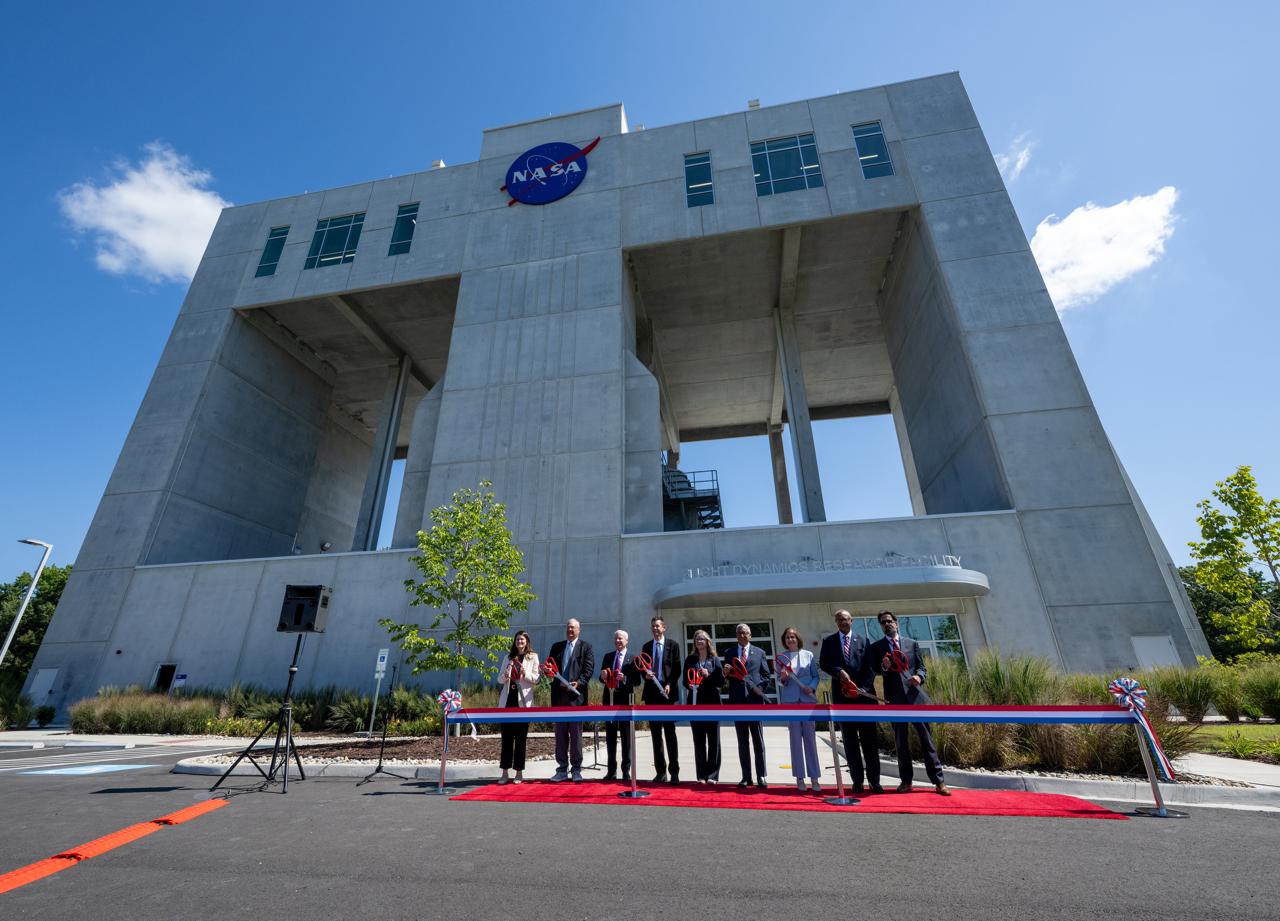
NASA Opens First Major New Wind Tunnel in More Than 40 Years at Langley
NASA opened its Flight Dynamics Research Facility at Langley Research Center in Hampton, Virginia, on Friday, marking the agency's first major new wind tunnel in more than four decades. The facility will test the safety and performance of future aircraft, rockets, and space exploration vehicles for NASA and its partners. The new facility combines and improves upon the capabilities of two historic NASA Langley wind tunnels, the 20-Foot Vertical Spin Tunnel and the 12-Foot Low-Speed Tunnel. It wa
OST Staff · July 31, 2026
NASA opened its Flight Dynamics Research Facility at Langley Research Center in Hampton, Virginia, on Friday, marking the agency's first major new wind tunnel in more than four decades. The facility will test the safety and performance of future aircraft, rockets, and space exploration vehicles for NASA and its partners.
The new facility combines and improves upon the capabilities of two historic NASA Langley wind tunnels, the 20-Foot Vertical Spin Tunnel and the 12-Foot Low-Speed Tunnel. It was built through a partnership with the U.S. General Services Administration and replaces aging infrastructure with an energy-efficient design that reduces maintenance costs. It is the fourth new building GSA has delivered to NASA under Langley's 20-year campus revitalization plan.
The 25,000-square-foot building features a vertical wind tunnel with improved airflow, modern digital systems, and flexible testing capabilities. Its 20-foot diameter test chamber is larger than those of its predecessors, allowing more air to pass around test models and improving data accuracy while accommodating larger, more detailed models. The facility's top airspeed of 117 miles per hour is twice that of the older facilities, enabling free-flight tests of heavier scale models and simulations of full-scale vehicles at higher altitudes. Its wind power comes from four 750-horsepower motors, each with an integrated 14-foot diameter, eight-bladed carbon fiber fan that enables rapid, precise airspeed adjustments during free-flight tests.
The facility will support both free-flight and mounted testing of a wide range of scale-model vehicles, from airplanes to space capsules returning to Earth. It will advance work on aircraft safety, X-plane development, drone research, and spacecraft technology, including autonomous flight vehicles and commercial and military aircraft.
"The Flight Dynamics Research Facility is NASA's first major new wind tunnel in more than 40 years and gives us a powerful new platform to test the ideas and technologies that will shape the future of aviation and exploration," said NASA Administrator Jared Isaacman. "America has led in air and space because we were willing to take on hard problems, challenge assumptions, and build what didn't exist before."
Dr. Trina Dyal, NASA Langley center director, said the facility "represents a significant advancement for NASA and for the nation. By bringing modernized testing capabilities under one roof, we are enabling transformative research that will ensure the United States remains at the forefront of aeronautics and exploration." GSA Administrator Edward C. Forst said the facility "will power the next generation of American dominance in aeronautics and space exploration."
As NASA prepares for a sustained human presence on the lunar surface through the Artemis program and the development of a Moon Base, the facility will help test vehicle designs for entry, descent, and landing to reduce mission risk and support the safe return of crews to Earth. NASA also expects to use the wind tunnel to help design aircraft for Mars and other destinations where atmospheric flight is possible.
The facility is managed under the Aerosciences Evaluation and Test Capabilities portfolio in the Aeronautics Division of NASA's Research and Technology Mission Directorate. NASA leaders, partners, and Virginia officials attended the ribbon-cutting ceremony marking the opening.