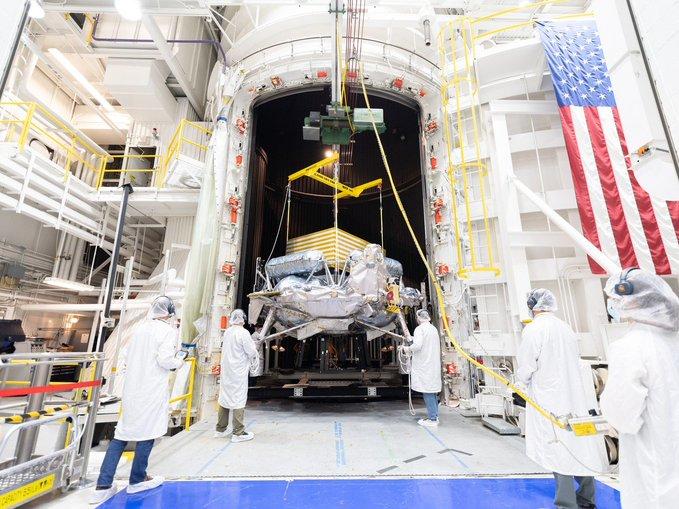
Griffin-1 Lunar Lander Clears Environmental Testing at NASA JPL
Voyager Technologies' Griffin Mission One lander has passed a series of critical environmental tests at NASA's Jet Propulsion Laboratory in Southern California, simulating the extreme temperatures and vacuum of space along with the shaking and roar of launch. NASA says the results show the spacecraft is ready to survive the rigors of space exploration ahead of a launch to the Moon later this year. Griffin-1 is part of NASA's Commercial Lunar Payload Services initiative within the Moon Base Prog
OST Staff · October 13, 2026
Voyager Technologies' Griffin Mission One lander has passed a series of critical environmental tests at NASA's Jet Propulsion Laboratory in Southern California, simulating the extreme temperatures and vacuum of space along with the shaking and roar of launch. NASA says the results show the spacecraft is ready to survive the rigors of space exploration ahead of a launch to the Moon later this year.
Griffin-1 is part of NASA's Commercial Lunar Payload Services initiative within the Moon Base Program, which aims to establish humanity's first lunar outpost. The lander is expected to launch aboard a SpaceX Falcon Heavy rocket and deliver more than 1,100 pounds, or 455 kilograms, of cargo to Nobile Crater near the lunar South Pole, a payload capacity that categorizes it as an infrastructure-class lander. It will carry 10 science and technology demonstrations from six countries, including Astrolab's FLEX Lunar Innovation Platform rover, described as the largest commercial payload ever delivered to the Moon.
Testing began in July after the 2,789-pound spacecraft traveled from Voyager Lunar Systems' manufacturing facilities in Pittsburgh to JPL. Engineers first spun the lander on a special table to measure its mass properties and check for unexpected wobbles, data key to understanding navigation in flight and landing on the lunar surface. Griffin-1 then underwent electromagnetic interference and electromagnetic compatibility testing inside an anechoic chamber lined with foam spikes that absorb sound and electromagnetic waves.
During vibration testing, hundreds of sensors monitored Griffin-1 as a shaker table rattled it in three directions with increasing force to simulate the ride out of Earth's atmosphere. To mimic the roar of launch, horns powered by compressed nitrogen gas blasted the spacecraft with up to 153 decibels inside a sealed acoustic chamber. Testing culminated in the 25-Foot Space Simulator, a thermal vacuum chamber listed on the National Register of Historic Places for its role supporting the Ranger, Surveyor, Mariner, and Voyager programs. There, for about two weeks, Griffin-1 alternately baked at up to 167 degrees Fahrenheit and froze at temperatures as low as minus 148 degrees Fahrenheit.
"Griffin-1 is being built for a historic purpose: to deliver the infrastructure and capabilities to the Moon," said John Thornton, executive vice president at Voyager. "Seeing the spacecraft complete this demanding environmental testing is a major milestone because it demonstrates that Griffin-1 is ready for the extreme journey ahead: launch, through deep space, to the lunar South Pole." He added that the mission is helping lay the groundwork for the Moon Base and turn sustained lunar exploration into reality.
Charles Whetsel, manager of the Exploration Systems Development Office at JPL, said the facility has been testing robotic explorers since the Ranger program delivered NASA's first close-up views of the lunar surface in the mid-1960s. "We're proud to provide our expertise and facilities to support this new phase of commercial lunar exploration," he said. NASA describes Griffin-1 as central to its efforts to establish a lunar outpost, making the completion of environmental qualification a real step toward flight.
Griffin-1 has returned to Voyager Lunar Systems' facility for final assembly. Next up are launch-readiness operations before the spacecraft ships to Cape Canaveral for a launch later this year.