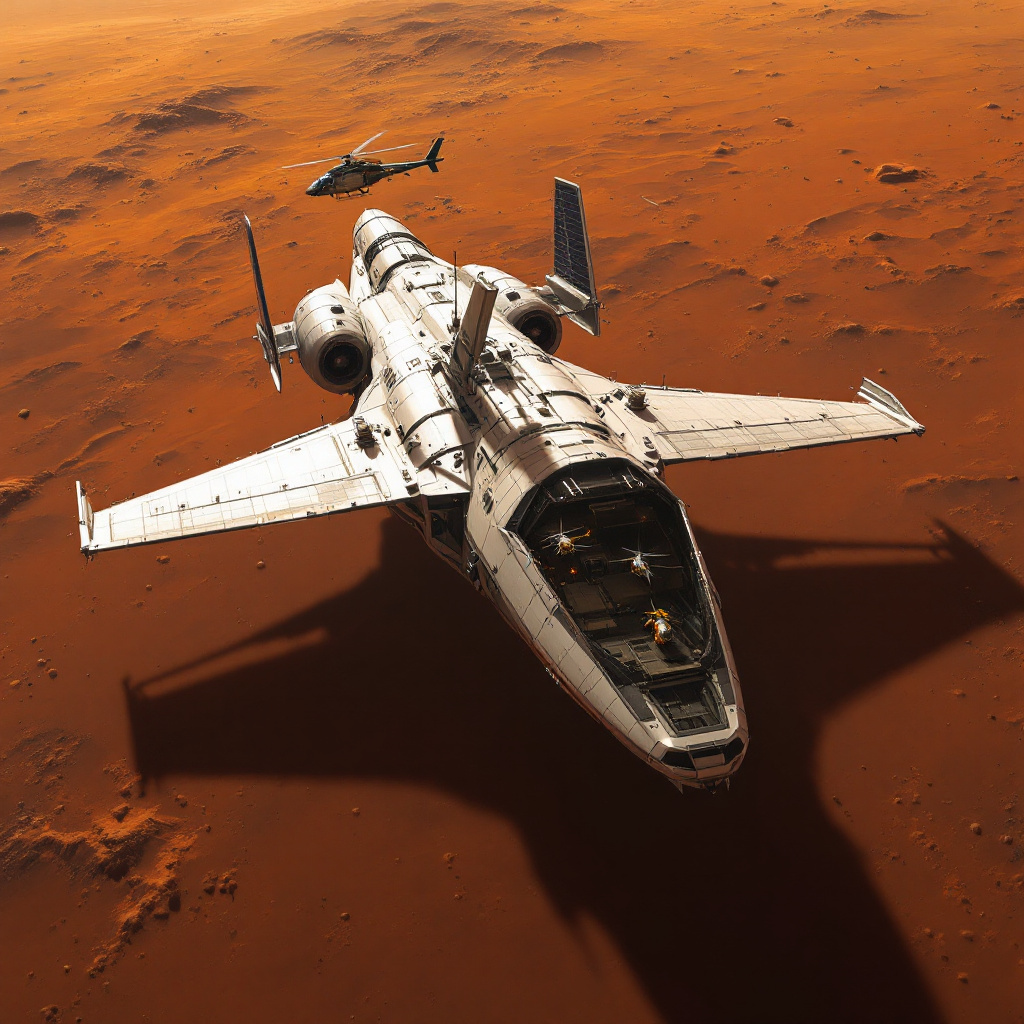
NASA Glenn Advances SR-1 Freedom, Billed as First Nuclear Fission-Powered Interplanetary Spacecraft
NASA Glenn Research Center in Cleveland is playing a key role in developing Space Reactor-1 Freedom, described as the first nuclear fission-powered interplanetary spacecraft. The vehicle is designed to travel to Mars and deliver a payload of three helicopters, then remain in space for testing of its nuclear power module. The project builds on NASA's prior work in nuclear power, which the agency has funded over many years. NASA Administrator Jared Isaacman framed SR-1 as a cost-conscious effort
OST Staff · August 29, 2026
NASA Glenn Research Center in Cleveland is playing a key role in developing Space Reactor-1 Freedom, described as the first nuclear fission-powered interplanetary spacecraft. The vehicle is designed to travel to Mars and deliver a payload of three helicopters, then remain in space for testing of its nuclear power module.
The project builds on NASA's prior work in nuclear power, which the agency has funded over many years. NASA Administrator Jared Isaacman framed SR-1 as a cost-conscious effort rather than an expansive new program. "Our nuclear program, SR-1, is not about going and, you know, lobbying for billions of dollars to undertake a grand new mission," Isaacman said during a March press conference. "Honestly, we have to earn the right to be able to do that after $20 billion worth of failed programs over time." He said SR-1 will draw on lessons learned to remain cost-effective for taxpayers.
Lindsay Kaldon, who works at NASA Glenn, is the project manager for SR-1 Freedom's nuclear power module. "I get so excited about it," Kaldon said. "And I hope, and I think it rubs off on other people. They get excited about it too."
Kaldon explained the rationale for nuclear power on deep space missions. "Now, we could have solar panels in space, absolutely," she said. "But when you travel further and further away from the sun, for example, those deep space missions, and you go on to Mars and you go out to Jupiter and other planets, you start losing the ability to have effective solar panels." She said one challenge in building the spacecraft is ensuring cargo and electronics are shielded from radiation. "At some point we may have humans that were transiting, and so we want to make sure we have another shielding on there to protect them and everything in between," Kaldon said.
A Falcon Heavy rocket will probably deliver SR-1 to space no earlier than 2028. The spacecraft will then travel to Mars, where it will deliver the Skyfall payload. "Skyfall is a set of three ingenuity-class helicopters that will be released on the surface of Mars, and they will fly around and survey Mars," Kaldon said. "They are going to be looking for potential habitation spots, things like that." After delivering the payload, SR-1 will remain in space, where NASA plans to run remote tests on its nuclear power module.
A nuclear-fission powered spacecraft would pave the way for longer, more ambitious space missions, enabling travel further from the sun where solar power becomes ineffective, as Kaldon described.
The next milestones named are the planned Falcon Heavy launch no earlier than 2028, the transit to Mars to deploy the Skyfall helicopters, and the subsequent remote testing of the nuclear power module while SR-1 remains in space.