NASA Ends 22-Year Swift Mission After Private Rescue Spacecraft Fails to Boost Orbit
NASA has officially ended the mission of its Neil Gehrels Swift Observatory after a private spacecraft failed in its attempt to raise the aging telescope's orbit. The agency announced the conclusion on Friday, October 23, stating that Swift is expected to reenter Earth's atmosphere "in the next few weeks." NASA had hoped to extend Swift's life. In September 2025, the agency awarded a $30 million contract to the Arizona company Katalyst Space Technologies to rescue the observatory, which was fal
OST Staff · October 26, 2026
NASA has officially ended the mission of its Neil Gehrels Swift Observatory after a private spacecraft failed in its attempt to raise the aging telescope's orbit. The agency announced the conclusion on Friday, October 23, stating that Swift is expected to reenter Earth's atmosphere "in the next few weeks."
NASA had hoped to extend Swift's life. In September 2025, the agency awarded a $30 million contract to the Arizona company Katalyst Space Technologies to rescue the observatory, which was falling back to Earth due to atmospheric drag. Swift has no thrusters capable of counteracting that drag, so Katalyst built a refrigerator-sized spacecraft called LINK, designed to rendezvous with Swift, grapple it with three robotic arms, and boost it to a higher orbit so it could continue its science work.
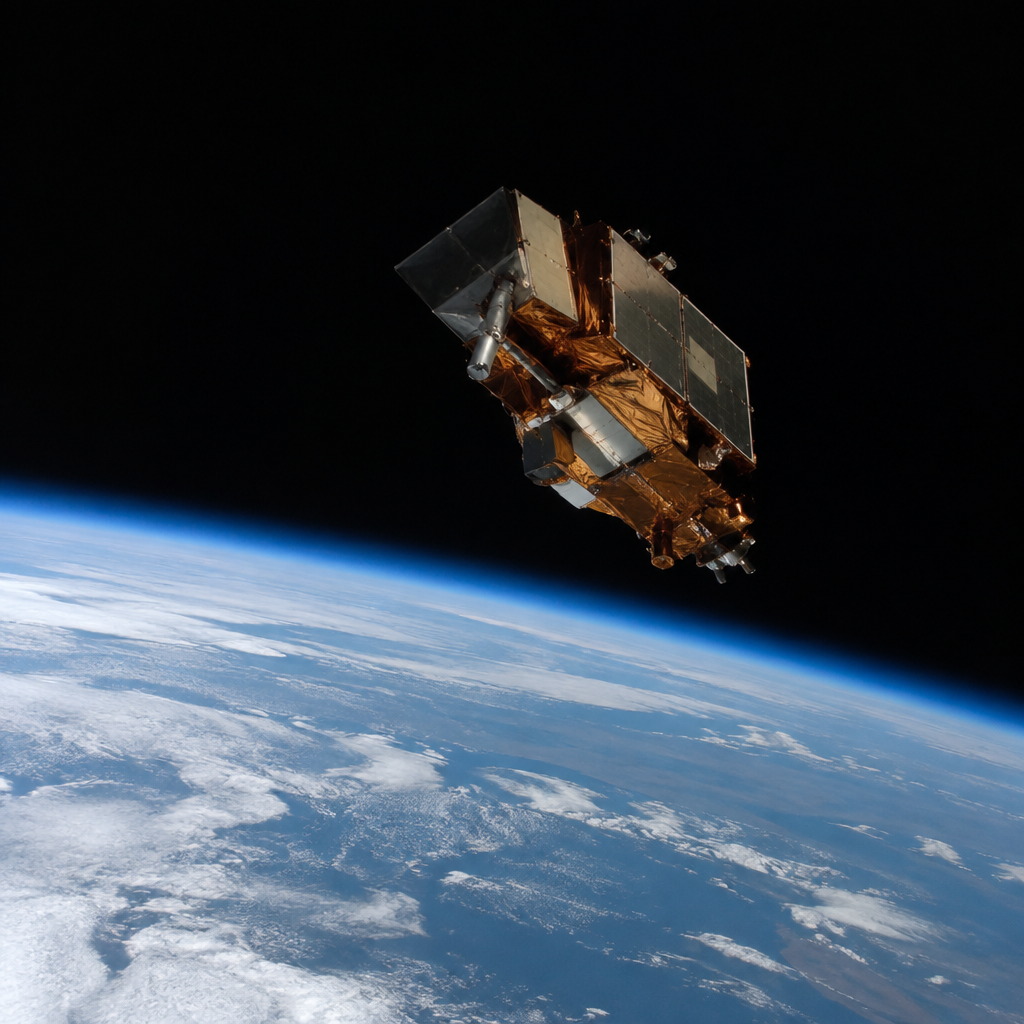
LINK launched on July 3, a little over nine months after Katalyst won the contract. NASA and Katalyst stressed from the start that success was far from guaranteed, as no private spacecraft had ever captured and boosted a satellite that was not designed to be serviced in this way. About three weeks after liftoff, LINK suffered problems with its propulsion system and orientation-maintaining reaction wheels, which caused it to begin spinning at an unexpected rate. Those issues prevented LINK from capturing and boosting Swift, though the craft did get within 7.5 to 9.3 miles, or 12 to 15 kilometers, of the observatory and photographed it. LINK fell back to Earth on September 25.
Swift launched to Earth orbit in November 2004, tasked with studying gamma-ray bursts, the most powerful explosions in the cosmos. Designed to operate for two years, it continued studying the high-energy universe for more than two decades. The telescope was officially renamed the Neil Gehrels Swift Observatory in 2018, after its first principal investigator, who died a year earlier. Swift gathered its last scientific data on October 20.
During its career, the space telescope observed more than 2,000 gamma-ray bursts, studied more than 1,400 supernova explosions, observed asteroids, comets and black holes, and conducted an all-sky survey in X-ray light. The mission's data has contributed to about 7,000 published scientific papers to date.
Shawn Domagal-Goldman, director of the Astrophysics Division at NASA Headquarters in Washington, said Swift "played a major role in advancing our understanding of the changing universe and was part of a revolution in astrophysics that showed how critical rapid-response observations are to the entire community." In a September 25 statement, he called the effort "a high-risk, high-reward mission," adding that the boost effort was "worthwhile either way, advancing U.S. spacecraft servicing technology, challenging us to meet unprecedented mission timelines, and testing how we operate satellites to extend their time in low Earth orbit." He said Swift "leaves us with an extraordinary archive of multiwavelength observations that will fuel new discoveries for decades more."
Swift is now expected to reenter Earth's atmosphere in the coming weeks, according to NASA's October 23 update.