NASA Turns a Departing Cargo Ship Into a Flying Heat Shield Lab
NASA is testing the next generation of thermal protection materials by hitching a ride on a cargo spacecraft at the end of its life. When Northrop Grumman's 24th cargo resupply mission undocked from the International Space Station, it carried 12 small experimental capsules designed to gather reentry data on materials that could protect astronauts returning from the Moon and Mars. The experiment, called the Kentucky Reentry Probe Experiment, or KREPE-3, is the third in a series of low-cost missi
OST Staff · October 10, 2026
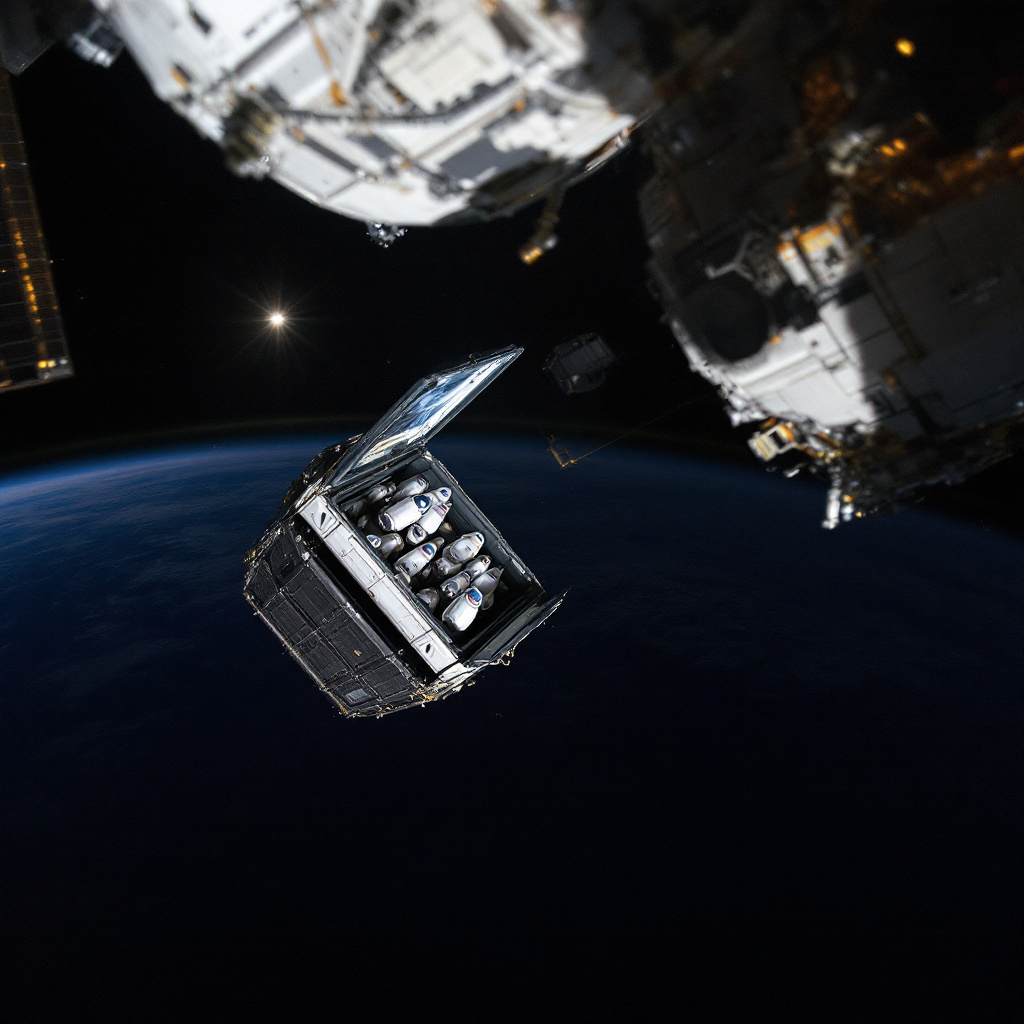
NASA is testing the next generation of thermal protection materials by hitching a ride on a cargo spacecraft at the end of its life. When Northrop Grumman's 24th cargo resupply mission undocked from the International Space Station, it carried 12 small experimental capsules designed to gather reentry data on materials that could protect astronauts returning from the Moon and Mars.
The experiment, called the Kentucky Reentry Probe Experiment, or KREPE-3, is the third in a series of low-cost missions that use the final moments of a cargo spacecraft's lifespan to collect data. Before the mission's Cygnus XL spacecraft departed the station, astronauts packed it with waste and activated the 12 capsules carried inside. As the vehicle breaks apart on its planned reentry path, the capsules will eject and begin collecting data, transmitting live information to researchers via satellite signals.
The project is a collaboration among the University of Kentucky, the state of Kentucky, NASA's Established Program to Stimulate Competitive Research (EPSCoR), several NASA centers, and other federal and commercial partners. The capsules, designed by University of Kentucky students, carry sensors that measure temperature, pressure, motion, magnetic field, and light during reentry. "It's a smart way to get flight data on materials that are still in development," said Keith Peterson, a materials engineer at NASA's Ames Research Center. "We're essentially hitching a ride on a vehicle that's already coming back to Earth."
The capsules carry a mix of proven and experimental technology. Some fly the ceramic tile material used on the space shuttle, while others test a 3D-printed heat shield from the Additive Manufacturing of Thermal Protective Systems project developed at NASA Johnson and Oak Ridge National Laboratory. NASA Ames contributed two capsules flying a next-generation material family called Materials Engineered for Re-entry using Innovative Needling Operations, or MERINO. Made from layers of carbon and phenolic fibers stitched together like felt, the materials are more flexible, faster to produce, and less expensive than traditional substances, making them candidates for Mars missions, where the thinner atmosphere allows lighter protection.
A third capsule, the Kentucky Instrumented Conical Hypersonic Experiment, uses a dual-cone shape combining a tungsten tip on a cone layered with carbon and heat-resistant plastic fibers, with an aft cone wrapped in MERINO, to validate computer models against real-world data. Another capsule is shaped like the aeroshell for NASA's Dragonfly mission to Saturn's moon Titan and will test the design's dynamic stability. It is covered in Phenolic Impregnated Carbon Ablator, a material developed at NASA Ames that flew on the Stardust, Mars Science Laboratory, and Mars 2020 missions. One capsule tests a deployable heat shield called Adaptable Deployable Entry and Placement Technology, shaped like an umbrella to increase surface area and slow descent. Additional capsules from domestic and international partners test further materials, including a heat flux sensor developed at the University of Stuttgart in Germany.
"KREPE-3 is a great example of the goals of NASA's EPSCoR program," said David Berger, EPSCoR program manager at NASA Headquarters. "We are supporting the next generation of scientists and engineers as they develop unique projects that benefit their education and NASA's mission goals." Peterson added, "We're pushing the boundaries of what heat shields can do, and we're testing them in a way that's fast, affordable, and incredibly effective."
Researchers will analyze the live data transmitted during reentry to assess how each set of experimental materials and designs performed, informing how larger heat shields could protect future cargo or crew.