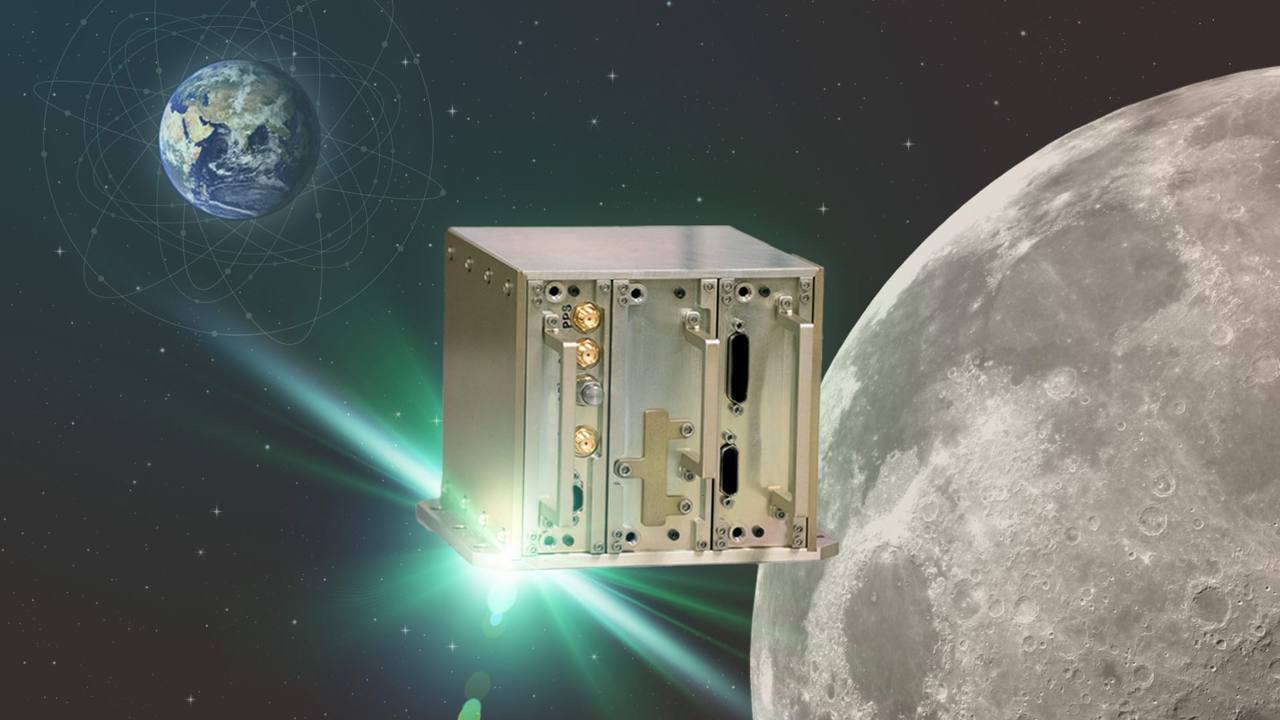
NASA Ships Shoebox-Sized Navigation Payload to Intuitive Machines for First Lunar Relay Satellite
NASA delivered its NavCube3-mini navigation payload on July 13 to Intuitive Machines for integration into Altus-1, the company's first lunar relay satellite. The delivery marks a milestone in developing the communications and navigation services intended to support astronauts and rovers at NASA's future Moon Base. Altus-1 is the first of a planned network of lunar relay satellites being developed under Intuitive Machines' Near Space Network Services contract with NASA. The relays are designed t
OST Staff · August 3, 2026
NASA delivered its NavCube3-mini navigation payload on July 13 to Intuitive Machines for integration into Altus-1, the company's first lunar relay satellite. The delivery marks a milestone in developing the communications and navigation services intended to support astronauts and rovers at NASA's future Moon Base.
Altus-1 is the first of a planned network of lunar relay satellites being developed under Intuitive Machines' Near Space Network Services contract with NASA. The relays are designed to provide communications and navigation support for missions at the Moon, including the challenging lunar South Pole region where Artemis astronauts will land in 2028 and where direct communications with Earth can be difficult.
About half the size of a shoebox and weighing 3.5 pounds, NavCube3-mini is a compact navigation receiver built to use signals from Earth-based GPS and Galileo Global Navigation Satellite Systems at lunar distances. Operating on less than 20 watts of power, roughly the same as a laptop computer, it can determine a spacecraft's precise position far beyond Earth orbit. The payload builds on a series of navigation technology advancements developed at NASA's Goddard Space Flight Center in Greenbelt, Maryland, each extending GPS navigation to new record distances from Earth.
Before shipment, NavCube3-mini underwent an extensive environmental and performance test campaign at Goddard. Environmental testing included vibration testing to simulate launch conditions, thermal vacuum testing to replicate the extreme temperatures and vacuum of space, and electromagnetic compatibility testing to ensure the payload can operate alongside other spacecraft systems without interference. Performance testing was conducted before and after each environmental test using high-fidelity simulations of the GPS and Galileo signals the receiver will encounter in lunar orbit.
Munther Hassouneh serves as the NavCube3-mini project manager. The payload will serve as a key technology demonstration aboard Altus-1, validating the use of GNSS-based navigation in the lunar region and providing performance data to support future lunar navigation infrastructure.
NASA describes the payload as part of a broader strategy to develop communications and navigation services that work across both commercial providers and NASA's networks. These capabilities are designed to support a growing lunar ecosystem that includes orbiters, landers, rovers, and eventually astronauts living and working on the Moon. By extending communications coverage and improving navigation services, the relay network is intended to help realize NASA's vision for a sustained human presence on the lunar surface. Through partnerships with commercial providers like Intuitive Machines, NASA says it is building a more connected and capable lunar environment that will enable spacecraft and explorers to operate more safely, efficiently, and autonomously.
Altus-1 is the first link in what will eventually need to be a full lunar communications network. The relays will support missions operating at the Moon, including the South Pole region targeted for the Artemis crewed landing in 2028.