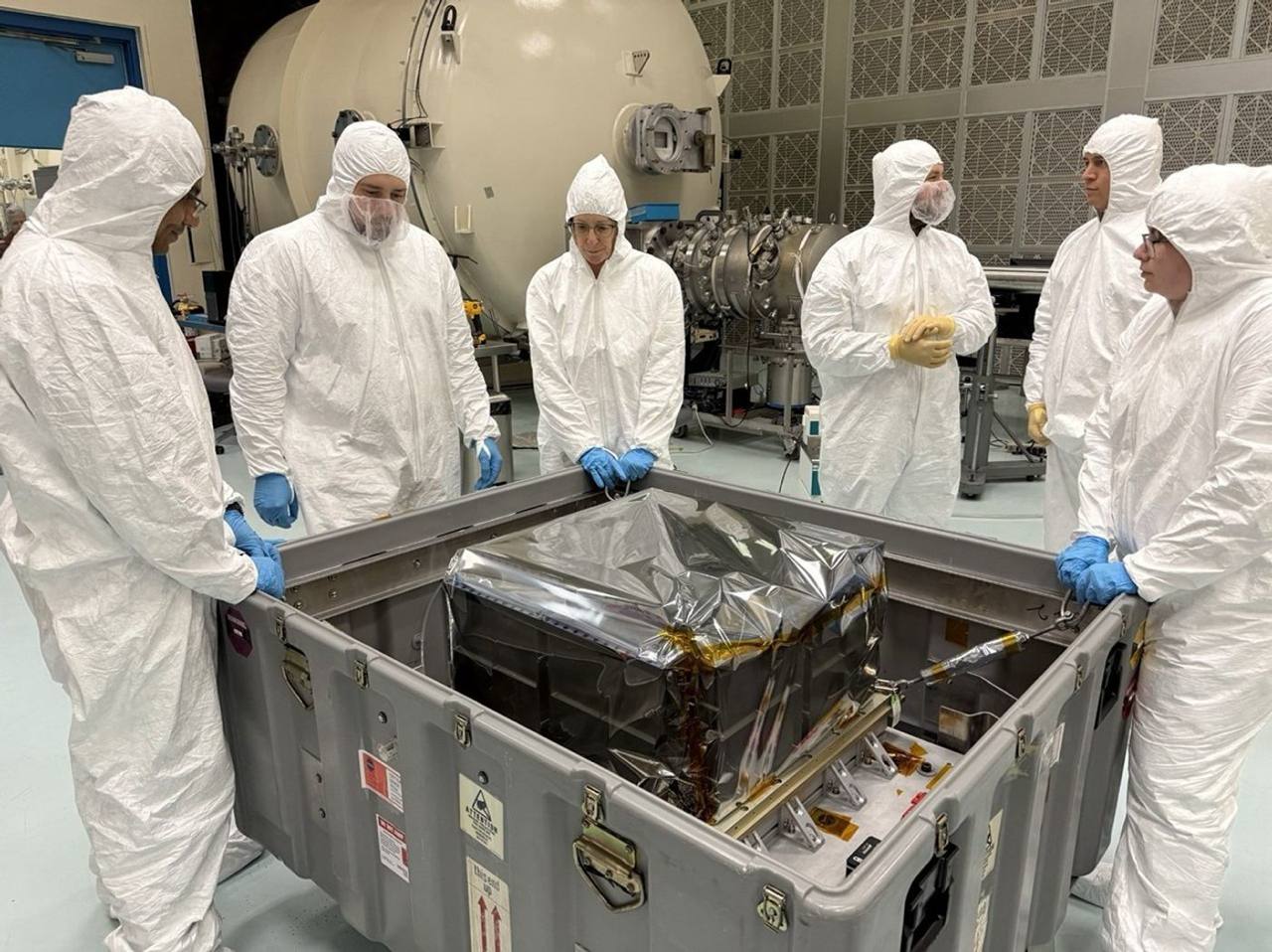
NASA Taps SpaceX Falcon 9 Rideshare for StarBurst Gamma-Ray Mission
NASA has selected SpaceX to launch its StarBurst mission, a small satellite built to study neutron star mergers and the origins of short gamma-ray bursts. The spacecraft will fly as a rideshare payload aboard a Falcon 9 no earlier than 2028, adding another astrophysics investigation to the agency's small-satellite portfolio. StarBurst is part of NASA's Astrophysics Pioneers Program, which supports lower-cost investigations using small spacecraft and other platforms. The mission is designed to o
OST Staff · September 18, 2026
NASA has selected SpaceX to launch its StarBurst mission, a small satellite built to study neutron star mergers and the origins of short gamma-ray bursts. The spacecraft will fly as a rideshare payload aboard a Falcon 9 no earlier than 2028, adding another astrophysics investigation to the agency's small-satellite portfolio.
StarBurst is part of NASA's Astrophysics Pioneers Program, which supports lower-cost investigations using small spacecraft and other platforms. The mission is designed to observe the entire portion of the sky not blocked by Earth, searching for brief, powerful explosions known as gamma-ray bursts.
The launch will take place on a Bandwagon rideshare mission from Space Launch Complex 40 at Cape Canaveral Space Force Station in Florida. The selection is a firm-fixed-price task order under NASA's Venture-Class Acquisition of Dedicated and Rideshare, or VADR, launch services contract. That indefinite-delivery, indefinite-quantity contract allows NASA to acquire launch services during a 10-year ordering period, with a maximum total value of 1 billion dollars across all contracts.
StarBurst will focus on detecting the initial high-energy emission from short gamma-ray bursts, which occur when dense stellar remnants called neutron stars merge. By combining the satellite's observations with gravitational-wave measurements and follow-up observations from other telescopes, researchers will study these events through multiple types of signals, an approach known as multimessenger astronomy.
NASA's Launch Services Program Office, based at the agency's Kennedy Space Center in Florida, manages the VADR contract.
The selection places StarBurst within NASA's Astrophysics Pioneers Program, the agency's effort to advance science using smaller, more affordable missions. NASA's stated aim for StarBurst is to capture the earliest high-energy signals from neutron star mergers and combine them with other detection methods, giving researchers a fuller picture of these events.
The mission is scheduled to launch no earlier than 2028 aboard the Bandwagon rideshare mission from SLC-40. Further information about StarBurst is available through NASA's science mission page.