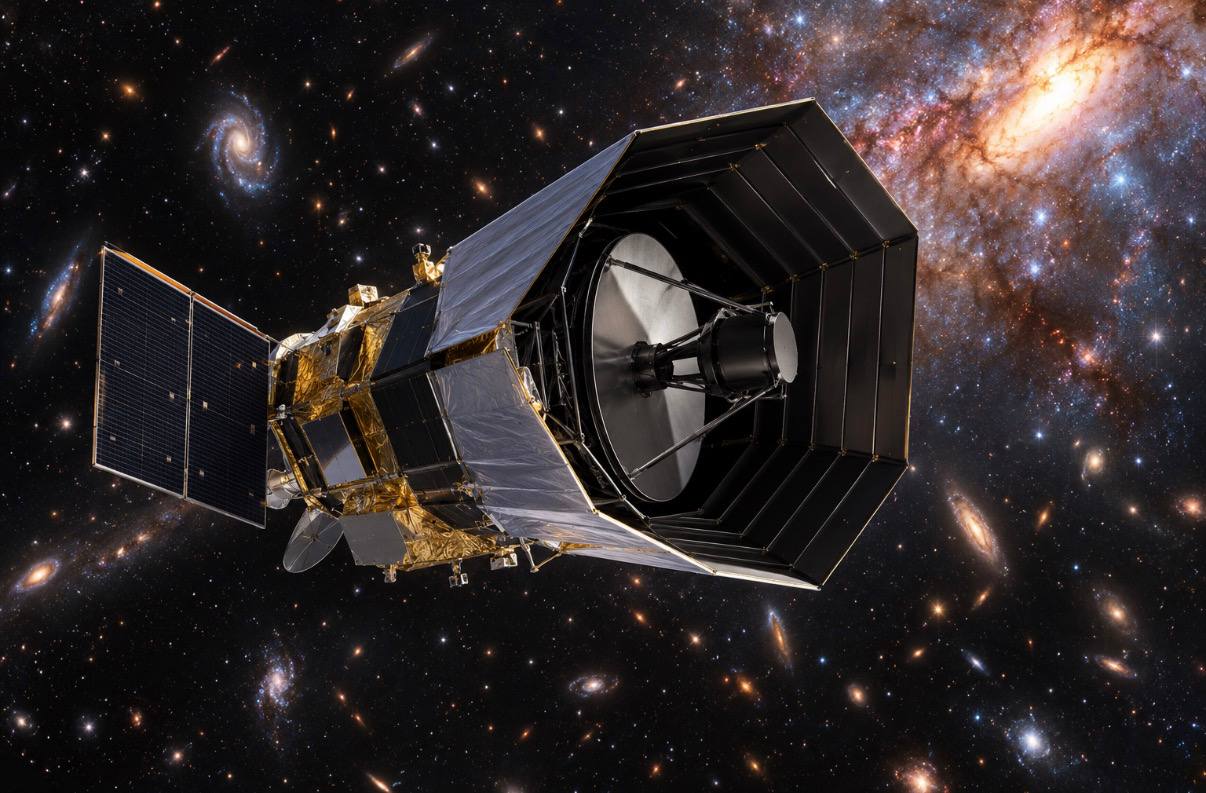
NASA Advances PRIMA Far-Infrared Telescope, First Mission in New Probe Explorers Class
NASA announced Wednesday that PRIMA, a far-infrared space telescope designed to study the history and evolution of the universe, is advancing to the next phase of development. The mission is the first in a new class of NASA astrophysics missions called Probe Explorers, part of the agency's longstanding Explorers Program. The National Academies of Sciences, Engineering, and Medicine's 2020 Decadal Survey recommended NASA establish the new Probe Explorers mission class. NASA selected PRIMA for de
OST Staff · September 23, 2026
NASA announced Wednesday that PRIMA, a far-infrared space telescope designed to study the history and evolution of the universe, is advancing to the next phase of development. The mission is the first in a new class of NASA astrophysics missions called Probe Explorers, part of the agency's longstanding Explorers Program.
The National Academies of Sciences, Engineering, and Medicine's 2020 Decadal Survey recommended NASA establish the new Probe Explorers mission class. NASA selected PRIMA for development after evaluating concept studies for Probe Explorer missions, weighing their scientific merit against the Decadal Survey's recommendations, the feasibility of their development plans on cost and schedule, and their use of technologies that could support future large missions.
NASA has moved PRIMA into Phase B, the stage that advances preliminary design and technology development. The mission is subject to a confirmation review based on technical, programmatic, and cost performance to determine its readiness to begin implementation in Phase C. If confirmed, PRIMA's project cost is capped at $1.2 billion, not including launch and other non-project costs. The observatory is targeted to launch in 2033 for a planned five-year mission.
With a 5.9-foot telescope, PRIMA will conduct deep, sensitive surveys of the universe in far-infrared light, helping bridge the gap between existing infrared observatories, such as NASA's James Webb Space Telescope, and radio telescopes. The mission will address questions about the origins of planets outside the solar system, how galaxies and their black holes have grown over cosmic history, and how dust and heavy elements have built up in the universe over time.
NASA's Jet Propulsion Laboratory in Southern California will manage the mission. Other partners include NASA's Goddard Space Flight Center in Greenbelt, Maryland, and NASA's Marshall Space Flight Center in Huntsville, Alabama. International contributions will come from CNES, ASI, DLR, CSA, KASI, JAXA, and the UK Space Agency.
"The PRIMA mission is humanity's next window into the deep universe. It will unveil the obscure across cosmic time to better understand the formation of planets, stars, black holes, and even how water on Earth came to be," said Nicky Fox, associate administrator, Science Mission Directorate, NASA Headquarters in Washington.
Shawn Domagal-Goldman, director of the Astrophysics Division at NASA Headquarters, said the mission extends the survey capabilities of NASA's fleet into far-infrared wavelengths. "With our Webb and Roman space telescopes, we set a cadence of launching premiere-class missions in both halves of the decade. We're going to keep that up and kick off the next decade with PRIMA, as part of a pipeline that will consistently have missions of this caliber ready to go," he said.
The Explorers Program is the oldest continuous NASA program designed to provide frequent, low-cost access to space using principal investigator-led space science investigations. Since the Explorer 1 launch in 1958, which discovered Earth's radiation belts, the program has launched more than 100 missions, including the Uhuru and Cosmic Background Explorer missions that led to Nobel prizes for their investigators.
PRIMA must pass a confirmation review based on technical, programmatic, and cost performance before it can begin implementation in Phase C. The observatory is targeted to launch in 2033.