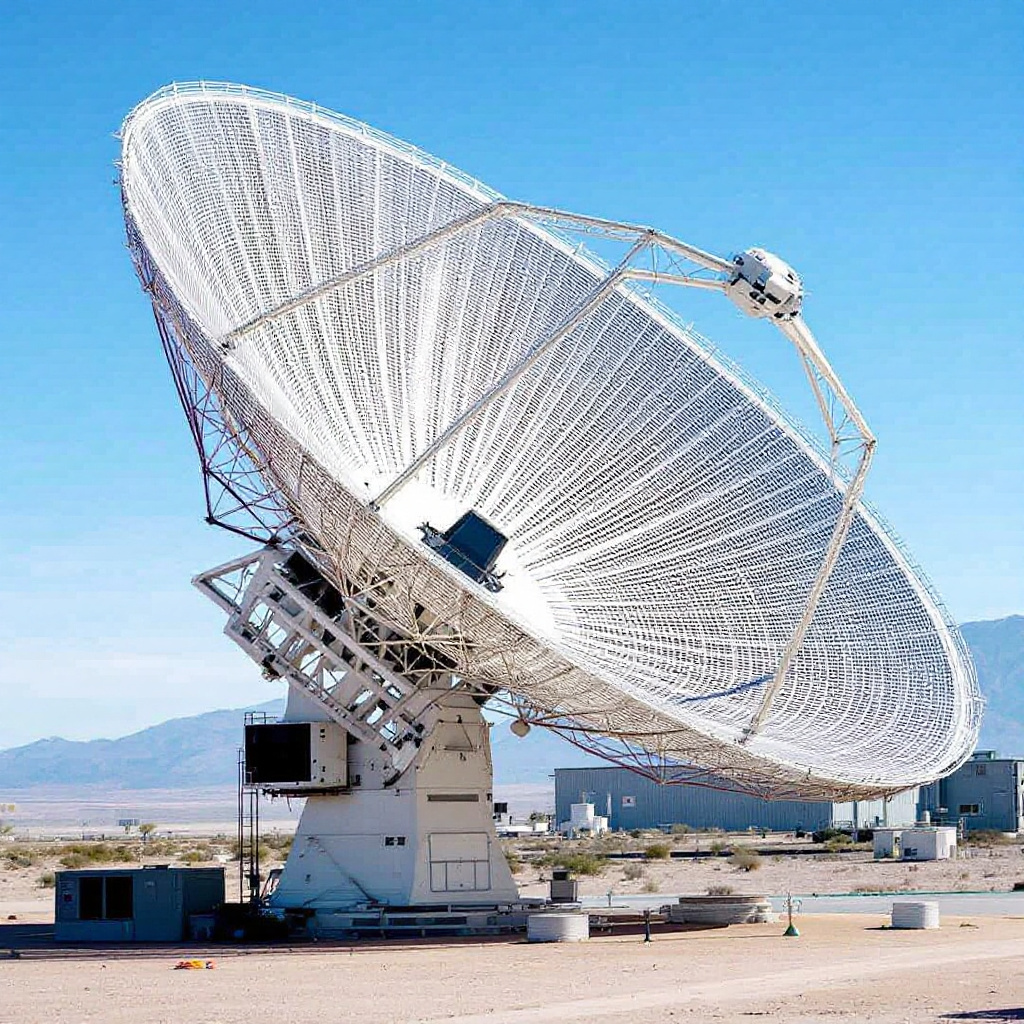
NASA Activates New 34-Meter Antenna at Goldstone, Expanding Deep Space Network
NASA has added a new 34-meter (114-foot) radio frequency antenna to its Deep Space Network at the Goldstone Deep Space Communications Complex near Barstow, California. The new dish, Deep Space Station 23 (DSS-23), began operations on August 3 and strengthens the communications and navigation system that supports more than 40 spacecraft across the solar system and interstellar space. DSS-23 is the latest antenna added under the Deep Space Network's Aperture Enhancement Project, which began in 20
OST Staff · August 26, 2026
NASA has added a new 34-meter (114-foot) radio frequency antenna to its Deep Space Network at the Goldstone Deep Space Communications Complex near Barstow, California. The new dish, Deep Space Station 23 (DSS-23), began operations on August 3 and strengthens the communications and navigation system that supports more than 40 spacecraft across the solar system and interstellar space.
DSS-23 is the latest antenna added under the Deep Space Network's Aperture Enhancement Project, which began in 2009 to upgrade and expand the network with six new 34-meter multifrequency beam-waveguide antennas. The Deep Space Network operates dish antennas at three global facilities, located at Goldstone, Madrid, and Canberra, Australia. NASA's Jet Propulsion Laboratory in Southern California manages the network.
NASA leadership, personnel, and dignitaries gathered at the completed antenna for a ceremonial ribbon cutting on August 25, 2026. DSS-23 completed a testing campaign from May through July before beginning operations on August 3, when it tracked NASA's Chandra X-ray Observatory. Since then it has communicated with dozens of missions including the Mars Reconnaissance Orbiter, Psyche, Juno, and Voyager 1.
Construction began in February 2020. The 133-ton metal reflector framework was placed and bolted atop the antenna's pedestal in December 2024, after which engineers installed the reflecting panels and calibrated the antenna to work with the rest of the network. DSS-23 is the fifth antenna at Goldstone, joining three 34-meter antennas and one 70-meter (230-foot) antenna, and the fifth enhancement project antenna to join the network. Multifrequency beam-waveguide antennas direct signals to a stable, climate-controlled underground room rather than housing heavy electronic equipment on the moving dish, a design that offers versatility and easier maintenance access.
"By expanding the Deep Space Network, we are strengthening the communications foundation NASA needs for the bold missions ahead, from exploring more of the Moon than ever before to peering deeper into the solar system," said James Kenyon, associate administrator of the Research and Technology Mission Directorate at NASA Headquarters. Dave Gallagher, director of JPL, said the addition brings the agency "closer to a completely modernized network" after more than 60 years of continuous operations. Germaine Aziz, manager of the Deep Space Network Aperture Enhancement Project at JPL, said the biggest challenge was "transforming a complex collection of mechanical, electrical, software, radio frequency, and infrastructure systems into a single, mission-ready asset," with every subsystem integrated, calibrated, and verified before it can support deep space missions.
The 34-meter antennas can be arrayed, combined and operated together, to provide an equivalent communications backup for each facility's single 70-meter antenna. Those 70-meter dishes, after more than 50 years of near-continuous operation, are getting increasingly costly to maintain and repair. More than 100 NASA and non-NASA missions rely on the Deep Space Network and the Near Space Network, including missions supporting astronauts aboard the International Space Station and future Artemis missions.
The Aperture Enhancement Project will be complete when a sixth enhancement-project antenna, Deep Space Station 33, comes online at the Canberra facility in 2029. That will bring the total number of 34-meter antennas across the network to 13.