Lockheed Martin to Attempt First Robotic Welding Demonstration in Open Space
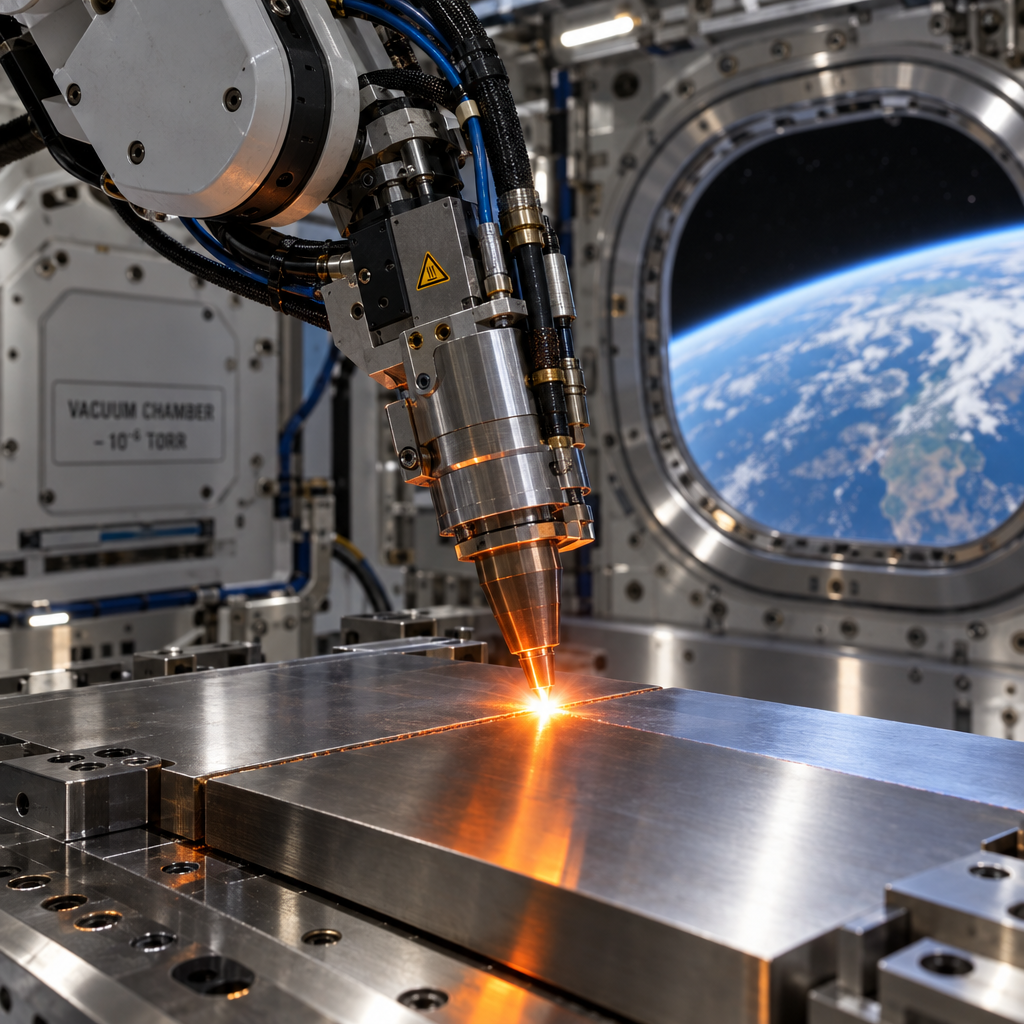
Lockheed Martin is preparing to carry out what it describes as the first American, and first-ever, robotic welding demonstration in exposed space. The payload, called JOINS, for JOining demonstrations IN-Space, is operating aboard the International Space Station and aims to prove that metals can be joined reliably in the vacuum, microgravity and temperature extremes of orbit. The company frames the effort as a step toward building large space and lunar structures that are too big to launch inta
OST Staff · November 23, 2026
Lockheed Martin is preparing to carry out what it describes as the first American, and first-ever, robotic welding demonstration in exposed space. The payload, called JOINS, for JOining demonstrations IN-Space, is operating aboard the International Space Station and aims to prove that metals can be joined reliably in the vacuum, microgravity and temperature extremes of orbit.
The company frames the effort as a step toward building large space and lunar structures that are too big to launch intact. Future infrastructure, from garages that shelter rovers through lunar nights to communications structures on the Moon and frameworks for large space telescopes, could be constructed directly in orbit or on the lunar surface rather than delivered whole.
The demonstration uses Voyager's Bishop Airlock on the ISS as both a staging area and testbed, exposing the JOINS hardware to the space environment so engineers can observe how joining techniques perform without gravity, atmosphere and conventional support systems. The program is designed to answer fundamental questions about how welding can be achieved with limited power, how heat flows and dissipates in a vacuum, and how robotic tools perform while expanding and contracting through thermal extremes.
JOINS will weld aluminum and stainless-steel samples using two approaches. Laser beam welding delivers high-energy precision in a concentrated beam, suited to thin or intricate joints where heat input must be tightly controlled. Friction stir welding joins metal through mechanical friction without melting the base material, potentially offering stronger, more crack-resistant seams in materials sensitive to thermal distortion. Both methods are paired with onboard inspection systems, including cameras, that will monitor weld integrity and transmit data to the payload's mission control in Houston. The physical test articles will return to Earth months later for in-person inspection and testing, completing a weld-and-inspect cycle that Lockheed Martin calls a critical first step toward certifying in-space joining technologies for operational use.
Lockheed Martin is executing JOINS as a 9.1 million dollar Funded Space Act Agreement under NASA's Tipping Point selections, with additional company investment to mature the technology. Bobby Biggs, JOINS program manager at Lockheed Martin, said the technology could enable robotic arms to assemble, integrate and repair large space structures as NASA prepares to establish a sustainable Moon Base. He described it as a transformational shift from relying on fixed assets constrained by launch and landing vehicles to building versatile and upgradable systems in space when and where they are needed.
Biggs said every kilogram saved and every joint welded enabling high stiffness and precision translates to cheaper missions and more capable architectures. The company positions JOINS as a building block in its broader in-space servicing, assembly and manufacturing roadmap, and as both an endpoint, proving robotic welding in space, and a launchpad for further work.
Lockheed Martin says JOINS sets the stage for STRATOS, a NASA Announcement of Collaboration Opportunity focused on robotic assembly technologies. Following the welding demonstration, the test articles will return to Earth for physical inspection and testing, part of the path the company describes as moving from 240 miles above Earth toward the lunar surface 240,000 miles away.