Livermore 3D Simulations Model How Nuclear Blasts Could Shatter or Deflect Asteroids
Scientists at Lawrence Livermore National Laboratory have built advanced three-dimensional simulations showing how a nuclear explosion detonated near an asteroid could deflect or destroy it, offering a potential last line of defense against a catastrophic impact. The work, published in The Planetary Science Journal, suggests nuclear mitigation could serve as an alternative to conventional deflection methods when an incoming object is too large or there is too little time to redirect it with a sp
OST Staff · October 17, 2026
Scientists at Lawrence Livermore National Laboratory have built advanced three-dimensional simulations showing how a nuclear explosion detonated near an asteroid could deflect or destroy it, offering a potential last line of defense against a catastrophic impact. The work, published in The Planetary Science Journal, suggests nuclear mitigation could serve as an alternative to conventional deflection methods when an incoming object is too large or there is too little time to redirect it with a spacecraft.
The research marks another step toward understanding whether humanity could prevent an asteroid impact using existing nuclear technology. The simulations focus on scenarios where conventional approaches fall short, particularly when an object is detected shortly before a potential collision and more aggressive intervention becomes necessary.
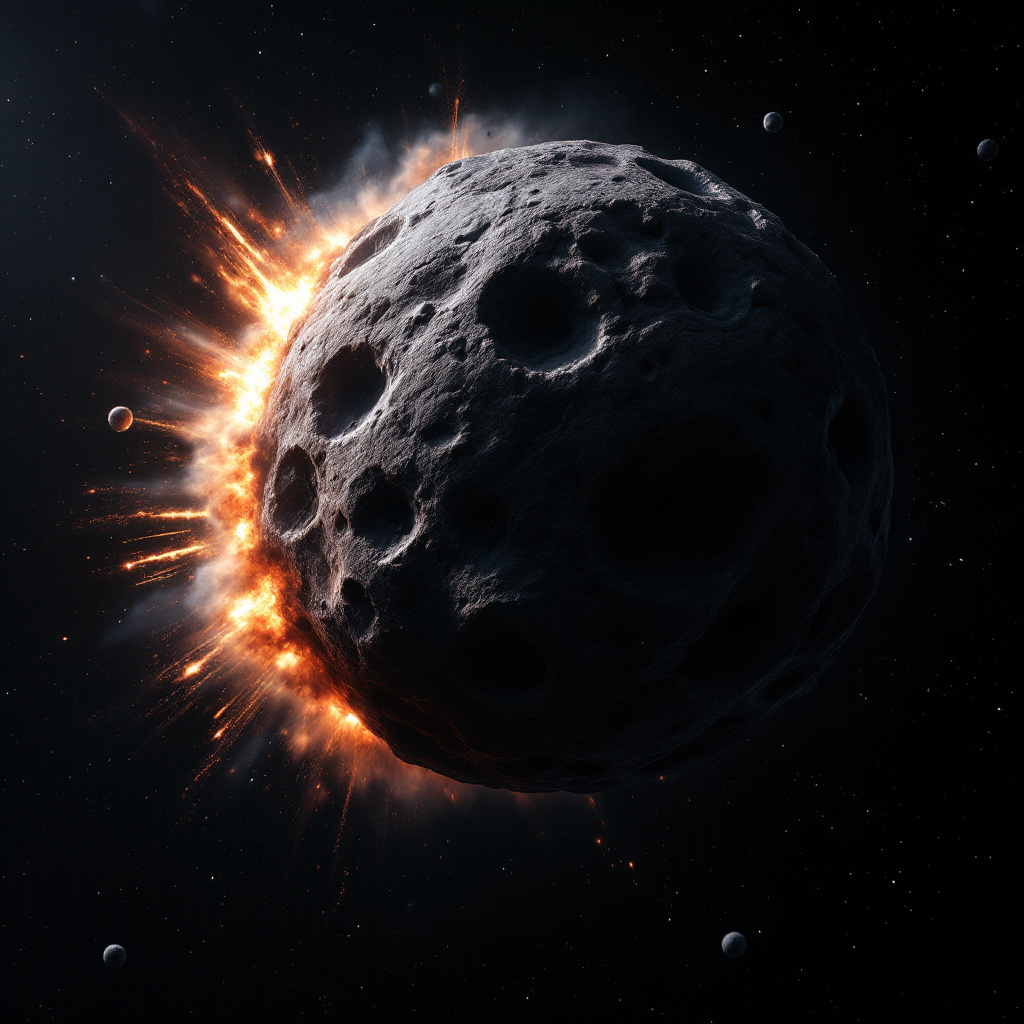
Unlike the Hollywood depiction of astronauts drilling a bomb into an asteroid, the technique studied at LLNL involves detonating a nuclear device near the asteroid's surface. The explosion releases an intense burst of radiation, including X-rays, that rapidly heats and vaporizes material on the asteroid's exterior. As that material expands away from the surface, it generates a recoil force capable of changing the asteroid's trajectory. Depending on the energy delivered, the asteroid's composition, and its internal structure, the result could take two forms. In deflection, the asteroid remains largely intact but receives enough of a velocity change to miss Earth. In disruption, the asteroid fractures into smaller pieces that disperse enough to prevent a dangerous impact.
The distinction is critical. If an asteroid is detected years before a potential collision, even a small change in velocity could be enough to avoid Earth. Nuclear devices are particularly attractive because they can deliver substantially more energy than a conventional spacecraft impactor.
The research team, led by LLNL scientist Isaiah Santistevan, used the laboratory's Spheral simulation software to model how asteroid material behaves under the extreme conditions created by a nearby nuclear detonation. The researchers first validated their approach by comparing more than 1,500 one-dimensional simulations against established asteroid-deflection models produced using LLNL's Ares simulation code. They then applied the modeling framework to three more complex three-dimensional disruption scenarios. Two of the three simulations demonstrated strong indications of asteroid disruption, with extensive material damage and movement consistent with an object breaking apart.
The three-dimensional approach matters because asteroids are not necessarily solid, uniform rocks. They can contain fractures, irregular structures, and materials with different physical properties, all of which influence how energy travels through an object. The simulations give researchers a far more detailed picture of how an asteroid may respond to a nuclear mitigation attempt.
The researchers stress that the results do not constitute a demonstration of nuclear asteroid defense in space. Instead, they provide a more sophisticated computational framework for predicting what might happen if such a mission were attempted. Modeling damage, fractures, and material movement in three dimensions represents an important step toward evaluating planetary defense options.
The work builds on earlier planetary defense efforts and continues to refine the computational tools scientists would rely on to assess whether a nuclear mitigation mission could succeed against a specific threatening object.