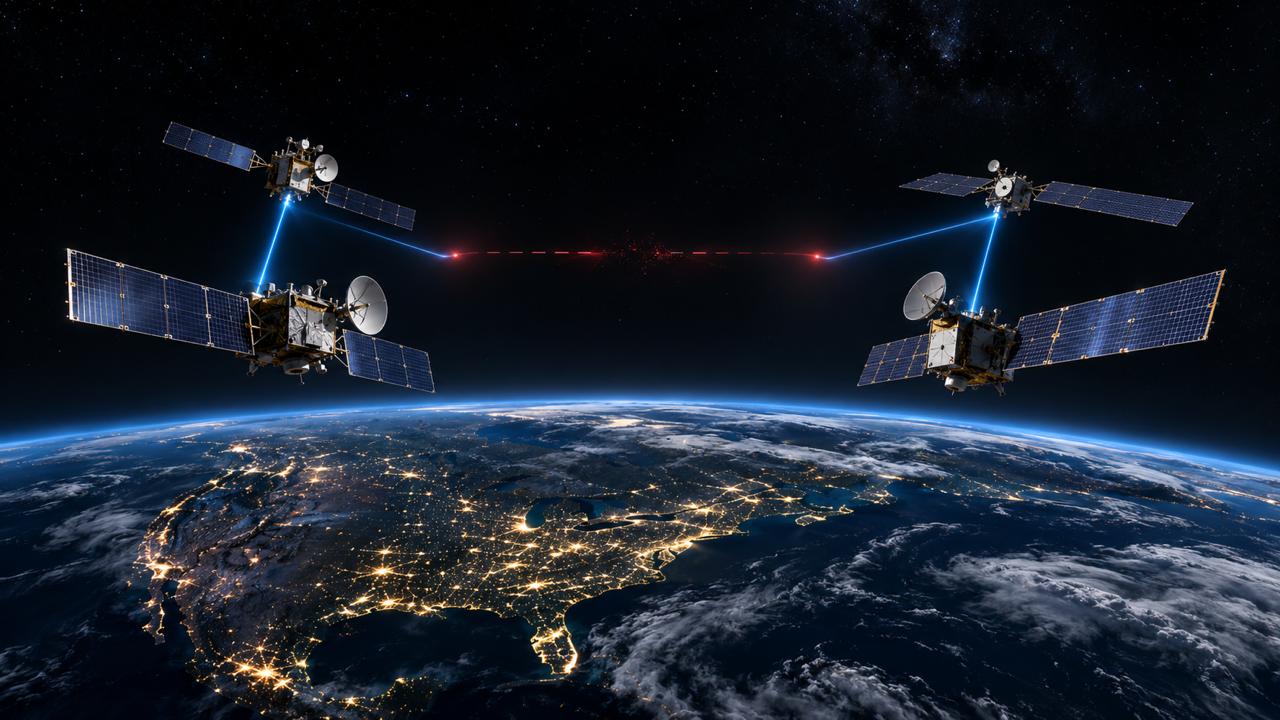
Space Force Eyes $1 Billion Fix to Connect Satellites That Cannot Talk to Each Other
The Space Force is weighing a fleet of 12 to 13 new translator satellites to bridge incompatible laser communications systems across its planned missile warning and tracking network, a solution multiple sources estimate at roughly $1 billion. The gap sits at the center of the architecture meant to speed the Trump administration's Golden Dome missile defense initiative into existence. The core problem is that the SpaceX-built Space Data Network Backbone, the Space Development Agency's Tracking L
OST Staff · November 6, 2026
The Space Force is weighing a fleet of 12 to 13 new translator satellites to bridge incompatible laser communications systems across its planned missile warning and tracking network, a solution multiple sources estimate at roughly $1 billion. The gap sits at the center of the architecture meant to speed the Trump administration's Golden Dome missile defense initiative into existence.
The core problem is that the SpaceX-built Space Data Network Backbone, the Space Development Agency's Tracking Layer satellites, and Space Systems Command's Resilient Missile Warning and Tracking satellites in medium Earth orbit all use optical communications terminals built to different technical standards. Those differing standards govern the precise optical waveforms used and how many gigabits per second the laser links can carry, meaning the satellites cannot directly exchange data. Part of the mismatch traces to a 2025 decision by the Department of the Air Force to switch from using SDA's Transport Layer as the SDN backbone to relying instead on SpaceX's constellation, at the time called MILNET and already in use by the National Reconnaissance Office. SDA had already been developing its satellites around its own open-source terminal standard, first published in 2022.
SpaceX won a $2.29 billion contract in May to fast-track development of the SDN Backbone to meet President Donald Trump's 2028 deadline for Golden Dome. The company plans to orbit an operational prototype of the backbone by 2027. SpaceX uses proprietary terminals dubbed Plasers that cannot directly exchange data with the SDA and SSC satellites, and those two sets of terminals are also incompatible with each other. An SDA official confirmed that the optical waveform and terminals on SDA's Transport and Tracking Layer satellites are not directly compatible with the Plaser waveform.
To fix the gap, the Space Force is considering a constellation of 12 to 13 satellites known as Space Exchange Points, or translator satellites, expected to cost somewhere between $12 million and $14 million each, two industry sources and one former Space Force official said. That totals roughly $1 billion in new money at a time the Pentagon is expected to receive less funding than it requested from Congress. Several sources expressed frustration, saying the situation could have been avoided with earlier standardization, given that both the SDA and SSC programs began at roughly the same time in 2019.
The connectivity gap strikes directly at the architecture meant to support Golden Dome, which the SDN is designed to help deliver by connecting sensors to shooters across missile warning, tracking, and targeting missions. Sources emphasized that the problem never needed to happen and that the service is now scrambling to fix it. An SSC spokesperson declined to comment on compatibility or on the SEP program's goals and costs, and SpaceX did not respond to inquiries.
G.P. Sandhoo, head of both SDA and the Space Force's new Missile Warning and Tracking Portfolio Acquisition Executive office, said on Oct. 28 at Silicon Valley Space Week that his office will eventually need to figure out how to integrate data from sensors on satellites in different orbits. An SDA spokesperson said interoperability between the LEO and MEO terminals is currently being evaluated. A potential alternative to the translator satellites is a new version of SDA's optical waveform standard, version 4.0.0, developed in consultation with SSC and featuring a mode allowing LEO to MEO transmission. The SDA spokesperson said that standard is not yet on contract for any SDA tranche but is under consideration for Tranche 4.