JPL Fires Lithium Thruster at 120 Kilowatts, Sets Sights on a Megawatt
NASA's Jet Propulsion Laboratory ignited a lithium-fed magnetoplasmadynamic thruster prototype five times at up to 120 kilowatts during a February 2026 ground test, operating at more than 25 times the power of the most capable electric thruster currently flying on a NASA spacecraft. The result opens a credible route to much higher-power electric propulsion, though it does not yet demonstrate that the full route can be travelled. The test took place on 24 February inside an eight-metre vacuum ch
OST Staff · August 29, 2026
NASA's Jet Propulsion Laboratory ignited a lithium-fed magnetoplasmadynamic thruster prototype five times at up to 120 kilowatts during a February 2026 ground test, operating at more than 25 times the power of the most capable electric thruster currently flying on a NASA spacecraft. The result opens a credible route to much higher-power electric propulsion, though it does not yet demonstrate that the full route can be travelled.
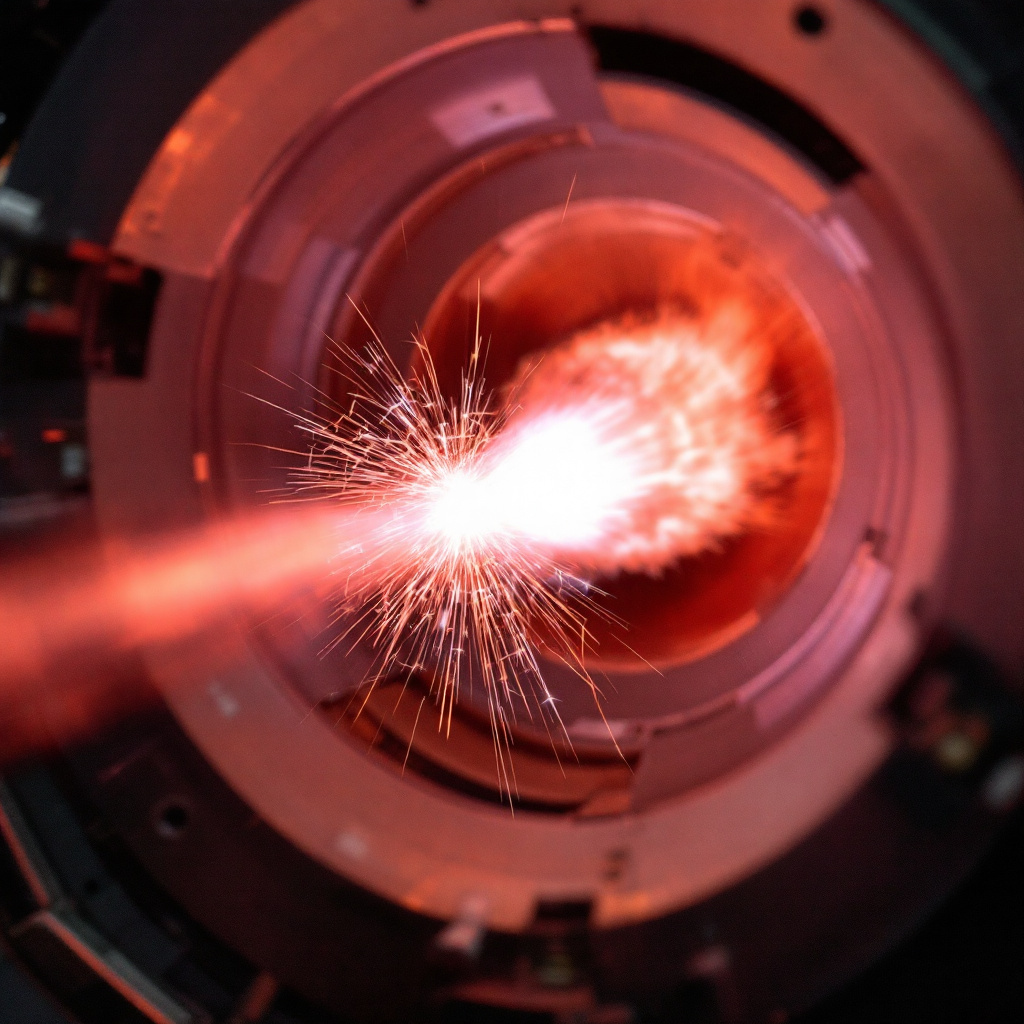
The test took place on 24 February inside an eight-metre vacuum chamber at JPL, with the thruster's central tungsten electrode glowing white at more than 2,800 degrees Celsius and a red plume spreading from the mouth of the machine. JPL announced the initial laboratory test on 28 April, describing it as an early experiment rather than an endurance run, a flight qualification or a measured journey. The immediate comparison is the Psyche mission, whose active Hall-effect thruster draws about 4.5 kilowatts at the reference level. Psyche's engine produces a maximum thrust of 240 millinewtons and consumes about 0.35 to 1.3 kilograms of xenon a day depending on power level.
The prototype is a lithium-fed magnetoplasmadynamic thruster, or MPD, a technology studied since the 1960s but never flown operationally. It turns lithium metal into vapour and then plasma, passing very high electric currents through that plasma. The interaction with a magnetic field creates an electromagnetic force that accelerates the plasma out of the thruster. The engine does not simply enlarge Psyche's Hall thruster; it is a different kind of device attractive at high power because it may process far more electricity through one thruster while still using propellant efficiently.
The February campaign ran in JPL's condensable metal propellant facility, known as CoMeT, a water-cooled vacuum chamber 26 feet, or eight metres, long and designed to contain tests involving metal vapours at power levels that may eventually reach the megawatt class. Across five ignitions, the thruster reached the team's intended power level of up to 120 kilowatts. JPL senior research scientist James Polk said the firing showed both that the thruster worked and that the testbed could support the scaling work ahead. Engineers now want to test a single thruster at between 500 kilowatts and one megawatt, a target rather than an accomplished engine specification. One megawatt is roughly 222 times Psyche's 4.5-kilowatt benchmark and 8.3 times the February test.
JPL did not publish the prototype's measured thrust, efficiency or specific impulse at 120 kilowatts, quantities that will be essential before the power level can be translated into a useful spacecraft design. Power and thrust are related but not interchangeable, so the 120-kilowatt figure should not be read as an engine pushing 26.7 times harder than Psyche. The result is a real hardware milestone. It establishes the first point on an engineering curve whose difficult end is endurance, since five starts are not the tens of thousands of hours and thousands of thermal cycles a flight engine must survive.
The planned 500-kilowatt and one-megawatt tests are the named next steps, along with the demands of scaling every current path, magnetic field, propellant channel, electrode and cooling boundary to a harsher operating environment. The power-processing electronics must scale too, conditioning the supply, starting and throttling the discharge and isolating faults around intense electromagnetic fields.