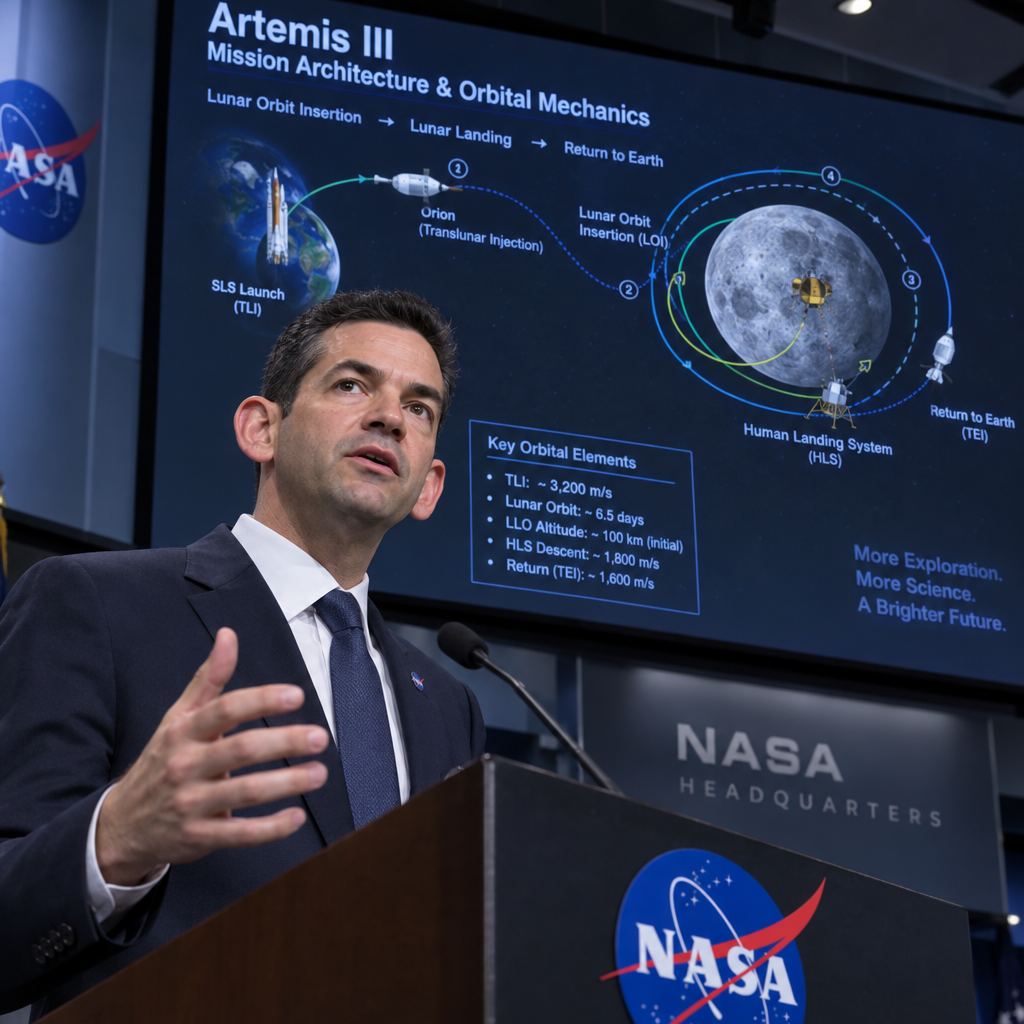
NASA Sets Artemis III Around Three Launches, With Blue Origin's Lander Flying First
NASA Administrator Jared Isaacman has laid out the architecture for Artemis III, describing a sequenced campaign of three launches from three providers that must come together in low Earth orbit. The agency will commit the Space Launch System and Orion only after Blue Origin's Blue Moon lander is already on orbit, making the lander the gating element of the mission. Artemis III is now planned as a low-Earth-orbit checkout and rendezvous campaign rather than a single-launch profile or an immedia
OST Staff · November 1, 2026
NASA Administrator Jared Isaacman has laid out the architecture for Artemis III, describing a sequenced campaign of three launches from three providers that must come together in low Earth orbit. The agency will commit the Space Launch System and Orion only after Blue Origin's Blue Moon lander is already on orbit, making the lander the gating element of the mission.
Artemis III is now planned as a low-Earth-orbit checkout and rendezvous campaign rather than a single-launch profile or an immediate surface landing. It is designed to exercise the three major flight elements together, gather operational data, and build experience ahead of a later crewed lunar landing attempt. Isaacman framed the approach as a deliberate departure from the Apollo model and from earlier, more tightly coupled Artemis concepts, reflecting both the available hardware and NASA's desire to practice multi-vehicle rendezvous and docking first.
The sequence begins with a New Glenn launch carrying Blue Moon, which is expected to loiter in orbit for roughly 30 days. That flight would be followed by the SLS and Orion crew launch and a Starship launch. "We're not going to launch without Blue Origin in it," Isaacman said. "That's why they're going to launch first. Like they need to be up there, do some checkouts, and then we commit SLS." He added, "You're committed once SLS goes. So Blue has got to go in order to trigger SLS, and then from there we'll take getting Starship."
During the roughly two-week period that includes two planned rendezvous events, Starship is expected to contribute high-definition imagery, controllability testing, and rendezvous and docking practice. Isaacman identified the lander as the primary remaining bottleneck. "For sure, the lander. We don't have a fully assembled Blue test article yet," he said, while noting Blue Origin is making substantial progress. He described the prospect of all three vehicles operating together as "just so cool," and emphasized the primary operational learning is expected from the Blue Origin side, which has not previously kept people alive outside the New Shepard suborbital environment for extended periods.
Isaacman said NASA would insist on the low-Earth-orbit rehearsal even if the landers were ready today. "The landers could be ready right now and we would still, and NASA would still insist on an Apollo 9 mission in low Earth orbit," he said, citing undocking, translation, and re-rendezvous before any lunar attempt. He described the multi-launch profile as a signal of where the program is heading, pointing to future autonomous assembly and fleets of fission-powered spacecraft that will each require many launches to build. He added that NASA has deployed its own people and in some cases built hardware to keep the program on schedule, including thermal protection system specialists for Orion, C-17 flights to move structural domes, and hundreds of personnel assisting Blue Origin with pad recovery, anomaly investigation, and welding. "It's incredibly important to get the Blue mission done," he said, adding NASA would accept limited schedule movement to gain more data from the Blue Origin team.
NASA's stated intent is to maximize what it learns on Artemis III and close remaining gaps relative to historical lunar landing profiles. "We'll close whatever gaps between the Apollo 9 mission and Apollo 11 with the uncrewed lander demonstration and then we'll go to the Moon," Isaacman said.