Inside the California Lab Building Robots to Construct the Moon's First Outpost
A Southern California company is developing a family of robotic arms, rovers, and autonomous spacecraft intended to perform lunar construction, excavation, and maintenance, including work carried out when no astronauts are present. GITAI USA, based in Torrance, aims to shift much of the labor of building a lunar outpost onto machines, cutting the cost of a resource that will be scarce and expensive: astronaut time on the Moon. Every hour an astronaut spends on the Moon is costly, and surface cr
OST Staff · November 2, 2026
A Southern California company is developing a family of robotic arms, rovers, and autonomous spacecraft intended to perform lunar construction, excavation, and maintenance, including work carried out when no astronauts are present. GITAI USA, based in Torrance, aims to shift much of the labor of building a lunar outpost onto machines, cutting the cost of a resource that will be scarce and expensive: astronaut time on the Moon.
Every hour an astronaut spends on the Moon is costly, and surface crews will be few and limited in time. The work of building a lunar outpost is enormous, and GITAI's central premise is that machines should handle much of it. Equipment will remain on the surface between crewed missions, creating a role for robots that can keep working after astronauts leave.
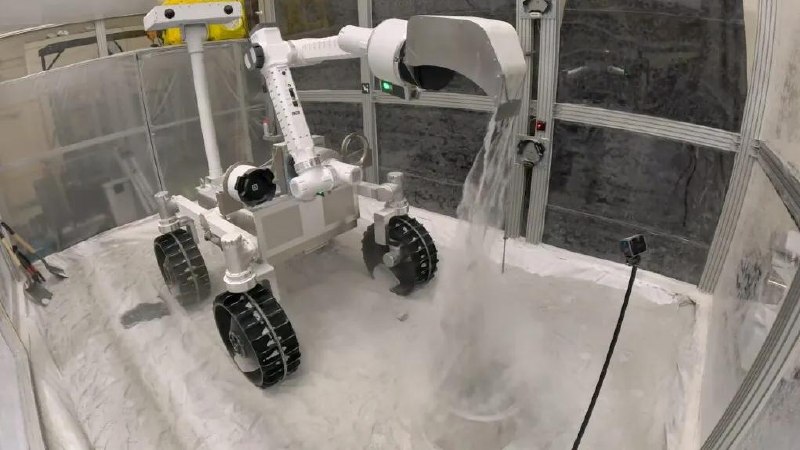
At the Torrance facility, a robotic arm called Inchworm crawls across a bed of simulated lunar soil, able to dig, pick up rocks, swap its own tools, and reposition itself by anchoring one end, releasing the other, and moving forward. The site also houses lunar rovers, spacecraft test systems, an endurance-testing area known as the Arm Farm, a thermal-vacuum chamber, a cleanroom, mission control, and seven tons of simulated lunar regolith.
GITAI's robots have already installed solar panels and communications equipment, performed welding, moved an inflatable habitat, conducted maintenance, and changed a rover tire. In a demonstration with Japanese telecommunications company KDDI, a rover and three Inchworm robots autonomously assembled a five-meter communications tower, installed its antenna, connected power cables, and confirmed the system was energized, then disassembled the structure, showing how the same machines could build, maintain, and reconfigure lunar infrastructure.
The company's work has moved beyond Earth. In 2021, GITAI demonstrated its S1 robotic system inside the International Space Station. In 2024, its S2 dual robotic arm was installed outside the station through Nanoracks' Bishop Airlock, and the company reported the S2 completed its planned in-space servicing, assembly, and manufacturing tasks, advancing to Technology Readiness Level 7. In June 2026, GITAI announced completion of the flight model for S3, a robotic satellite designed for an on-orbit servicing demonstration that pairs a servicing spacecraft equipped with a robotic arm and autonomous rendezvous and docking capability with a separate target satellite.
There is also a direct link to NASA's Artemis effort. In 2025, GITAI's Japanese subsidiary received a JAXA contract to study a robotic arm for Japan's planned pressurized crewed lunar rover, one of the country's major Artemis contributions. Potential tasks include excavating lunar material, collecting rock and soil samples, unloading equipment, and handling large scientific payloads, some considered for times when astronauts are not aboard the rover.
GITAI says its ultimate goal is to reduce the cost of labor in space by a factor of 100, a target the company acknowledges remains to be demonstrated. Robots capable of operating independently could prepare sites, move equipment, inspect hardware, or maintain systems before another crew arrives, allowing astronauts to find that some work has already been done.
The company is now preparing the on-orbit servicing demonstration using the completed S3 flight model, and continues the JAXA-funded study of a robotic arm for Japan's pressurized crewed lunar rover.