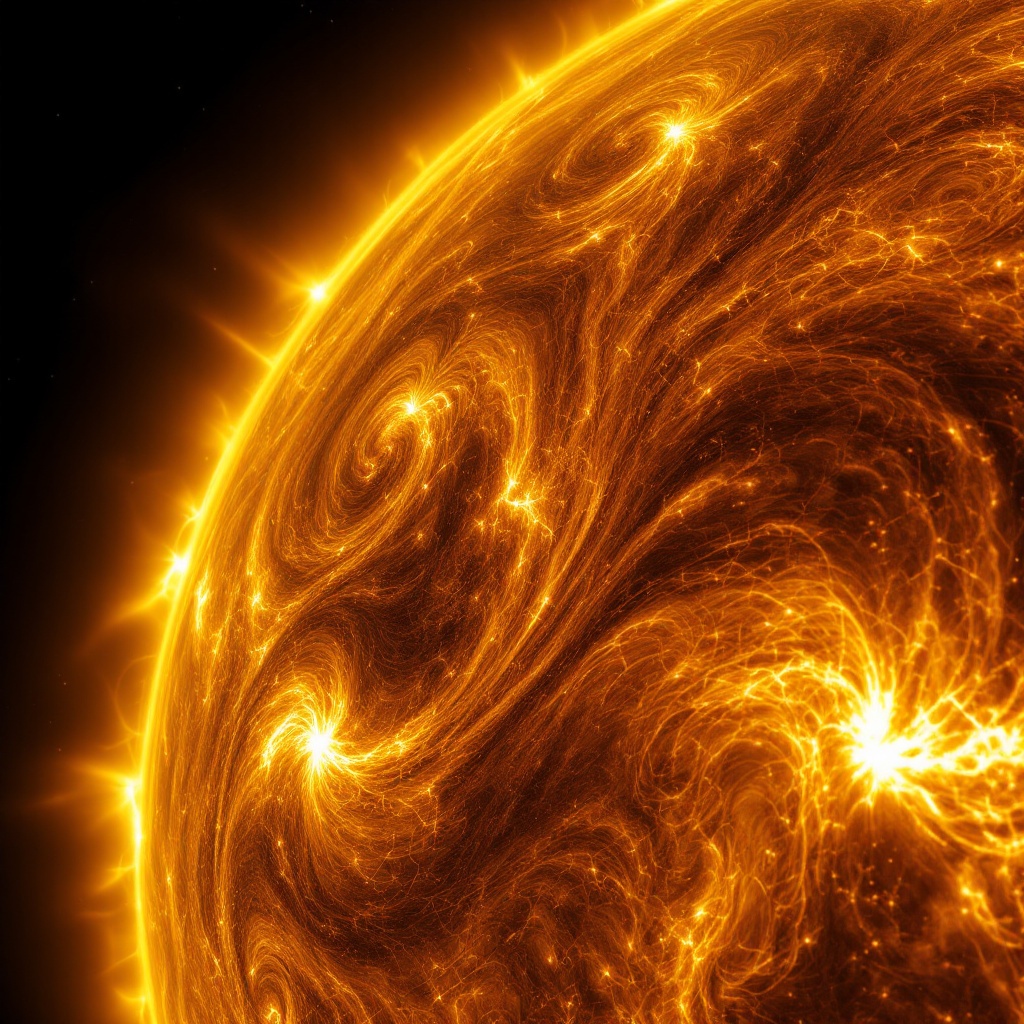
Inouye Solar Telescope Resolves Wave Structures Never Before Seen on the Sun's Surface
The Daniel K. Inouye Solar Telescope has captured the sharpest images ever taken of the Sun's visible surface, revealing swirling wave-like vortices that have never been observed there before. Published August 5th in Nature, the observations resolve features as small as 19 kilometers across and could help explain how energy transforms in the Sun's atmosphere. The structures are the signature of the Kelvin-Helmholtz instability, a process that occurs when two fluids flow past each other at signi
OST Staff · August 5, 2026
The Daniel K. Inouye Solar Telescope has captured the sharpest images ever taken of the Sun's visible surface, revealing swirling wave-like vortices that have never been observed there before. Published August 5th in Nature, the observations resolve features as small as 19 kilometers across and could help explain how energy transforms in the Sun's atmosphere.
The structures are the signature of the Kelvin-Helmholtz instability, a process that occurs when two fluids flow past each other at significantly different speeds and small disturbances grow into swirling vortices. These wave-like shapes appear throughout the solar system, in Earth's clouds and wind-swept ocean, between the stripes in Saturn's upper atmosphere, and in hints seen in the solar corona. Until now, they had never been seen on the Sun's visible surface, where the corona and solar wind originate.
David Kuridze of the National Solar Observatory and colleagues zoomed into an active region near a sunspot, observing the boiling motions of plasma at a wavelength of 416 nanometers, in violet light. Plasma wells up at the center of convection cells known as granules, releasing radiation and heat into space before cooling and sinking at the granule edges. Where the plasma flows converge, the magnetic field lines carried by the plasma also converge, producing stronger fields that stymie the flow of plasma and create the sudden velocity change needed to set up Kelvin-Helmholtz instabilities.
At granule edges, the researchers found not the blurry, smooth interfaces seen in previous images, but clear vortices forming and dissipating. Computer simulations of magnetized plasma in the solar atmosphere, known as MURaM, confirmed that the swirls are Kelvin-Helmholtz instabilities. The observations were made with the National Science Foundation's 4-meter Inouye Solar Telescope near the summit of Maui's Haleakalā.
"The smallest resolve features in these images are around 19 km, which is also diffraction limit of the telescope," Kuridze said. "Resolving structures as small as 19 kilometers and tracking their rapid motions over just a few seconds is an extraordinary technological achievement in observational solar physics."
Solar physicists see these instabilities as signs of turbulence and energy dissipation on the Sun's visible surface. The energy from pent-up magnetic fields drives most solar activity, but much remains unknown about how that energy turns into solar flares and coronal mass ejections. "The Kelvin-Helmholtz instability is an extremely efficient process for transferring, transforming, and dissipating energy, as well as reshaping magnetic fields," Kuridze explained. "This makes it critical for tackling fundamental open problems in solar and stellar astrophysics, including why outer layers of stellar atmospheres are much hotter than their surfaces."
The findings open a new observational window on the mechanisms of energy release at the smallest scales, which are key to nearly every process observed on the Sun. Researchers will continue analyzing the vortex behavior at the telescope's diffraction limit as they probe how energy dissipates on the solar surface.