NASA Frames European-Led Gravitational Wave Mission as a Model "Good Deal"
NASA is holding onto its partnership on the Laser Interferometer Space Antenna, the European-led gravitational wave observatory, as a template for international cooperation under a new agency philosophy that prioritizes cost-effective arrangements. The mission's US science lead calls LISA "a very good deal for the US," paying roughly a third of the cost while retaining full access to the science data. The emphasis comes as NASA reshapes its approach to foreign partnerships, requiring collaborat
OST Staff · October 7, 2026
NASA is holding onto its partnership on the Laser Interferometer Space Antenna, the European-led gravitational wave observatory, as a template for international cooperation under a new agency philosophy that prioritizes cost-effective arrangements. The mission's US science lead calls LISA "a very good deal for the US," paying roughly a third of the cost while retaining full access to the science data.
The emphasis comes as NASA reshapes its approach to foreign partnerships, requiring collaborators to make meaningful contributions that US agencies or companies aren't already pursuing, delivered when NASA needs them. The agency has canceled the Lunar Gateway and the Mars Sample Return mission, the latter after its budget exceeded $10 billion, as the administration directs NASA toward human spaceflight and a Moon Base near the lunar south pole.
NASA Administrator Jared Isaacman has cited existing partnerships he views as strong, including Japan's commitment to provide a pressurized rover for lunar astronauts and Italy's agreement to build what will likely be the first Moon Base habitat. Isaacman dismissed an earlier European proposal to develop a cargo lander for the Moon Base, a role NASA officials expect US-built landers to fill sooner.
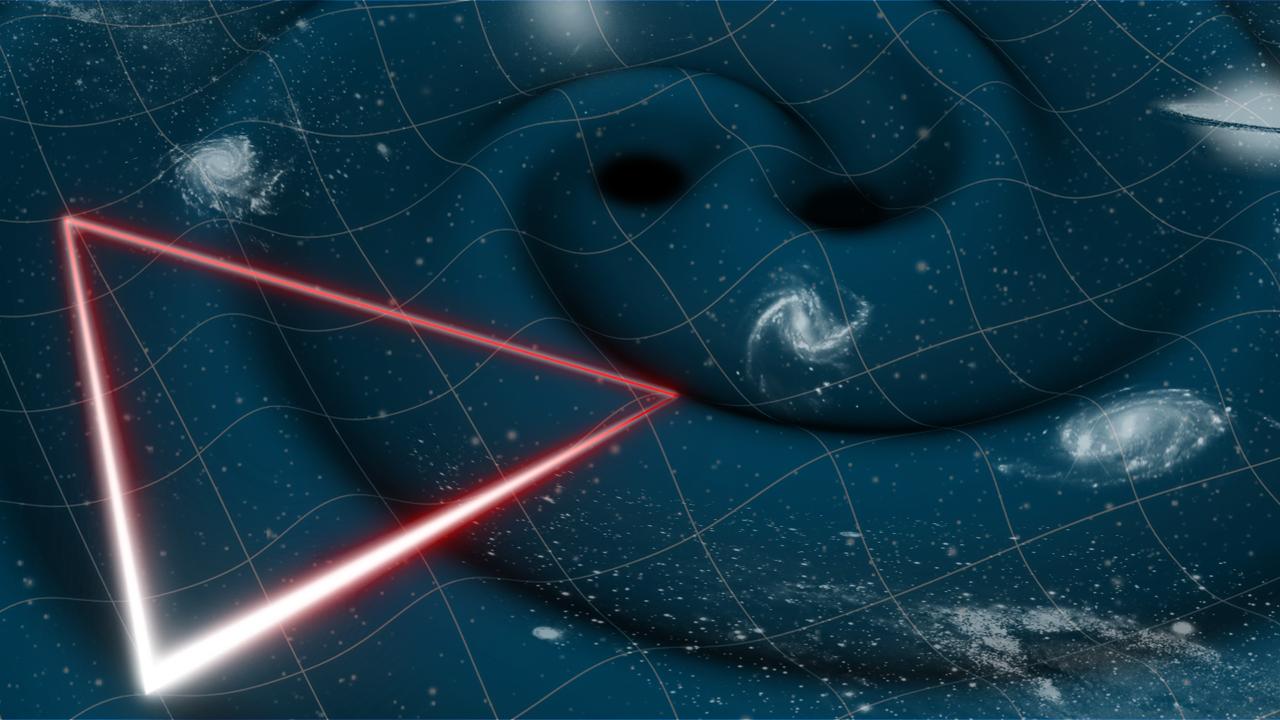
LISA, as currently envisioned, will be led by the European Space Agency with significant US contributions. The mission uses three spacecraft flying in a triangle formation in heliocentric orbit, positioned nearly 1.6 million miles apart to detect low-frequency gravitational waves. Launch is scheduled for around 2035. Each spacecraft carries two free-floating gold-platinum cubes inside a Faraday cage, shielded from all external forces other than gravitation, while inter-satellite lasers measure the distances between the test masses with precision finer than the size of an atom.
Under the agreement, NASA supplies the laser transmitters and telescopes, charge management devices to limit electric charge buildup on the proof masses, and ground-based data analysis. Europe builds, launches, and operates the spacecraft. ESA approved development in 2024 with a budget of 1.75 billion euros, about $2 billion, excluding US and member-state contributions. NASA's work is expected to cost around $1 billion, though the agency has not yet set a firm commitment.
Ira Thorpe, a gravitational wave astronomer at NASA's Goddard Space Flight Center and leader of the US science team, laid out the value in a presentation at the National Academies' Committee on Astronomy and Astrophysics. "We are paying for roughly a third of the mission," Thorpe said. "We're getting all of the science data, 100 percent of it. That is very good leverage." He estimated that building LISA alone would cost the US roughly $3 billion. Thorpe called it "the largest science mission that ESA has attempted to do. Full stop."
Thorpe framed the arrangement as precisely the kind of partnership NASA should preserve, noting the agency is not building its own space-based gravitational wave observatory and likely could not afford one. "We are in the era of people interested in having good deals, and LISA is a very good deal for the US," he said. The mission, he added, now sits in a stable structure with ESA clearly leading and NASA as a critical major partner.
The project has faced political uncertainty. The White House proposed canceling NASA's participation last year alongside dozens of other science missions, but Congress rejected the cuts and restored funding for fiscal year 2026. The administration again proposed cancellation in its 2027 budget request. Thorpe said the repeated proposals caused understandable concern in Europe, but the project team continues its work.