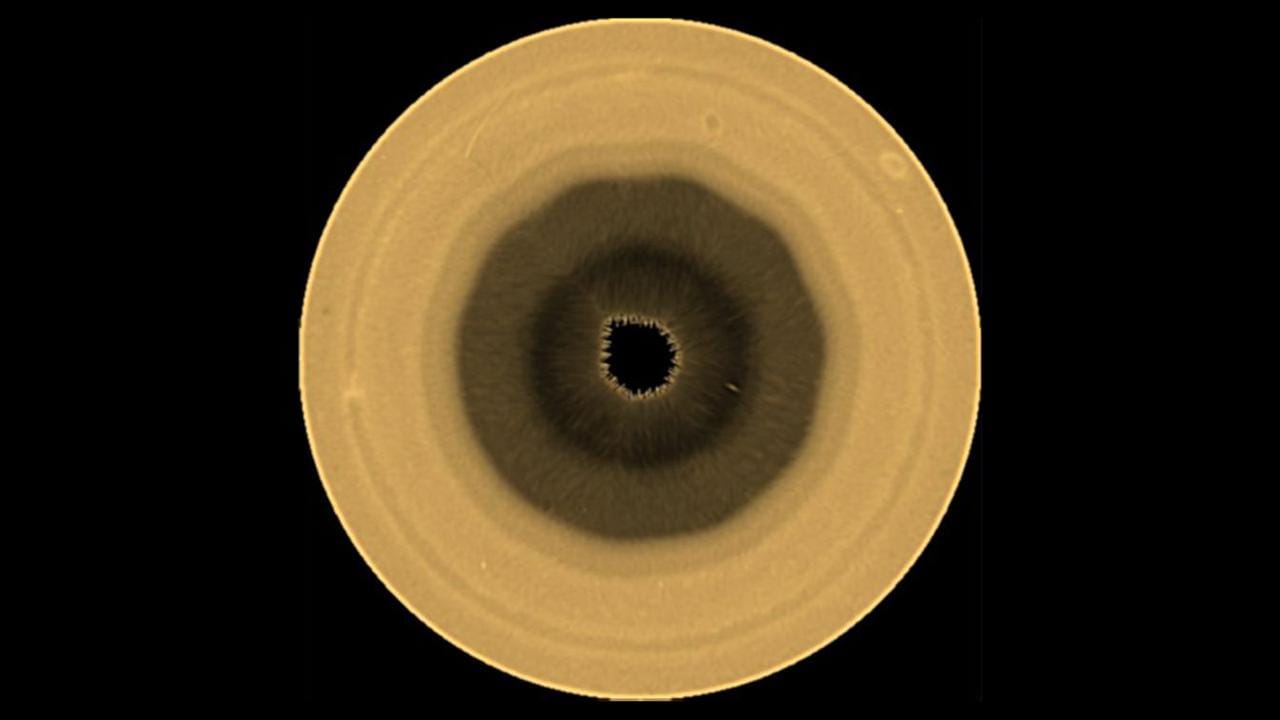
Hubble Reveals a 10-Sided Wave Taking Shape Over Saturn's South Pole
NASA's Hubble Space Telescope has identified a giant, evolving 10-sided atmospheric wave circling Saturn's south pole, the first time scientists have observed a large, regularly shaped jet pattern in the planet's southern hemisphere. The structure, described as a decagon, appears to have formed only in the past few years and is still strengthening, giving researchers a rare chance to watch a giant atmospheric pattern develop in real time. The findings were published in the journal Science Advanc
OST Staff · September 4, 2026
NASA's Hubble Space Telescope has identified a giant, evolving 10-sided atmospheric wave circling Saturn's south pole, the first time scientists have observed a large, regularly shaped jet pattern in the planet's southern hemisphere. The structure, described as a decagon, appears to have formed only in the past few years and is still strengthening, giving researchers a rare chance to watch a giant atmospheric pattern develop in real time. The findings were published in the journal Science Advances.
The discovery emerged as Saturn moved through its seasonal cycle, gradually bringing its south pole back into view from Earth. Astronomers studying ground-based images were the first to recognize the unusual structure. Researchers then reconstructed its development using several years of Hubble observations dating back to 2023, finding faint signs of the feature in earlier images before it sharpened into the clearer pattern seen more recently.
The observations came from Hubble's Outer Planet Atmospheres Legacy program, or OPAL, which has captured annual images of the outer planets for more than a decade. Study lead author Agustín Sánchez-Lavega, a researcher at the University of the Basque Country in Spain, worked with amateur astronomers Trevor Barry and Jean-Paul Oger, who noticed a faint, wavy band near Saturn's south pole in 2024 images. Ground-based observations in 2025 provided stronger evidence that the feature had developed into a decagon, prompting the team to turn to Hubble for a more detailed view.
"We've never seen anything quite like this in Saturn's southern hemisphere," said Amy Simon, study co-author and OPAL principal investigator at NASA's Goddard Space Flight Center in Greenbelt, Maryland. "The northern hexagon has been there every time we've looked for more than 40 years. This feature is different, it appears to be strengthening, giving us the rare opportunity to watch a giant atmospheric pattern develop." Sánchez-Lavega noted that Cassini spacecraft images, taken while the probe orbited Saturn between 2004 and 2017, showed no sign of a long-lived formation at the south pole. The wave lies within one of Saturn's powerful jet streams and extends through several layers of the atmosphere, indicating it is a vertically extended structure rather than a pattern confined to the cloud tops. Its apparent location shifts slightly depending on the wavelength Hubble uses, reflecting different observed altitudes.
Scientists say the decagon has some similarities to Saturn's famous northern hexagon but important differences suggest it may be a distinct phenomenon. "The most intriguing part to me is that this seems to have just formed recently," Simon said. "The question is, why did it suddenly form now when we haven't seen one before?" Researchers still do not know what triggered the pattern or whether it will remain stable, and they point to the value of OPAL's long observational record. "A lot of the discoveries we see coming from OPAL are not just based on one observation, but on years and years of data," said Mike Wong, study co-author at the University of California, Berkeley.
Researchers plan additional observations from Hubble and NASA's James Webb Space Telescope, along with computer modeling, to determine how the structure formed, how long it might survive, and how closely it resembles the northern hexagon. They will continue monitoring Saturn to see whether the southern decagon becomes a stable, long-lived feature or keeps changing. Future observations may also help explain what powers the wave and offer broader insights into atmospheric dynamics on giant planets and on Earth.