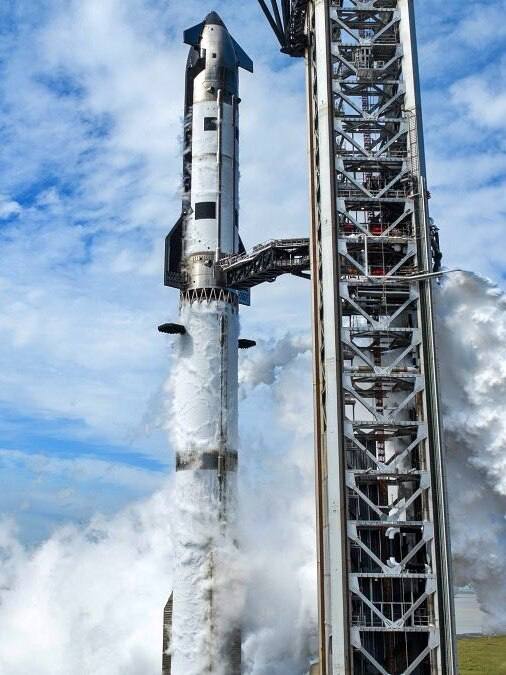
SpaceX Pairs Booster 22 and Ship 42 at Massey's for Flight 15 Cryo Testing
SpaceX has rolled Super Heavy Booster 22 out of Mega Bay 1 to its Massey's test site for cryogenic proof testing, where Ship 42 has since joined it on a second trip to the stand. The pairing is slated to fly on Flight 15, which could come about a month after the upcoming Flight 14 if that mission meets its objectives. The vehicles reached the test site while SpaceX still awaits a confirmed launch date for Flight 14, which pairs Booster 21 and Ship 41 and is aiming for around mid-September. Both
OST Staff · September 10, 2026
SpaceX has rolled Super Heavy Booster 22 out of Mega Bay 1 to its Massey's test site for cryogenic proof testing, where Ship 42 has since joined it on a second trip to the stand. The pairing is slated to fly on Flight 15, which could come about a month after the upcoming Flight 14 if that mission meets its objectives.
The vehicles reached the test site while SpaceX still awaits a confirmed launch date for Flight 14, which pairs Booster 21 and Ship 41 and is aiming for around mid-September. Both Flight 14 vehicles are awaiting rollout from the Production Site to Pad 2. If that flight succeeds, SpaceX could later attempt a Pad 2 catch of the booster, the ship, or both on Flight 15, contingent on Flight 14 results, vehicle health, and regulatory approval.
Ship 42 completed two cryogenic campaigns at Massey's on the ship cryo stand a few days before Booster 22 rolled, then returned to the test site for what is likely another round of cryo testing. These tests confirm structural integrity and load the vehicle under thermal and pressure conditions seen before and during flight. Teams typically load liquid oxygen into the LOX tanks and use liquid nitrogen in the methane tanks, then hold for several hours while temperatures, pressures, COPVs, and strain gauges are monitored. Once Ship 42 clears this phase, engine installation is the next major step toward launch.
Booster 22 was stacked and staged in Mega Bay 1 before the overnight move. On September 4, NSF cameras recorded the booster thrust simulator returning from Massey's to the Production Site. That stand holds a booster and applies hydraulic loads through the aft section in place of Raptor thrust, and its removal cleared the pad for Booster 22's cryoproof series. Massey's tank farm can now support full booster-scale cryo loads, which shortens the proof campaign when tests run clean. Next for Booster 22 is a multi-day cryo series, then Raptor install in Mega Bay 1 and a Pad 2 static fire. Ship 42 still needs engines in Mega Bay 2 and its own static fire.
Flight 14 is planned as Starship's first dedicated orbital attempt from Starbase. Ship 41 is expected to complete insertion burns, deploy operational Starlink V3 satellites, and return on an ocean trajectory. A tower catch of the ship was discussed after Ship 40's splashdown accuracy, then removed from the immediate flight plan. Flight 14's booster is not planned for a Pad 2 catch, with soft-landing performance and the FAA safety case for a land return remaining open items.
SpaceX has pointed to a ship catch in the coming months and a first ship reflight late this year or early next. Pad 2 is the only orbital pad in service while Pad 1 is rebuilt. Flight 15 could attempt a booster catch, a ship catch, or both on the same mission. A booster catch would restart Super Heavy recovery at Starbase, not yet done with Block 3, while a ship catch would be the first tower recovery of an orbital upper stage.
SpaceX has filed a communications permit for Flight 15 listing Starbase as the launch site and an orbital second stage, with a requested operating period from September 28, 2026, to March 28, 2027. The application has not been granted and can still be amended. A best-case turnaround from Flight 14 to Flight 15 is on the order of one month, though a failed hold, a proof abort, or a Flight 14 anomaly would push Flight 15 out. Flight 14 remains the immediate focus, and a successful vehicle return is a prerequisite for any Pad 2 catch attempt.