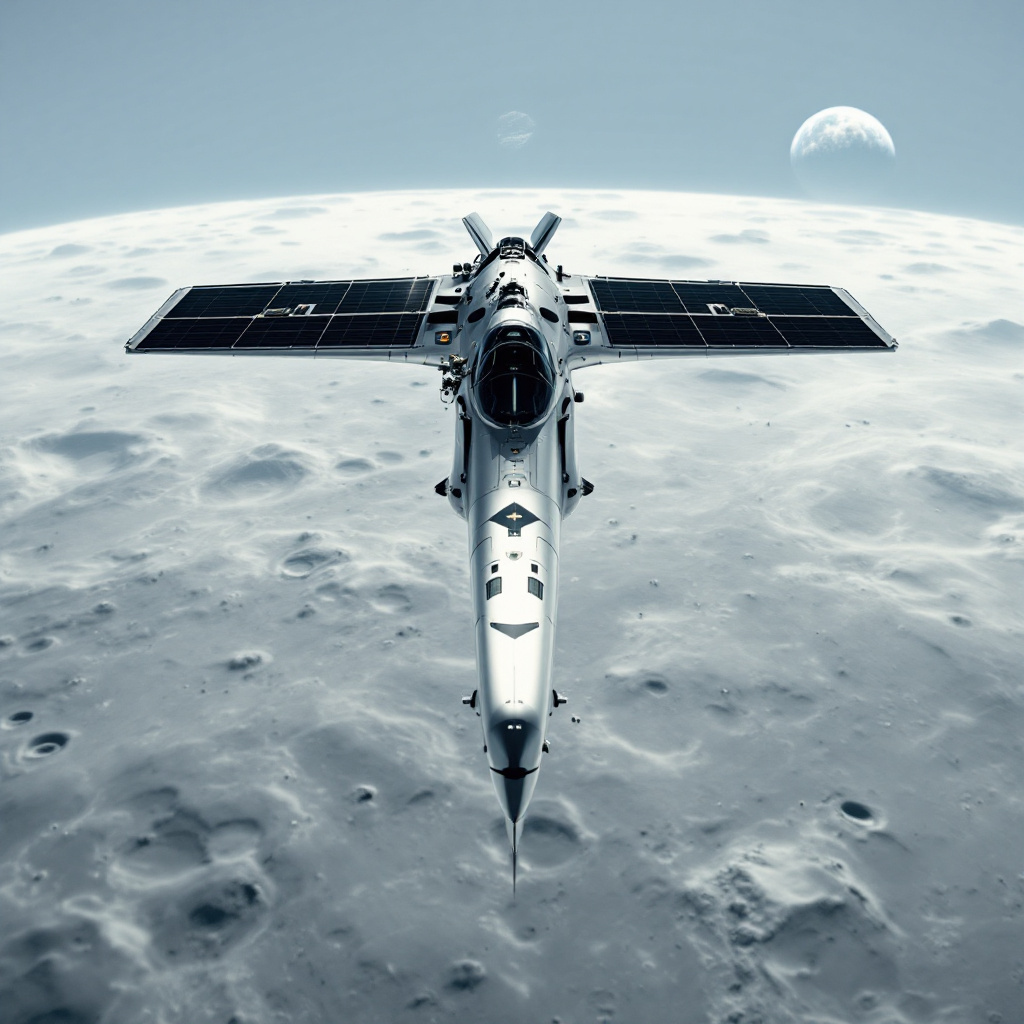
Firefly Signs Starcloud to Test AI Data Center Compute in Lunar Orbit
Firefly Aerospace has signed Starcloud as a commercial customer to demonstrate advanced AI computing in lunar orbit, flying a compute payload aboard Firefly's Elytra orbital vehicle. The agreement, announced September 30 from Firefly's Cedar Park, Texas headquarters, aims to validate the core capabilities of a future data center around the Moon capable of supporting lunar surface and orbital infrastructure. The demonstration builds directly on Starcloud's recent AI computing demonstration in lo
OST Staff · September 30, 2026
Firefly Aerospace has signed Starcloud as a commercial customer to demonstrate advanced AI computing in lunar orbit, flying a compute payload aboard Firefly's Elytra orbital vehicle. The agreement, announced September 30 from Firefly's Cedar Park, Texas headquarters, aims to validate the core capabilities of a future data center around the Moon capable of supporting lunar surface and orbital infrastructure.
The demonstration builds directly on Starcloud's recent AI computing demonstration in low Earth orbit, extending those capabilities into lunar orbit. Starcloud's payload, designated SC-1L, is being onboarded to Firefly's third lunar mission, targeted to launch no earlier than 2028.
On that mission, Firefly's Elytra orbiter will first serve as the transfer vehicle and communications relay for Firefly's Blue Ghost lander, which will land on the Moon's Gruithuisen Domes and operate science and technology instruments under NASA's Commercial Lunar Payload Services initiative. After the mission is complete, Elytra will remain in lunar orbit for five years to enable customer payload and imaging operations, including Starcloud's demonstration.
Integrated on Elytra, the SC-1L processor will ingest data from Firefly's onboard Solux vision system, perform high-power AI computing on orbit, and rapidly transmit the processed data back to Earth. The Solux system, formerly known as Sol3, enables spacecraft to autonomously navigate, land, and track their orientation in environments where Global Navigation Satellite Systems and GPS are unavailable. Elytra will also carry high-resolution telescopes to support Firefly's Ocula lunar imaging service, which provides lunar surface mapping, mineral detection, and reconnaissance.
Ray Allensworth, Vice President of Spacecraft at Firefly Aerospace, said the collaboration takes another step toward establishing the infrastructure to power a permanent human and robotic presence at the Moon. "By pairing Starcloud's AI computing payload with our Elytra vehicle and Solux vision system, we're demonstrating how data can be captured, processed, and delivered from lunar orbit, laying the groundwork for the computing infrastructure future lunar operations will depend on," he said.
Ezra Feilden, Cofounder and CTO at Starcloud, said the company had validated its ability to run and train AI models on enterprise grade GPUs in low Earth orbit and was now taking the technology to lunar orbit. "We'll demonstrate high-power AI computing and further prove we can process massive volumes of data right where it's generated to support the growing infrastructure beyond Earth," he said.
The agreement demonstrates data center style compute around the Moon, with Firefly positioning Elytra as the vehicle to carry it. This will be the second Elytra vehicle Firefly deploys to lunar orbit, following the launch of Blue Ghost Mission 2, targeted for no earlier than 2027. Each Elytra vehicle is designed to remain in lunar orbit for up to five years, enabling more rapid revisit times of the lunar surface for government and commercial customers. Firefly also recently announced a collaboration with NVIDIA to process Ocula data on orbit using the NVIDIA Jetson module and Firefly's AI software through its SciTec subsidiary, mitigating downlink constraints from the Moon by processing data before transmission to Earth.
Next milestones include the launch of Blue Ghost Mission 2, targeted for no earlier than 2027, and Firefly's third lunar mission carrying the Starcloud payload, targeted for no earlier than 2028.