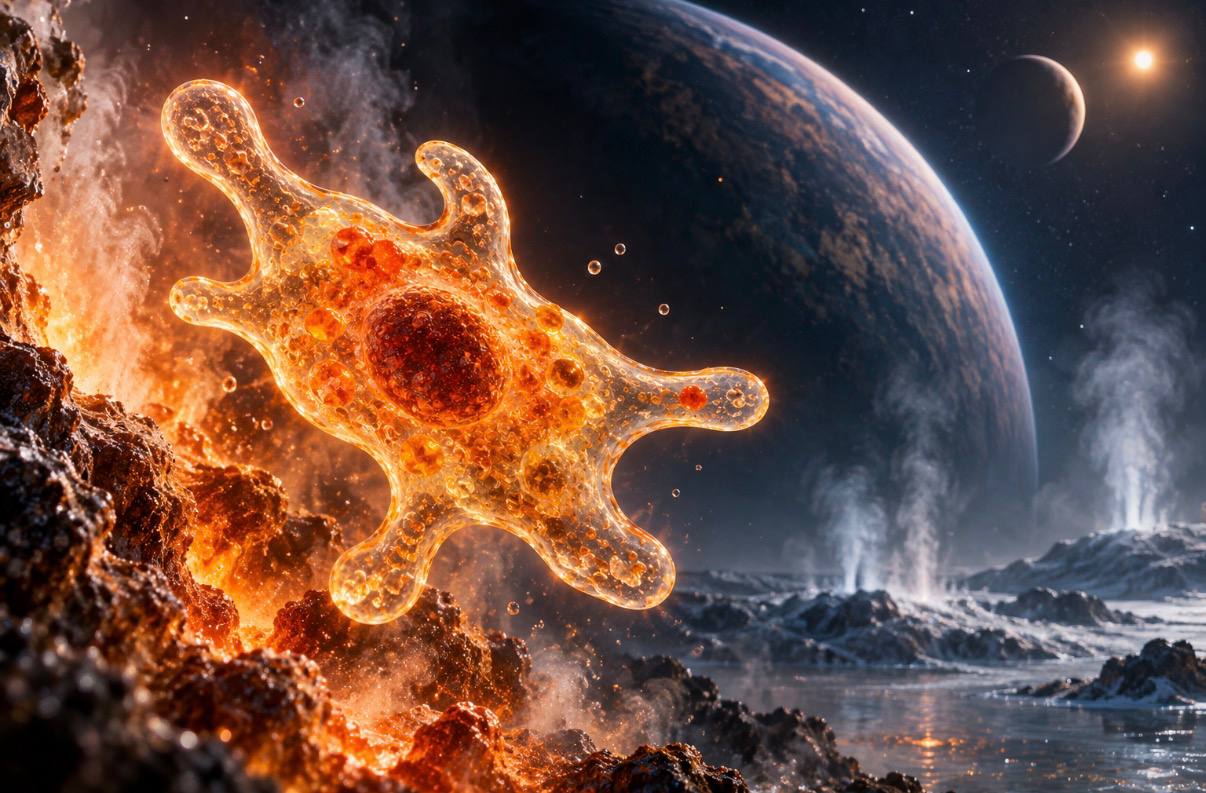
Fire Amoeba Sets New Heat Record for Complex Life, Reshaping the Search for Life Beyond Earth
NASA-supported scientists have discovered an amoeba that thrives at temperatures long thought impossible for complex cells, setting a new upper limit for all known eukaryotes. The organism, found in the heated waters of California's Lassen Volcanic National Park, reproduces at 145 degrees Fahrenheit (63 degrees Celsius), surpassing the previous eukaryotic limit of 140 degrees Fahrenheit set by certain fungi and red algae. The findings were published Tuesday in the journal Cell. High temperature
OST Staff · September 22, 2026
NASA-supported scientists have discovered an amoeba that thrives at temperatures long thought impossible for complex cells, setting a new upper limit for all known eukaryotes. The organism, found in the heated waters of California's Lassen Volcanic National Park, reproduces at 145 degrees Fahrenheit (63 degrees Celsius), surpassing the previous eukaryotic limit of 140 degrees Fahrenheit set by certain fungi and red algae. The findings were published Tuesday in the journal Cell.
High temperatures destroy proteins, biomolecules, and cell membranes, which poses a particular problem for eukaryotes because their cells contain a nucleus and membrane-bound organelles that hold fragile genetic information. Scientists had suggested that organelle membranes in eukaryotes could not remain stable above 144 degrees Fahrenheit (62 degrees Celsius). The discovery of the new species disproves that assumption. Previous extremophile research focused largely on single-celled bacteria and archaea, which lack a nucleus and have less cellular machinery vulnerable to extremes.
The organism, named Incendiamoeba cascadensis, or the fire amoeba, stops reproducing above 145 degrees Fahrenheit but remains active, moving to search for food at up to 147 degrees Fahrenheit (64 degrees Celsius). In laboratory tests it stayed partially active at 150.8 degrees Fahrenheit (66 degrees Celsius) and recovered from five minutes at 158 degrees Fahrenheit (70 degrees Celsius). Exposure to 176 degrees Fahrenheit (80 degrees Celsius) proved fatal.
The team sequenced the amoeba's genome and studied gene expression at multiple temperatures. They identified genes that help stabilize DNA and protect it from breaking down, along with genes that sense the external environment. At high temperatures, expression of certain genes increased, including those involved in maintaining protein folding. Beryl Rappaport, a graduate student at Syracuse University and lead author of the study, said some proteins in the amoeba carry a high positive surface charge that could help them remain stable, similar to charges found in thermophilic bacteria and archaea. The team also found similar DNA in geothermal samples from New Zealand and Yellowstone National Park, suggesting related thermophilic amoebas may exist worldwide.
The discovery expands scientists' understanding of where and how complex life might persist. "Finding eukaryotes surviving in high temperature environments not only expands our understanding of where life could be found, but also of how complex that life could be," said Alison Olcott, program scientist for Exobiology at NASA Headquarters in Washington. Olcott said studying extremophiles helps clarify the biochemical and physiological limits of life as we know it, which in turn guides NASA's search for life by widening the range of conditions where life might exist. Rappaport said the discovery could encourage others to keep searching for high temperature eukaryotes, noting that limited earlier study may have stemmed from assumptions about membrane stability.
Researchers cautioned that survival depends on more than temperature. "It could certainly be possible for complex life like I. cascadensis to survive on another planet, but Earth is the only planet we currently know of to have all the requirements for I. cascadensis to be happy," Rappaport said. She added that an environment also needs the right acidity, oxygen levels, pressure, water, and food, and that the amoeba could not survive without other life to support it. The team's comparison of global genetic data points to further undiscovered thermophilic amoebas, leaving open the prospect of new species awaiting identification in geothermal sites around the world.