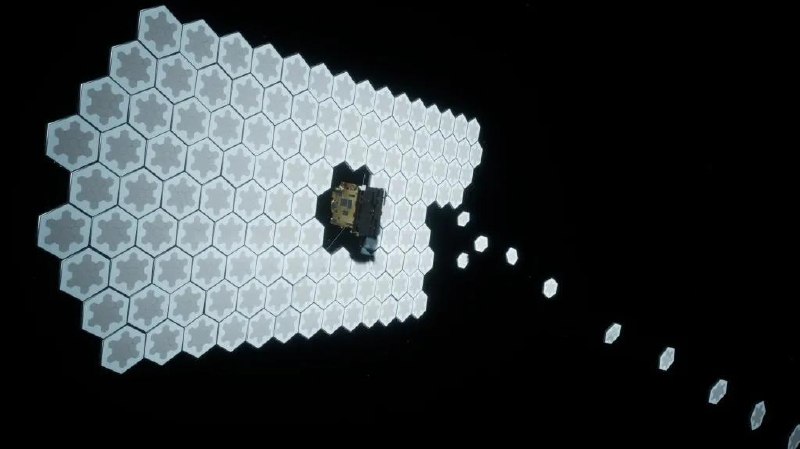
Rendezvous Robotics Raises $20M to Build Satellites That Assemble Themselves in Orbit
Rendezvous Robotics, a Colorado startup developing self-assembling spacecraft, announced $20 million in fresh funding to support an in-space demonstration launching no earlier than April 2028. The raise funds development of technology that would let future satellites launch in pieces and assemble themselves in orbit, sidestepping the size limits of rocket fairings. The company is responding to a growing mismatch between satellites and the rockets meant to carry them. Across the industry, manufa
OST Staff · October 28, 2026
Rendezvous Robotics, a Colorado startup developing self-assembling spacecraft, announced $20 million in fresh funding to support an in-space demonstration launching no earlier than April 2028. The raise funds development of technology that would let future satellites launch in pieces and assemble themselves in orbit, sidestepping the size limits of rocket fairings.
The company is responding to a growing mismatch between satellites and the rockets meant to carry them. Across the industry, manufacturers are developing satellites that require football-field-sized solar arrays and large-aperture antennas, neither of which fit comfortably inside available fairings. While many are turning to origami-style folding designs, Rendezvous Robotics is instead building satellites that launch as components and construct themselves in space.
MaC Venture Capital and Toyota Ventures led the round, with additional participation from the University of Michigan Endowment, Astera Ventures, Industrious Ventures, Aurelia Foundry, ATX Venture Partners, Mana Ventures and others. The technology builds on nearly a decade of research by cofounder Ariel Ekblaw under the TESSERAE program, which began at the Massachusetts Institute of Technology. The company's version uses roughly one-meter hexagonal tiles, each equipped with sensors and onboard processing, that use electromagnetic fields to self-assemble in the vacuum of space. The tiles are designed to support different subcomponents of a typical satellite, including computers, solar panels, propulsion systems and radiators.
Though the technology was initially developed to support construction of large structures such as astronaut habitats and pressurized space stations, the company has narrowed its near-term focus to satellites in response to demand for larger spacecraft. "Nobody's talking about making satellites smaller and less capable," CEO Joe Landon said. "They're talking about more capable satellites, more power, more heat dissipation, bigger antennas, more sensitive communication. It's all more and more and more, and we can't do that until we figure out how to build in space."
The tiles have already flown early demonstration missions, including zero-G aircraft flights, one suborbital mission, and two missions to the International Space Station. The next orbital mission will launch 32 tiles to the ISS no earlier than December to continue testing self-assembly inside the space lab. For the 2028 demonstration, the company plans to send seven tiles into the vacuum of space for the first time to validate its ability to assemble, and reconfigure, the tiles into a single functional satellite.
Landon said the goal is not simply building bigger. The self-assembling tiles would also let operators change a satellite's configuration, add new tiles, or replace malfunctioning parts. "The ability to service the satellite today really is limited to life extension, but we go far beyond that," Landon said. "If you have a satellite and something goes wrong, you have to build a new satellite and send it to space. What we could do if something is damaged or degraded: the system can autonomously reconfigure physically into the next best available configuration." In the long term, Landon said the company could stage tiles in orbit in a kind of depot that could send out replacement parts on demand.
The 2028 demonstration will be the first test of the tiles in open space rather than inside the ISS. Before that, the company will launch 32 tiles to the ISS no earlier than December to continue self-assembly testing inside the space lab.