Europe Rehearses Mars Rover Mission in Spanish Desert Ahead of 2030 Landing
An Airbus-built prototype tested autonomous driving and remote science operations as ESA prepares Rosalind Franklin to search beneath the Martian surface. Europe has put its next Mars rover mission through a desert rehearsal, testing how scientists will guide a robotic explorer and choose where to search for evidence of life. In an update published today, October 6th, the European Space Agency described an eight-day exercise held in September in Spain’s Tabernas desert. An Airbus-built prototy
OST Staff · October 6, 2026
An Airbus-built prototype tested autonomous driving and remote science operations as ESA prepares Rosalind Franklin to search beneath the Martian surface.
Europe has put its next Mars rover mission through a desert rehearsal, testing how scientists will guide a robotic explorer and choose where to search for evidence of life.
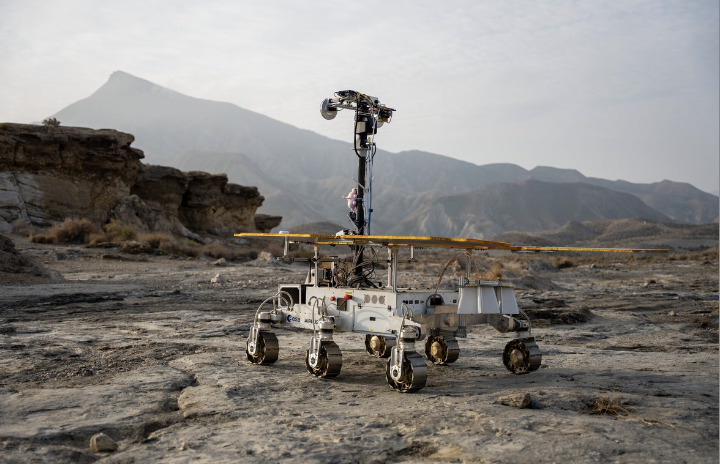
In an update published today, October 6th, the European Space Agency described an eight-day exercise held in September in Spain’s Tabernas desert. An Airbus-built prototype called Charlie covered 220 metres while a science team worked from the Rover Operations Control Centre in Turin, Italy, roughly 1,200 kilometres away.
Around 100 scientists and engineers participated. Charlie ran the same guidance, navigation and control software intended for the Rosalind Franklin rover, allowing teams to test navigation and hazard avoidance in rugged terrain.
On the sixth day, the prototype travelled more than 60 metres autonomously, recording a navigation error below 1%, according to ESA.
The exercise also tested scientific decision-making. Teams interpreted camera images, subsurface radar measurements and spectral data to identify promising targets, rehearsing how they will coordinate exploration once the mission reaches Mars.
Rosalind Franklin is planned to launch in 2028 and land in 2030. Airbus is also developing the European landing platform, including systems needed to brake, touch down and stabilise the spacecraft on the surface. The rover’s defining scientific capability will be its drill, designed to collect material from as deep as two metres underground. ESA expects it to reach deeper than any previous Mars mission, accessing samples better protected from the radiation and extreme conditions that alter material at the surface.
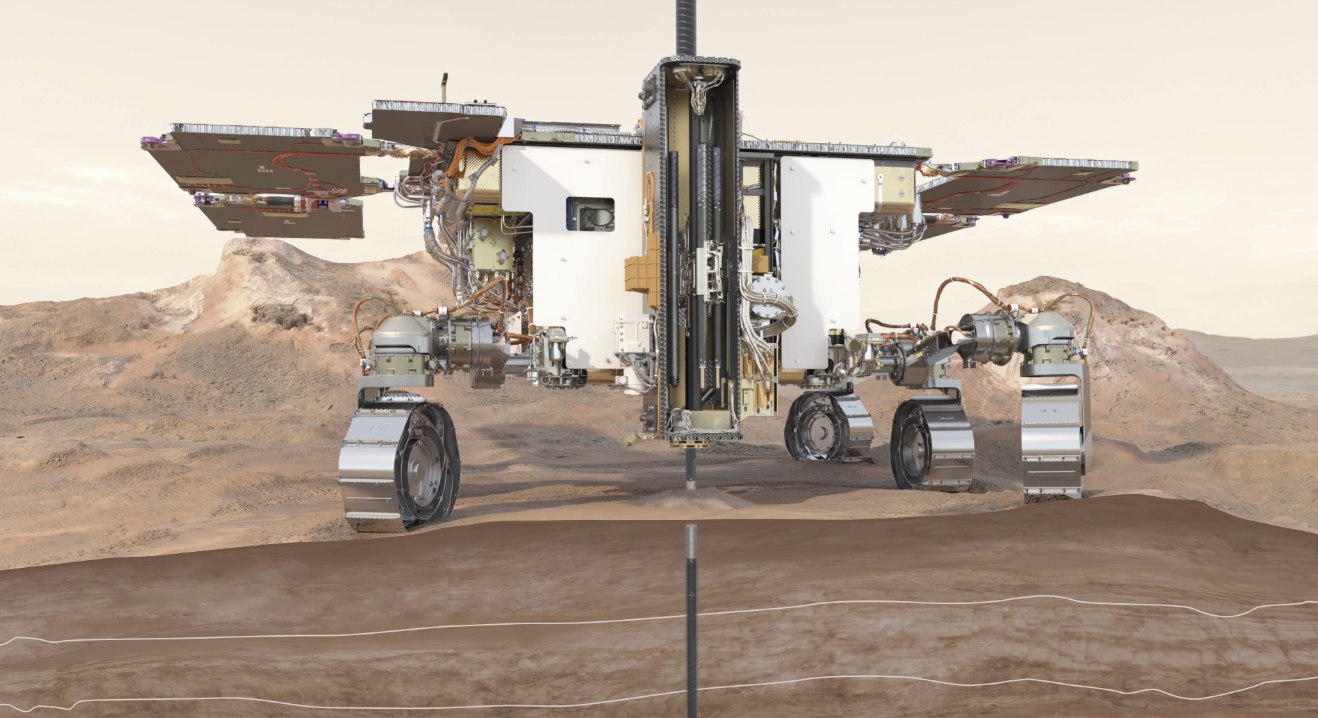
That depth matters because the search for ancient life depends partly on preservation. Organic molecules that could help scientists reconstruct Mars’s biological history may survive better below ground. Finding organic material would not, by itself, establish that life existed, but its composition and geological context could provide crucial evidence.
Rosalind Franklin’s instruments are designed to work through that problem in stages. Scientists will study the surrounding landscape, select targets for closer inspection, investigate the shallow subsurface and analyse drilled samples using the rover’s onboard laboratory. The drill will also use infrared spectroscopy to examine mineral composition inside the borehole.
The practical challenge is choosing where to commit those capabilities. A promising location must offer both scientific value and a route the rover can safely traverse.
For Europe, the goal extends beyond reaching Mars. It is to arrive with a rover and an operations team ready to investigate a largely unexplored environment beneath its surface.